Chapter 3 Preview — Subject Matter Jurisdiction & Statutory Authority
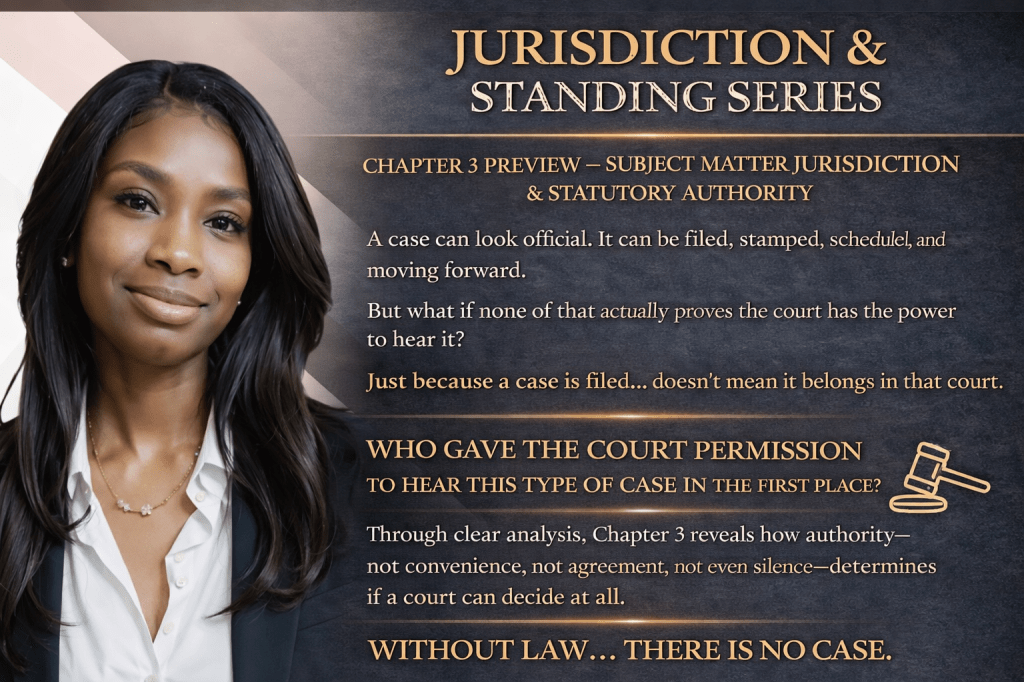
A case can look official.
It can be filed, stamped, scheduled, and moving forward.
But what if none of that actually proves the court has the power to hear it?
Chapter 3 exposes one of the most misunderstood—and most dangerous—assumptions in litigation:
Just because a case is filed… doesn’t mean it belongs in that court.
This chapter shifts the focus from who is suing to something even more foundational:
Who gave the court permission to hear this type of case in the first place?
Because courts do not operate on appearance.
They operate on authority—and that authority must come from law.
Not convenience.
Not agreement.
Not silence.
Law.
Through a clear and disciplined breakdown, Chapter 3 reveals how many cases proceed without ever proving that the court has subject matter jurisdiction—and why that failure cannot be fixed later, ignored, or waived.
Even if both parties show up.
Even if the hearing moves forward.
Even if the case seems routine.
If the law does not authorize the court to act…
the entire case is built on nothing.
This chapter teaches readers how to identify that invisible boundary—the line between a court that can act and one that cannot—and how to challenge cases that cross it.
Because once you understand this principle, everything changes:
The question is no longer who is right.
The question becomes whether the court has the legal power to decide at all.
And if the answer is no…
The case never truly existed.
Chapter 4 Next Page


Leave a Reply