Chapter 2 Preview —
The Identity Problem
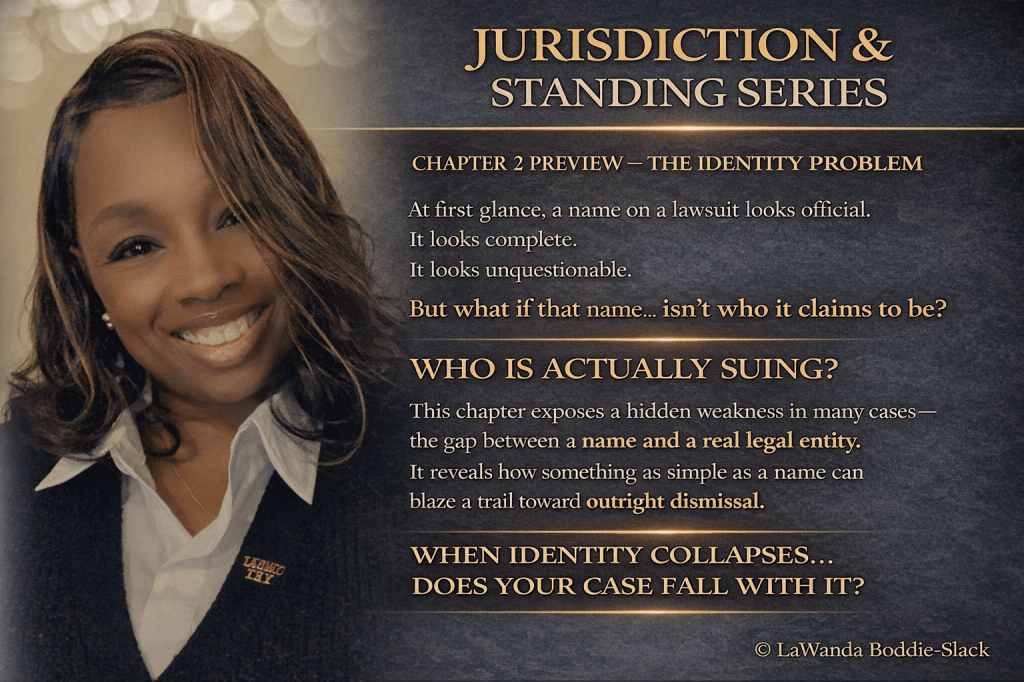
At first glance, a name on a lawsuit looks official.
It looks complete.
It looks unquestionable.
But what if that name… isn’t who it claims to be?
Chapter 2 shifts the focus from court power to something even more dangerous when overlooked—identity. Because before a case can move forward, the court must know one critical thing:
Who is actually suing?
This chapter exposes a hidden weakness in many cases—the gap between a name and a real legal entity. It reveals how businesses, trade names, management companies, and inconsistent documents can blur that line… and how that confusion can quietly unravel an entire case.
What appears simple on paper often isn’t.
A property name may not be the owner.
A company name may not be registered.
A plaintiff may not be the real party in interest at all.
And when identity starts to break down, something bigger happens:
Standing begins to collapse.
Chapter 2 teaches readers how to slow down, examine documents with precision, and stop making assumptions about names that “look right.” It introduces a disciplined method of comparison—one that exposes inconsistencies others overlook.
Because in litigation, identity is not a formality.
It is proof.
And if the plaintiff cannot prove who they are…
they may not be able to prove they belong in court at all.
This is where the case begins to shift.
Not through argument—
but through exposure.
Chapter 3 Next Page


Leave a Reply