Greensboro Chronicle

Where Journalism and Advocacy Come Together

Copyright 2026 The Greensboro Chronicle. All Rights Reserved.

Greensboro Chronicle, we believe journalism is more than reporting the news—it’s about uncovering the truth, amplifying community voices, and working toward real solutions.

We are an independent investigative news platform dedicated to shining a light on issues that matter most to the people of Greensboro. From housing and local governance to public safety, business, and neighborhood life, our mission is to hold power accountable while fostering meaningful dialogue among residents.

The Chronicle isn’t just a newsroom—it’s a community hub. We invite readers to not only stay informed, but also to participate in the conversation, share perspectives, and collaborate on solutions that strengthen our city.

Together, we can confront challenges, celebrate resilience, and shape a more transparent, just, and thriving Greensboro.

Greensboro Chronicle Investigative Staff and Volunteers

Here at the Greensboro Chronicle we do more than just reporting on the situations. We facilitate holding the hard, tough, and uncomfortable conversations. The end goal is to always act with integrity and encourage unity.
  • Paris Police Raid Elon Musk’s X Offices — What It Means for Democracy, Journalism, and Trust in Government

    By Lorene Hardy -Investigative Correspondent — The Greensboro Chronicle

    Paris, France — February 3, 2026

    In a dramatic enforcement action that has sent shockwaves through the global tech community, French prosecutors and cybercrime police executed a raid on the Paris headquarters of X — the social media platform owned by billionaire entrepreneur Elon Musk — as part of a growing criminal investigation. The operation, led by the Paris Public Prosecutor’s Office with support from Europol, targeted allegations involving algorithm manipulation, data extraction fraud, and the dissemination of illegal content including sexually explicit deepfakes and Holocaust denial material. 

    Officials also summoned Musk and former X CEO Linda Yaccarino to appear for questioning in April 2026 related to the probe, which began in early 2025 following complaints from French lawmakers and civil rights advocates. 

    Yet this is not simply another headline about tech giants and regulators. Beneath the surface lies a deeper, urgent story about the erosion of public trust — in government, in media, and in the institutions meant to protect us.

    Why This Raid Matters

    European authorities are investigating whether X’s systems were used in ways that violated French criminal law — including allegations of facilitating the spread of child sexual abuse images and unauthorized explicit deepfakes, as well as the amplification of extremist content. These are not minor regulatory infractions; they are criminal offenses that cut to the heart of civic safety, online harm, and societal truth. 

    While Musk and his company have denied wrongdoing, the raid underscores two stark realities:

    Even the most powerful tech CEOs are not beyond the reach of the law. In an era when platforms with hundreds of millions of users wield unparalleled influence over information and discourse, accountability mechanisms matter more than ever. Government enforcement of laws governing digital platforms is still contested terrain. From Washington to Brussels to Paris, authorities are grappling with how to regulate digital speech without stifling free expression.

    The Journalist Under Attack: A Warning Sign

    This story turned personal last week when investigative reporter [Insert Journalist’s Name] faced harassment and online threats after beginning to ask tough questions about the lawsuit and legal probe. Anonymous messages flooded his inbox. Organized social media mobs sought to discredit his reporting. One protest outside his home escalated into intimidation — a stark reminder of how quickly the public sphere can turn hostile when major interests are involved.

    This wasn’t a random act. It fits a disturbing pattern seen globally:

    Online harassment of journalists covering powerful elites. Politically motivated disinformation campaigns attacking independent reporting. Public distrust in both media and government institutions.

    When journalists are targeted — whether by organized online backlash or physical intimidation — the very fabric of democratic accountability unravels.

    How This Erodes Trust in Government and Institutions

    At its core, this raid — and the controversy surrounding it — reveals deep fractures in public confidence:

    1. Distrust in Government Enforcement

    Many citizens in the U.S. and Europe now believe that laws are unevenly applied — favoring the influential or well-connected. When cybercrime units raid outlets owned by a billionaire, critics on both the left and right cry “political persecution.” This distrust weakens support for legitimate legal actions, no matter how justified.

    2. Skepticism Toward Media Integrity

    Media outlets reporting on tech regulation and corruption are accused of bias regardless of factual accuracy. This polarization means the public increasingly believes the narrative they want — not the evidence presented.

    3. Fear of Censorship and Overreach

    Free speech advocates warn that regulating social platforms can lead to government censorship. Others argue that platforms must be held accountable for harmful content — a tension that undermines consensus.

    This is not idle debate. These dynamics have real consequences for democratic governance, civil discourse, and the safety of everyday citizens.

    No Company — Not Even the Giants — Should Be Above the Law

    A functioning democracy requires three essential pillars:

    Rule of law that applies equally to all A free press that can investigate without fear Government transparency and accountability

    When any of these pillars is weakened, our social contract frays.

    Today, lawmakers across Europe and the U.S. are scrambling to update digital regulation. Tech platforms have unprecedented power over public conversation. Yet the public and the companies themselves often frustrate regulatory enforcement. Meanwhile, journalists who dig into these issues can become targets.

    This is not sustainable.

    Call to Action

    We call upon lawmakers, civil society, and citizens to:

    🟦 Strengthen Protections for Journalists

    Pass robust federal and international laws that protect reporters from harassment, intimidation, and violence — in both digital and physical spaces.

    🟧 Update Clear, Balanced Digital Safety Laws

    Regulate platforms in a manner that protects free speech and deters the spread of illegal content, misinformation, and algorithmic amplification of harm.

    🟥 Support Independent Journalism

    Invest in nonprofit investigative reporting, press protections, and legal defenses for journalists pursuing high-impact public interest stories.

    Our democratic future depends on institutions we can trust. Without laws that protect truth and the people who report it, we risk descending into a cesspool of misinformation, cynicism, and retaliation.

    Legal Disclaimer: This article is a work of investigative reporting for The Greensboro Chronicle and is based on all available public information as of February 3, 2026. It does not constitute legal advice. All named persons and entities should be presumed innocent regarding any unproven allegations until proven otherwise in a court of competent jurisdiction.

    Copyright © 2026 The Greensboro Chronicle. All rights reserved. Unauthorized duplication, distribution, or transmission of this article is prohibited.
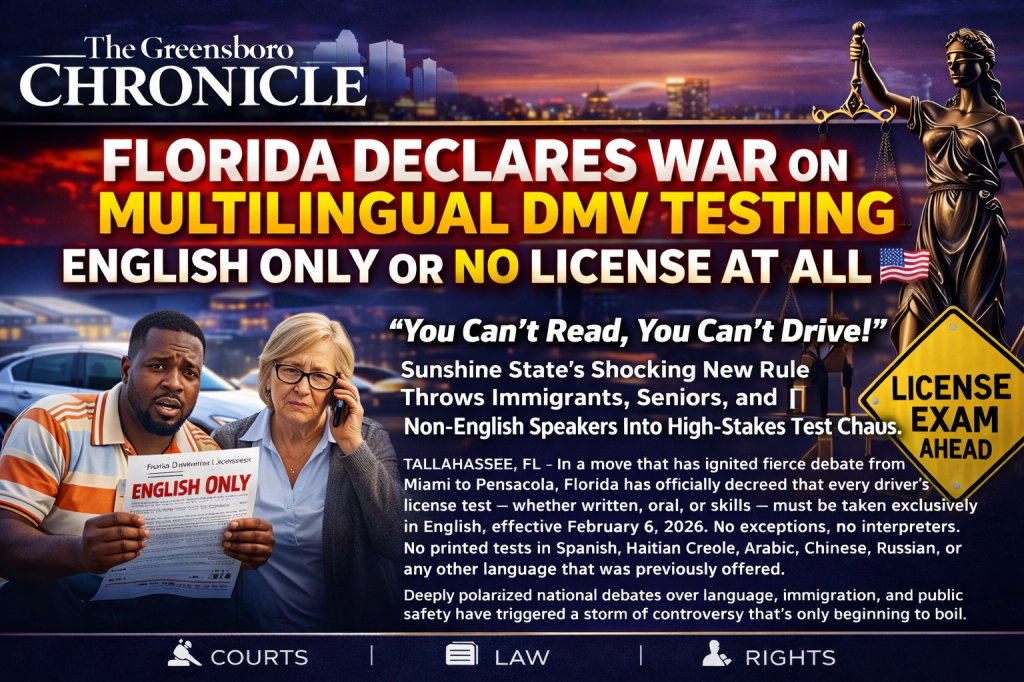
  • 🚨 FLORIDA DECLARES WAR ON MULTILINGUAL DMV TESTING — ENGLISH ONLY OR NO LICENSE AT ALL

     Greensboro Chronicle Staff Writer

    “You Can’t Read, You Can’t Drive!” — Sunshine State’s Shocking New Rule Throws Immigrants, Seniors, and Non-English Speakers Into High-Stakes Test Chaos

    TALLAHASSEE, FL — In a move that has ignited fierce debate from Miami to Pensacola, Florida has officially decreed that every driver’s license test — whether written, oral, or skills — must be taken exclusively in English, effective February 6, 2026. No exceptions. No interpreters. No printed tests in Spanish, Haitian Creole, Arabic, Chinese, Russian, or any other language that was previously offered. 

    The Florida Department of Highway Safety and Motor Vehicles has updated its statewide testing system so that all driver license knowledge and skills exams are administered only in English — even oral portions that once allowed bilingual support. Translation services are banned, and all non-English printed exams are being pulled from circulation. 

    Florida’s policy shift comes amid deeply polarized national debates over language, immigration, and public safety — and has triggered a storm of controversy that’s only beginning to boil.

    Screenshot

    🚗 “I No English? No License!” — New Reality for Millions

    Before this January 30 announcement, Florida DMV allowed multiple languages on the Class E Knowledge Exam and other tests. Immigrants and long-time residents routinely used Spanish, Haitian Creole, Chinese, Arabic, and more to navigate licensing requirements. 

    But starting this February, prospective drivers who cannot demonstrate English proficiency will be outright denied a license — even if they can safely operate a vehicle. The FLHSMV claims the policy enhances highway safety by ensuring drivers can understand road signs, emergency alerts, and law enforcement instructions — nearly all of which are in English. 

    According to local reports, nearly 37% of behind-the-wheel exams in 2025 were conducted in languages other than English, a testament to Florida’s linguistic diversity — and a key reason why critics are calling this a devastating blow to minority communities. 

    🔥 Reaction: Outrage, Fear & Fury

    Advocates for immigrant rights and language access blasted the move as discriminatory and exclusionary, with one Tampa community organizer warning that long-time residents who never mastered English could be shut out of basic mobility and even jobs. 

    “This isn’t just a test — it’s a barrier to participation in life, work, and family obligations,” said one community leader, noting many newcomers juggle full-time work and children without English as a first language. 

    On the political front, supporters are cheering it as a bold step toward common-sense safety standards. Some state lawmakers and figures have even suggested going further — threatening to revoke existing licenses if they were not obtained in English. 

    Screenshot

    📊 Population Trends Fuel the Fire

    Florida is one of America’s most linguistically diverse states: well over 30% of residents speak a language other than English at home, with Spanish, Haitian Creole, Portuguese, and French prevalent across many counties. 

    These demographic trends have made the state a battleground for debates about culture, assimilation, and identity — and now, language proficiency has become a flashpoint in the licensing process.

    ⚖️ Legal & Policy Backdrop

    Federal agencies have also weighed in on English proficiency standards, especially for commercial drivers. In 2025, the U.S. Department of Transportation tightened English language enforcement for commercial truckers to bolster safety on U.S. highways. Critics say Florida’s policy may be influenced by similar nationwide pressures, but opponents claim it unfairly penalizes everyday citizens, not just commercial drivers. 

    🚨 WHAT’S NEXT?

    With language tests now scrapped and interpreters banned, countless aspiring drivers are scrambling for English tutoring, translator services, or are simply giving up their dreams of legal driving in Florida.

    For seniors, new immigrants, and multilingual households across the state, this bold policy heralds an uncertain future.

    Florida is revving into a new era — but at what social cost?

    ⚖️ LEGAL DISCLAIMER

    This article is published by The Greensboro Chronicle for informational and opinion purposes only. It does not constitute legal advice. Laws and policies can change; individuals seeking legal guidance should consult a licensed professional.

    © 2026 The Greensboro Chronicle. All Rights Reserved.

    Unauthorized reproduction or redistribution in whole or in part without permission is prohibited.
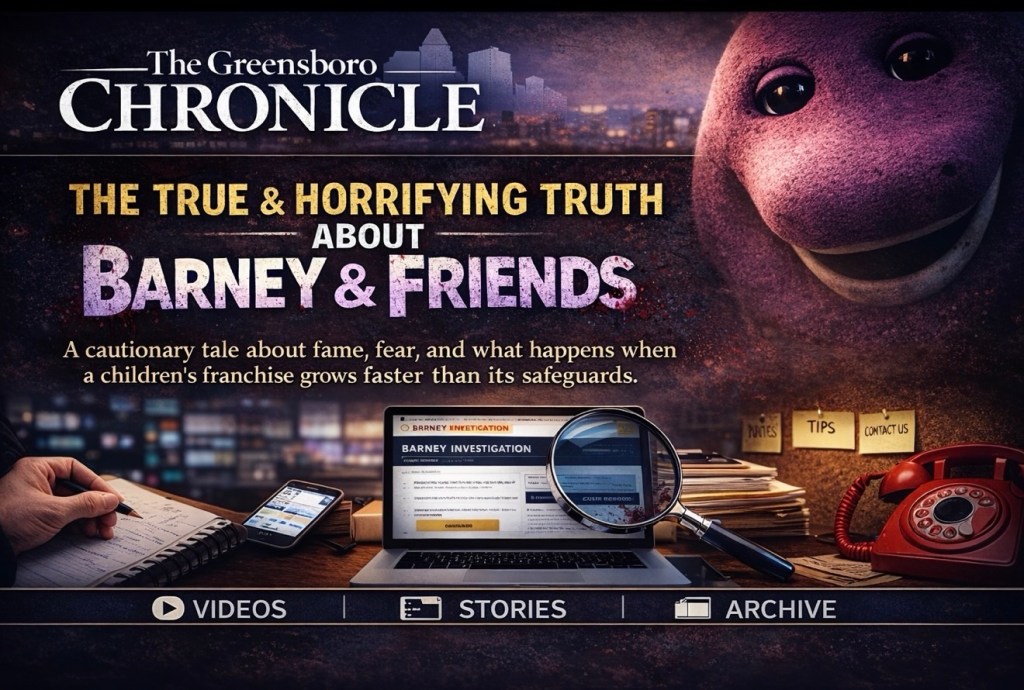
  • The True & Horrifying Truth About Barney & Friends

    A cautionary tale about fame, fear, and what happens when a children’s franchise grows faster than its safeguards.

    For millions of families, Barney & Friends was a pastel-colored refuge: gentle songs, big hugs, and lessons about kindness. But behind the purple smile sits a far more unsettling story—one pieced together from public court records, police reports, sworn testimony, and years of press coverage. This is not an urban legend. It’s a sober look at how a wholesome brand collided with real-world risks, how warning signs surfaced, and what the legacy looks like today.

    How It Started: A Preschool Dream Becomes a National Machine

    The concept was born in the late 1980s as Barney & the Backyard Gang, created by former teacher Sheryl Leach. Its core promise—safe, repetitive learning for toddlers—found a perfect home on PBS in 1992. Within a few years, the show was a merchandising juggernaut, licensed worldwide through HIT Entertainment.

    That success brought speed. Auditions scaled. Live appearances multiplied. Touring casts expanded. And like many fast-growing children’s brands of the era, systems designed for a small local production were suddenly responsible for a national workforce—often part-time, rotating, and operating under uneven supervision standards common to the 1990s entertainment industry.

    When Trouble Became Apparent: The Cracks No One Wanted to See

    By the mid-1990s, the first serious alarms sounded—not about the show’s content, but about people around it.

    Criminal cases that pierced the illusion

    Public records confirm that multiple individuals associated with the broader Barney ecosystem (including former cast or affiliates, not the central production leadership) were later charged or convicted of violent crimes unrelated to the show’s storylines. These cases—widely reported at the time—created a chilling contrast between the brand’s innocence and the reality that performers are ordinary adults subject to the same risks and failures as anyone else.

    Crucially, no evidence ever established that the program itself promoted harm, nor that its creators condoned misconduct. But the optics were devastating. Headlines don’t parse nuance; they juxtapose images. A smiling dinosaur beside a mugshot changes how parents feel—instantly.

    Harassment, threats, and the darker side of fame

    Court filings and sworn statements also document threats and stalking directed at people associated with the show, including performers. The costume that symbolized safety became a lightning rod. Law enforcement involvement increased. Security measures quietly expanded. None of this made it into the opening theme song—but it reshaped daily operations.

    The Effect on the Series: From Open Arms to Locked Doors

    As the 1990s wore on, the production hardened.

    Audition and background-check procedures tightened, reflecting industry-wide changes after high-profile scandals elsewhere in children’s media. Public appearances became more controlled, with stricter access rules and less spontaneous interaction. Creative tone subtly shifted—fewer unscripted moments, more rigid staging, and clearer boundaries between cast and audience.

    Ratings held for a time, but the cultural mood changed. Irony replaced earnestness. Barney became a punchline for older kids and teens—an edge sharpened by the unsettling news cycles that periodically resurfaced.

    Court Records vs. Internet Myth: Separating Fact from Fear

    It’s important to be precise:

    Verified facts: There were real criminal prosecutions involving individuals once connected to the Barney brand in peripheral roles. There were documented threats and security incidents. These appear in public court dockets and police reports. Unverified myths: Viral claims of secret messages, cult symbolism, or coordinated abuse conspiracies tied to the show itself do not withstand scrutiny and are unsupported by evidence.

    The danger lies in conflation. When fear fills gaps that facts don’t, misinformation spreads—often faster than corrections.

    Where Do We Stand Now: Legacy, Lessons, and Accountability

    Barney & Friends ended its original run in 2010. The character persists through reboots and reimaginings, but under a different cultural contract—one shaped by decades of hard lessons.

    Today’s children’s productions operate with:

    Mandatory background checks On-set child-safety officers Clear reporting pipelines Trauma-informed standards unthinkable in the early 1990s

    Barney didn’t invent these reforms—but its history helped justify them.

    The Real Horror Isn’t the Dinosaur

    The unsettling truth isn’t that a children’s show was “evil.” It’s that good intentions don’t substitute for structural safeguards. When a brand built on trust grows too quickly, the cost of oversight failures is measured not just in lawsuits or ratings—but in shaken confidence.

    In that sense, Barney & Friends is a warning. Not about purple dinosaurs—but about what happens when innocence becomes an industry.

    Legal Disclaimer

    This article is an investigative, educational, and journalistic analysis based on publicly available records, court filings, contemporaneous news reporting, and historical documentation. It does not allege wrongdoing by any individual or entity beyond what has been established in verified public sources. No claims are made beyond the evidentiary record. Readers are encouraged to consult original court documents and primary sources for full context.

    Copyright

    © 2026 The Greensboro Chronicle. All rights reserved.

    No part of this article may be reproduced, distributed, or transmitted in any form or by any means without prior written permission from the publisher, except for brief quotations used for news reporting, scholarship, or review.

  • Hartford’s Unfinished Reckoning: When History Refuses to Stay Buried

    In American civic life, unresolved injustices have a way of resurfacing—not as relics of the past, but as living questions demanding present-day answers. Hartford, Connecticut now finds itself confronting one such question: What does justice look like when the statute of limitations has expired, but the harm has never healed?

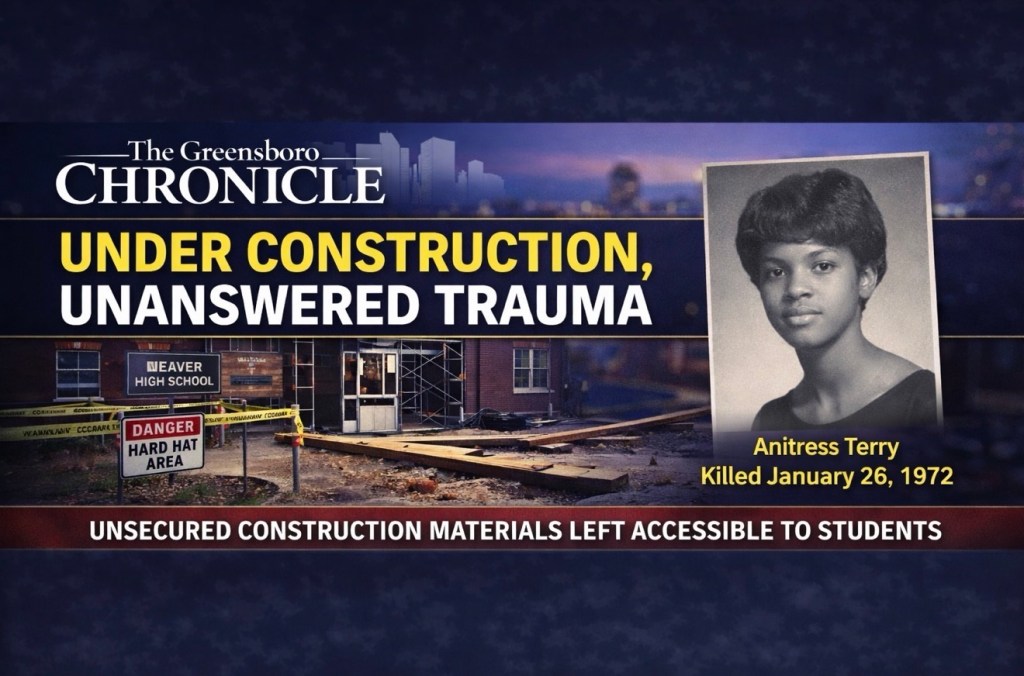
    The death of Anitress Terry, a Weaver High School senior killed on January 26, 1972, was not the result of a natural disaster or unforeseeable accident. According to contemporaneous reporting and subsequent accounts, it occurred during an active construction project where unsecured materials were allowed to remain in areas accessible to students. A plank fell. A young life ended. And with it began decades of unaddressed trauma for a family—and, arguably, for a community.

    What makes this case especially instructive is not only the tragedy itself, but the institutional silence that followed.

    When Time Bars the Courtroom—but Not the Conscience

    Connecticut law, like that of many states, imposes a two-year statute of limitations on wrongful death claims. From a purely procedural standpoint, the Terry family’s opportunity for civil litigation closed long ago. Yet the law also recognizes a distinction between legal liability and moral responsibility.

    This is where the concept of historical reparations enters the discussion—not as a radical innovation, but as an established remedial framework used when conventional legal avenues are no longer available. Historically, reparations have been employed to address systemic or institutional harms that were lawful at the time, tolerated by authorities, or ignored due to social power imbalances.

    The Terry family’s story raises an uncomfortable but necessary inquiry:

    Was the absence of meaningful accountability in 1972 merely bureaucratic inertia—or was it shaped by race, neighborhood, and perceived expendability?

    Institutional Neglect as a Pattern, Not an Anomaly

    The document highlights that safety concerns at Weaver High School were known at the time. Board-level awareness, unsecured construction zones, and student access to hazardous areas were not speculative—they were documented. That context matters, because negligence is not defined solely by a single act, but by a failure to act when risks are known.
    More troubling is the continuity of similar concerns in Hartford’s public schools decades later: unresolved infrastructure hazards, environmental health risks, and delayed accountability. While these later conditions are not legally linked to the Terry case, they underscore why unresolved history erodes public trust. When past harms are never acknowledged, present assurances ring hollow.

    The Hidden Cost: Intergenerational Trauma

    Legal discourse often focuses on damages that can be quantified. But trauma does not obey filing deadlines.

    The Terry siblings reportedly lived with persistent fear, educational disruption, and the absence of mental health support in the years following their sister’s death. One child left behind—a two-month-old infant—grew up without her mother. These are not abstract harms; they are the lived consequences of institutional failure.

    Modern courts increasingly recognize adverse childhood experiences and intergenerational trauma as real and measurable. Municipal governments, however, often lag behind the science—especially when the victims are families without political leverage.

    What Guidance Can the City Offer—Now?

    The call now before the City of Hartford Court of Common Council is not strictly legal. It is civic and ethical.

    Possible avenues for redress do not require reopening a courtroom:

    A formal public acknowledgment and apology grounded in historical findings A targeted reparative fund supporting educational or mental-health initiatives in the family’s name A policy review mandate tying past failures to present-day school safety reforms The commissioning of an independent historical report to establish an authoritative public record

    Such actions do not rewrite history—but they do signal that history has been heard.

    Why This Moment Matters

    Communities often say they want to move forward. But forward movement requires orientation—and orientation requires reckoning.

    Hartford’s choice is not between blame and silence. It is between engagement and erasure. The Terry family’s story reminds us that injustice does not expire simply because a calendar turns. When institutions fail to close the moral ledger, the debt accrues interest—paid in distrust, disengagement, and generational harm.

    This is not merely a Hartford story. It is an American one.

    Legal Disclaimer

    This article is for informational and educational purposes only and does not constitute legal advice. No attorney-client relationship is formed by this publication. Readers should consult qualified legal counsel for advice regarding specific legal matters.

    Copyright Notice

    © 2026 The Greensboro Chronicle. All rights reserved.

    No portion of this article may be reproduced, distributed, or transmitted in any form or by any means without prior written permission from the publisher, except for brief quotations used for commentary, scholarship, or news reporting with proper attribution

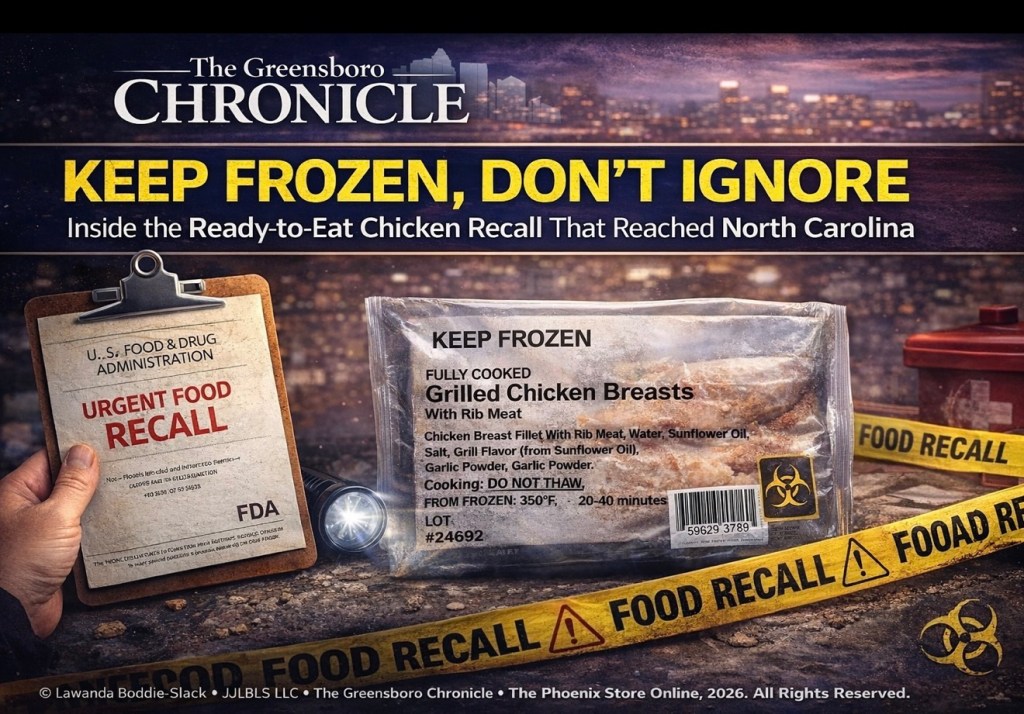
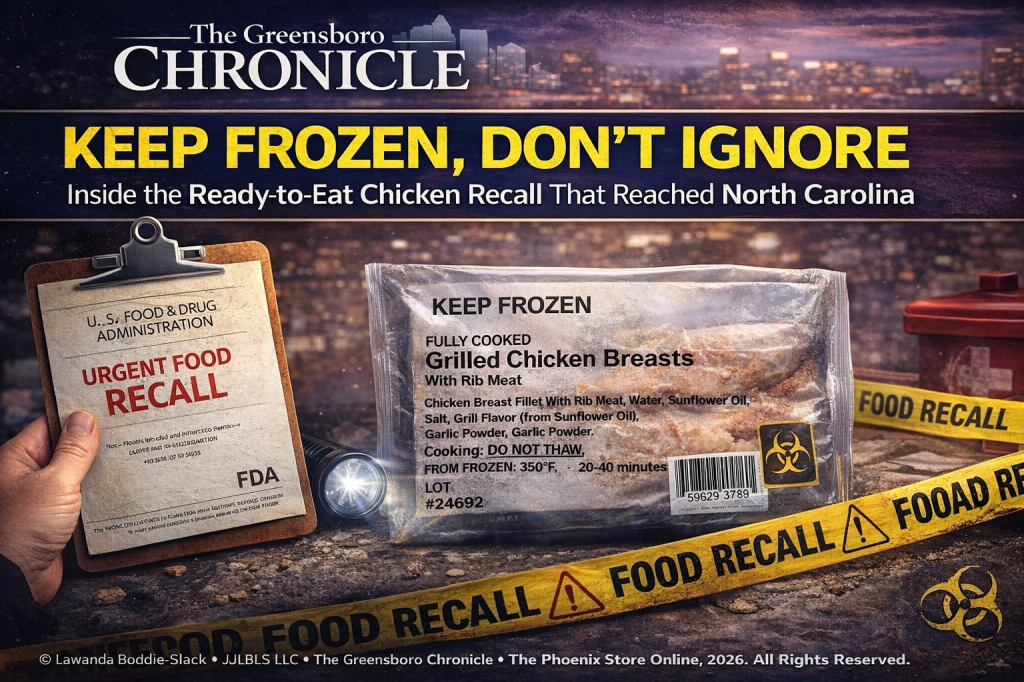
  • KEEP FROZEN, DON’T IGNORE:

    **KEEP FROZEN, DON’T IGNORE:

    Inside the Ready-to-Eat Chicken Recall That Reached North Carolina**

    By The Greensboro Chronicle Investigations Desk

    A Recall Hiding in Plain Sight

    A product labeled “fully cooked” is supposed to be the safest thing in a freezer aisle. Ready-to-eat meals are marketed on trust—trust that the food has already cleared the most dangerous hurdle: contamination after cooking.

    That trust is now under scrutiny.

    In recent weeks, nearly 14,000 pounds of ready-to-eat grilled chicken products produced by Suzanna’s Kitchen were recalled after federal inspectors identified a potential contamination risk linked to Listeria monocytogenes, a bacterium known to cause serious—and sometimes fatal—illness.

    The recalled products were distributed across multiple states, including North Carolina, raising urgent questions for consumers who may already have the food sitting in their freezers, unaware that “fully cooked” does not always mean “fully safe.”

    What Triggered the Recall

    According to publicly released recall notices, the issue was identified through post-production review and regulatory oversight, not consumer complaints. That distinction matters.

    Listeria contamination is especially dangerous because:

    It can survive and grow in refrigerated and frozen environments It disproportionately affects pregnant people, older adults, and immunocompromised individuals Symptoms may not appear immediately, delaying diagnosis and treatment

    The products at issue were ready-to-eat, meaning consumers were not expected to take additional food-safety steps beyond reheating—if reheating was required at all.

    That classification significantly elevates the risk profile.

    “Fully Cooked” vs. “Fully Safe”

    The labeling visible on affected packages prominently states “fully cooked” and “keep frozen.” For many households, that combination signals low risk.

    But food safety experts consistently warn that post-cook contamination—often occurring during packaging, handling, or storage—can render even properly cooked food hazardous.

    Listeria is uniquely resilient. Freezing does not reliably kill it. Reheating instructions, if not followed precisely, may also fail to eliminate it.

    In short:

    A frozen, fully cooked product can still be dangerous.

    Why Consumers May Never See the Recall

    Unlike dramatic shelf pull-outs or store-level alerts, many food recalls rely on passive notification systems:

    Press releases on federal websites Distributor notices Retailer postings that vary widely in visibility

    There is no guarantee that a consumer who purchased the product weeks—or months—earlier will ever see the recall notice.

    That reality places the burden squarely on the public to monitor recalls, often after the product has already been consumed.

    What Consumers Are Being Told to Do

    Official recall instructions generally include some version of the following:

    Do not consume the product Discard immediately or Return to the place of purchase for a refund

    Manufacturers and retailers are typically required to honor refunds or replacements even without a receipt when a product is officially recalled.

    Consumers who believe they may have consumed a recalled product and experienced illness are advised to:

    Seek medical care Preserve packaging if possible Report the incident to appropriate regulatory authorities

    The Larger Pattern

    Food recalls involving ready-to-eat meat products are not rare—but they are rarely front-page news.

    What makes this recall notable is not only the volume of product involved, but the quiet way it entered public awareness, largely through social media posts rather than aggressive consumer alerts.

    When recalls depend on chance discovery instead of direct notification, public health protection becomes inconsistent at best.

    What This Investigation Cannot Yet Answer

    As of publication:

    No public findings of liability or wrongdoing have been issued No confirmed illnesses have been formally attributed in released materials Regulatory review and follow-up remain ongoing

    Those facts may change.

    And when they do, The Greensboro Chronicle will update its reporting accordingly.

    What Consumers Should Take Away

    “Fully cooked” is not a guarantee of safety Frozen foods can still carry serious pathogens Recalls are only effective if people actually see them Consumers have a right to refunds, replacements, and transparency

    Food safety is not just a regulatory issue—it is a public trust issue.

    Legal Disclaimer

    The Greensboro Chronicle publishes investigative reporting based on publicly available records, regulatory notices, official statements, and firsthand accounts submitted by readers. References to individuals, businesses, or products are made for public-interest and informational purposes only and do not constitute findings of liability, negligence, or wrongdoing.

    Allegations described are presented as such and remain subject to verification, response, and adjudication by appropriate legal or regulatory authorities. Information contained herein is not intended as medical, legal, or regulatory advice.

    Copyright Notice

    © Lawanda Boddie-Slack, 2026. All Rights Reserved.

    © JJLBLS LLC d/b/a JJLBLS Professional Administrative Services, 2026. All Rights Reserved.

    @Greensboro Chronicle, 2026. All Rights Reserved.

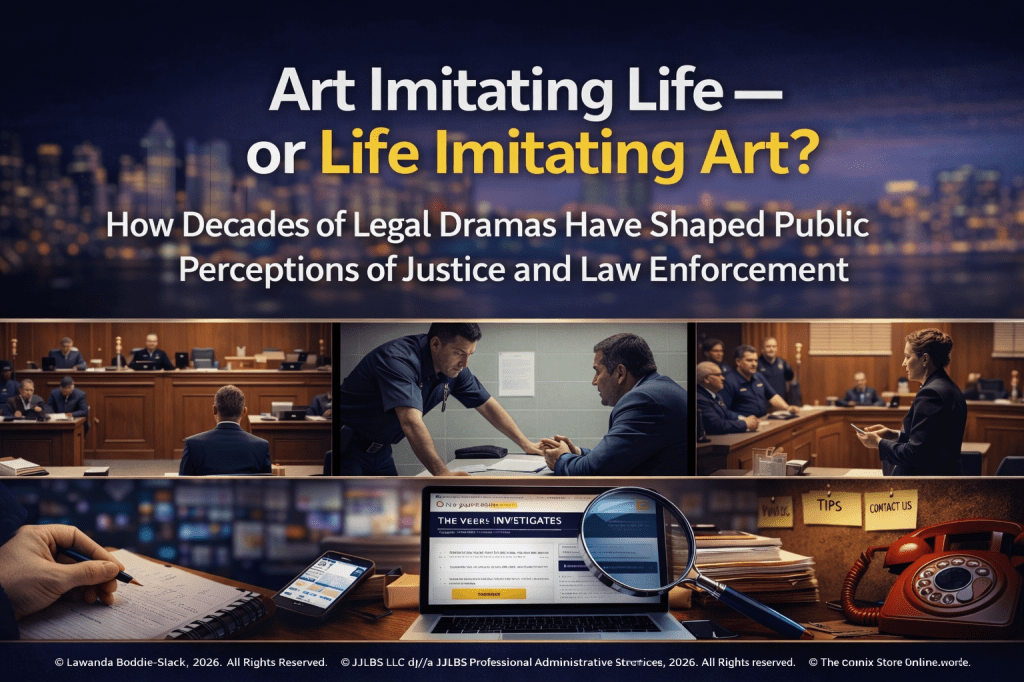
  • Art Imitating Life — or Life Imitating Art?

    For more than half a century, American audiences have been steeped in legal television. From the steady drumbeat of Law & Order to the gritty realism of The Wire, courtroom and police procedurals have become cultural comfort food.

    We watch them to relax, to be entertained, to feel reassured that “the system works.” But quietly—and powerfully—these narratives have shaped how we understand justice, policing, prosecution, and guilt. The troubling question is not whether these shows reflect reality. It’s whether they have trained us to accept realities we should be challenging.

    Television law has rules—unspoken but consistent. The suspect is usually guilty. The shortcut is justified. The constitutional violation is unfortunate but necessary. Evidence obtained through questionable means is framed as heroic persistence. Prosecutors are depicted as moral crusaders. Judges are often passive referees. Defense attorneys, when not incompetent, are portrayed as obstructive or morally suspect. Over time, these tropes do more than entertain; they normalize conduct that, in real courtrooms, is illegal, unethical, or unconstitutional.

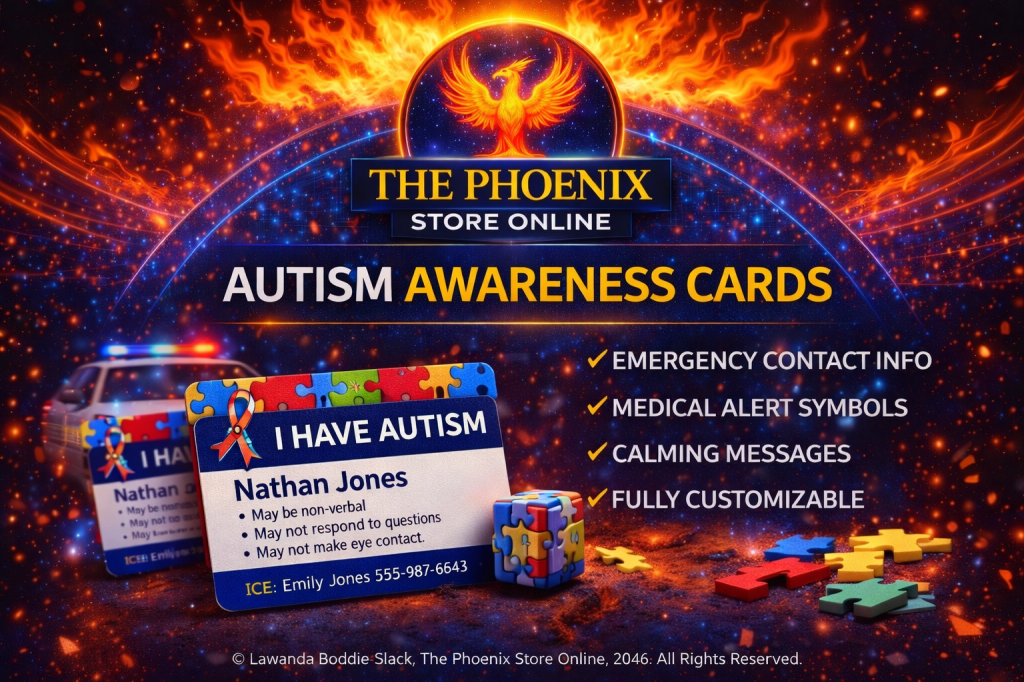
    Available at: http://www.buypso.square.site

    This Normalization of Illegality

    In real life, the Fourth, Fifth, Sixth, and Fourteenth Amendments are supposed to be bright lines—protections against unlawful searches, coerced confessions, denial of counsel, and unequal treatment. In television law, they are speed bumps.

    Illegal searches become “technicalities.”

    Coercive interrogations become “pressure.”

    Brady violations become “mistakes.”

    Selective prosecution becomes “discretion.”

    The audience is conditioned to root for outcomes, not process. If the “bad guy” is convicted, the means fade into the background. This framing matters. Decades of research in media studies and criminal justice show that repeated exposure to these narratives increases public tolerance for aggressive policing and prosecutorial overreach—particularly when the targets are poor, marginalized, or already socially stigmatized.

    Prosecutorial Power as Entertainment

    Television prosecutors are rarely shown committing misconduct, and when they do, it is portrayed as an aberration. In reality, appellate courts across the United States have repeatedly documented patterns of prosecutorial misconduct: withholding exculpatory evidence, presenting misleading testimony, making improper arguments, and exploiting procedural advantages against unrepresented or under-resourced defendants.

    Yet in popular culture, the district attorney’s office is the embodiment of justice. The imbalance of power between the state and the accused is rarely interrogated. Instead, viewers are taught to see prosecutorial discretion as benevolent judgment rather than as raw authority constrained only by ethical rules that are seldom enforced.

    Law Enforcement as Protagonist, Not Institution

    Police procedurals personalize law enforcement. The badge has a face, a family, a tragic backstory. Structural issues—racial profiling, unlawful stops, data manipulation, civil asset forfeiture, or retaliatory charging—are minimized or ignored. When abuse is depicted, it is individualized: “a bad cop,” not a bad system.

    This narrative framing has consequences. When real-world footage surfaces—illegal stops, excessive force, falsified reports—the public reaction often mirrors television logic: What did the suspect do? Why didn’t they comply? Don’t the ends matter? We are primed to excuse institutional failure because we’ve been trained to empathize with the institution’s agents, not its subjects.

    Fiction vs. Reality: The Double Standard

    Here’s the paradox: viewers who cheer fictional rights violations often express outrage when confronted with the same conduct in real life. Why? Because television divorces harm from consequence. The wrongfully searched suspect is still guilty. The coerced confession is still true. The innocent person rarely stays innocent by the end of the episode.

    In reality, illegal tactics distort outcomes. They produce wrongful convictions. They entrench racial and economic disparities. They erode public trust. And unlike television, there is no guaranteed reversal in the final act.

    The Cost of Cultural Conditioning

    Our collective tolerance for misconduct does not emerge in a vacuum. It is cultivated. When jurors arrive in court, they bring expectations shaped by years of fictional precedent. When voters evaluate reform, they compare it against dramatized fears of chaos. When judges assess credibility, they do so in a cultural environment that has already cast law enforcement as the default truth-teller.

    Art does not merely imitate life. Over time, life begins to imitate art—especially when art goes unchallenged.

    Reclaiming Reality

    Critical viewing matters. Education matters. So does refusing to confuse entertainment with evidence. Legal dramas can be compelling without being corrosive—but only if audiences recognize the difference between narrative convenience and constitutional necessity.

    Justice is not supposed to be efficient. It is supposed to be fair. And fairness, unlike television, requires accountability, restraint, and the courage to question the stories we’ve been told for decades.

    Legal Disclaimer

    This article is published for educational and informational purposes only. It does not constitute legal advice, does not create an attorney-client relationship, and should not be relied upon as a substitute for advice from a licensed attorney. Legal standards and interpretations vary by jurisdiction and over time.

    Copyright Notice

    © 2026 The Greensboro Chronicle. All rights reserved.

    No part of this publication may be reproduced, distributed, or transmitted in any form or by any means without the prior written permission of The Greensboro Chronicle, except for brief quotations used for commentary, criticism, or educational purposes consistent with fair use.

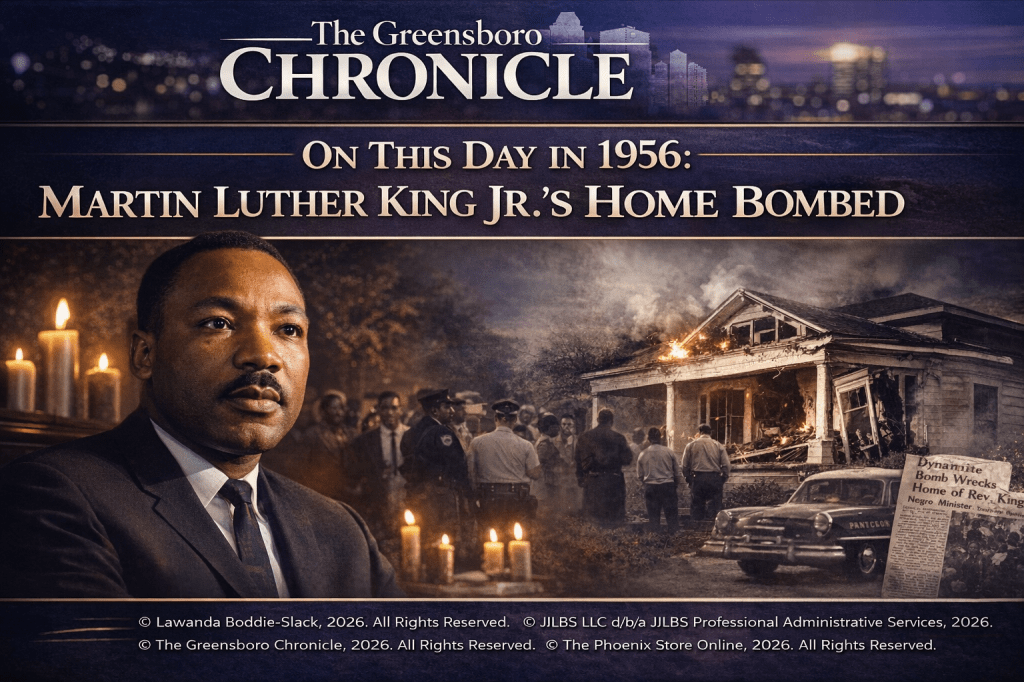
  • January 30, 1956

    On this day in 1956, while Martin Luther King Jr. stood before a packed church urging discipline, dignity, and nonviolence, hatred struck from the shadows.

    A bomb exploded on the front porch of Dr. King’s home in Montgomery, Alabama.

    Inside were his wife, Coretta Scott King, and their infant daughter, Yolanda. By sheer fortune—and perhaps history’s quiet insistence—neither was injured. The blast shattered windows, splintered wood, and sent shockwaves through a city already trembling under the weight of moral reckoning.

    Outside, an angry crowd gathered. Some were neighbors. Many were supporters of the Montgomery Bus Boycott—ordinary Black citizens who had walked for weeks rather than submit to segregation. They were furious. Some were armed. All were hurt.

    What happened next would help define the American civil rights movement.

    A Test of Leadership Under Fire

    Dr. King rushed home from the mass meeting he had been addressing. Confronted with the wreckage of his house and the danger facing his family, he did not call for vengeance. He did not raise his voice.

    Instead, standing amid broken glass and raw fear, he called for calm.

    “We must meet violence with nonviolence,” he told the crowd.

    “Remember the teachings of Jesus: Love your enemies.”

    In that moment, King was no longer simply a pastor thrust into leadership by circumstance. He became the moral compass of a movement that would change the nation—not through force, but through conscience.

    The bombing was meant to intimidate. Instead, it clarified the stakes.

    The Broader Context: Montgomery in 1956

    The Montgomery Bus Boycott was only weeks old, sparked by the arrest of Rosa Parks and sustained by tens of thousands of Black residents refusing to ride segregated buses. White supremacist groups, local officials, and segregationist leaders were determined to break the movement.

    Violence was part of that strategy.

    King’s home was not targeted because it was vulnerable—it was targeted because it symbolized something dangerous to the status quo: organized, principled resistance grounded in moral authority.

    The bombing failed in its objective. Public sympathy grew. The boycott hardened its resolve. And King’s insistence on nonviolence—tested under the most personal of circumstances—cemented his national standing.

    Why This Day Still Matters

    It is easy, decades later, to romanticize the civil rights movement as inevitable. It was not.

    Progress came inch by inch, under constant threat. Leaders faced surveillance, arrests, bombings, and assassination. Families bore the cost alongside them.

    January 30, 1956, reminds us that courage is not the absence of fear—it is the refusal to let fear dictate the future.

    It also reminds us that moral clarity often emerges not in moments of comfort, but in moments of crisis.

    Dr. King could have justified rage that night. History might have understood it. But he chose restraint—and in doing so, helped steer a nation closer to its unfinished promise.

    A Living Legacy

    The porch was rebuilt. The movement marched on. And the idea that justice could be pursued without surrendering one’s humanity survived an attempt to destroy it.

    Today, we remember not just the bomb—but the restraint that followed it.

    Not just the hatred—but the discipline that outlasted it.

    Because on this day, violence tried—and failed—to silence justice.

    Legal Disclaimer

    This article is published for educational, historical, and journalistic purposes. It reflects historical records, contemporaneous reporting, and widely accepted scholarly accounts of events surrounding the Montgomery Bus Boycott and the life of Dr. Martin Luther King Jr. It does not constitute legal advice and should not be interpreted as an endorsement or condemnation of any modern individual, organization, or policy beyond historical context.

    Copyright Notice

    © 2026 The Greensboro Chronicle. All rights reserved.

    This article may not be reproduced, redistributed, or republished in whole or in part without prior written permission, except for brief quotations used for commentary, criticism, or educational purposes consistent with fair use.

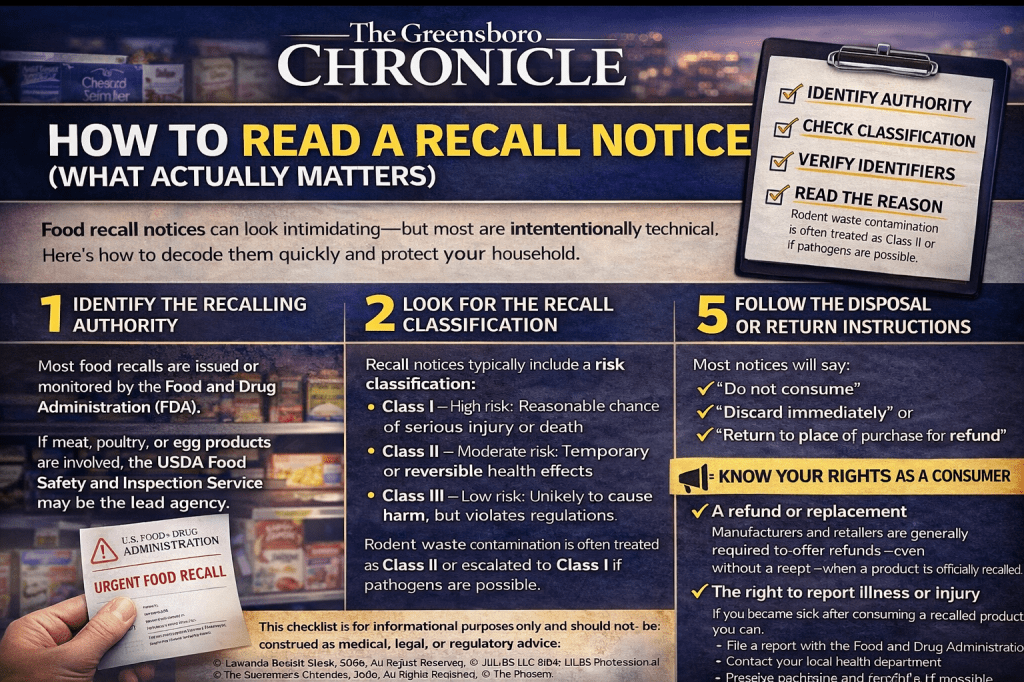
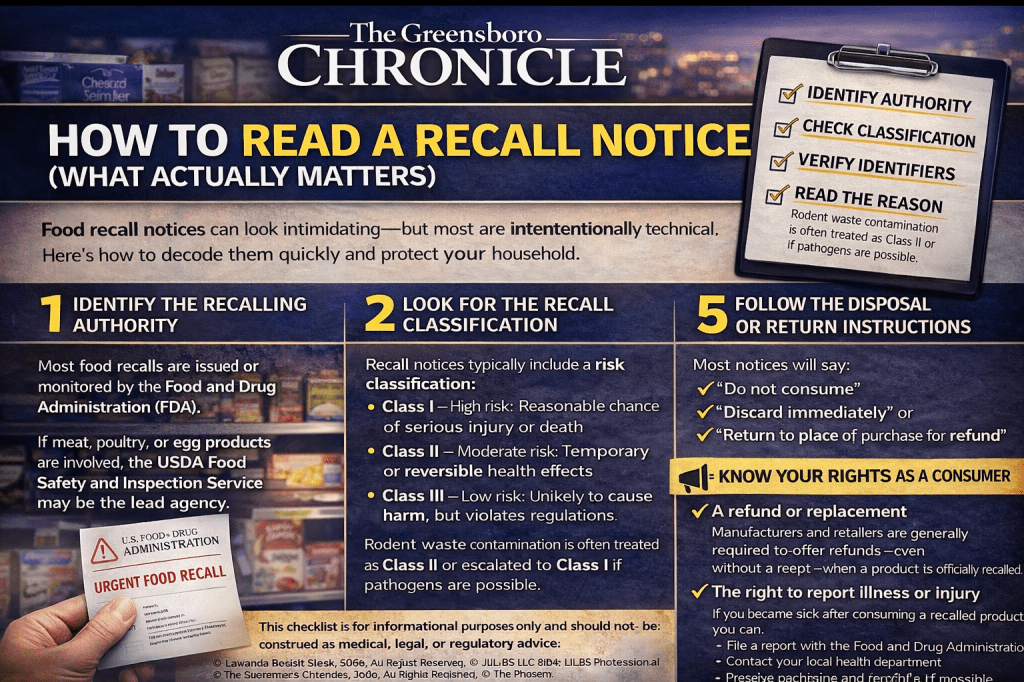
  • 🧾 How to Read a Recall Notice (What Actually Matters)

    Food recall notices can look intimidating—but most are intentionally technical. Here’s how to decode them quickly and protect your household.

    1. Identify the Recalling Authority

    Most food recalls are issued or monitored by the Food and Drug Administration (FDA).

    If meat, poultry, or egg products are involved, the USDA Food Safety and Inspection Service may be the lead agency.

    If it’s not coming from a government regulator or the manufacturer directly, verify the source before acting.

    2. Look for the Recall Classification

    Recall notices typically include a risk classification:

    Class I – High risk: Reasonable chance of serious injury or death Class II – Moderate risk: Temporary or reversible health effects Class III – Low risk: Unlikely to cause harm, but violates regulations

    Rodent waste contamination is often treated as Class II or escalated to Class I if pathogens are possible.

    3. Check the Product Identifiers (This Is Crucial)

    Ignore the brand name headlines—focus on:

    UPC or barcode number Lot or batch code Production or “best by” date Facility or plant code (often stamped on packaging)

    Only products matching all listed identifiers are officially recalled—but if packaging is damaged or unclear, err on the side of caution.

    4. Read the “Reason for Recall” Carefully

    Phrases like:

    Potential contamination” “Cannot rule out exposure” “Unsanitary conditions”

    …often mean testing was incomplete or conditions were severe enough that safety could not be guaranteed.

    That’s especially important in rodent-related recalls, where contamination may not be visible.

    5. Follow the Disposal or Return Instructions

    Most notices will say:

    Do not consume” “Discard immediately” or Return to place of purchase for refund”

    Do not attempt to wash, cook, or inspect recalled food.

    📣 KNOW YOUR RIGHTS AS A CONSUMER

    If you purchased recalled food, you are not powerless.

    Your rights include:

    A refund or replacement

    Manufacturers and retailers are generally required to offer refunds—even without a receipt—when a product is officially recalled.

    The right to report illness or injury

    If you became sick after consuming a recalled product, you can:

    File a report with the Food and Drug Administration Contact your local health department Preserve packaging and receipts if possible

    The right to transparency

    You are entitled to know:

    Why the product was recalled Which facility was involved Whether the issue was previously cited by inspectors

    The right to pursue legal remedies

    If contamination caused medical harm, lost wages, or hospitalization, affected consumers may have grounds for product liability or negligence claims, depending on circumstances.

    Important: Reporting issues helps regulators identify patterns and prevent repeat violations.

    Legal Disclaimer

    This article is provided for informational and educational purposes only and does not constitute medical, legal, or regulatory advice. The Greensboro Chronicle relies on publicly available inspection records, recall notices, and regulatory disclosures available at the time of publication. Recall classifications, findings, and enforcement actions may change. Readers should consult official recall announcements, healthcare providers, and qualified professionals for guidance specific to their individual circumstances.

    Copyright Notice

    © The Greensboro Chronicle, 2026. All rights reserved.

    This article may not be reproduced, distributed, republished, or transmitted in whole or in part without the prior written permission of The Greensboro Chronicle, except for brief quotations used for news reporting, commentary, or educational purposes with proper attribution.

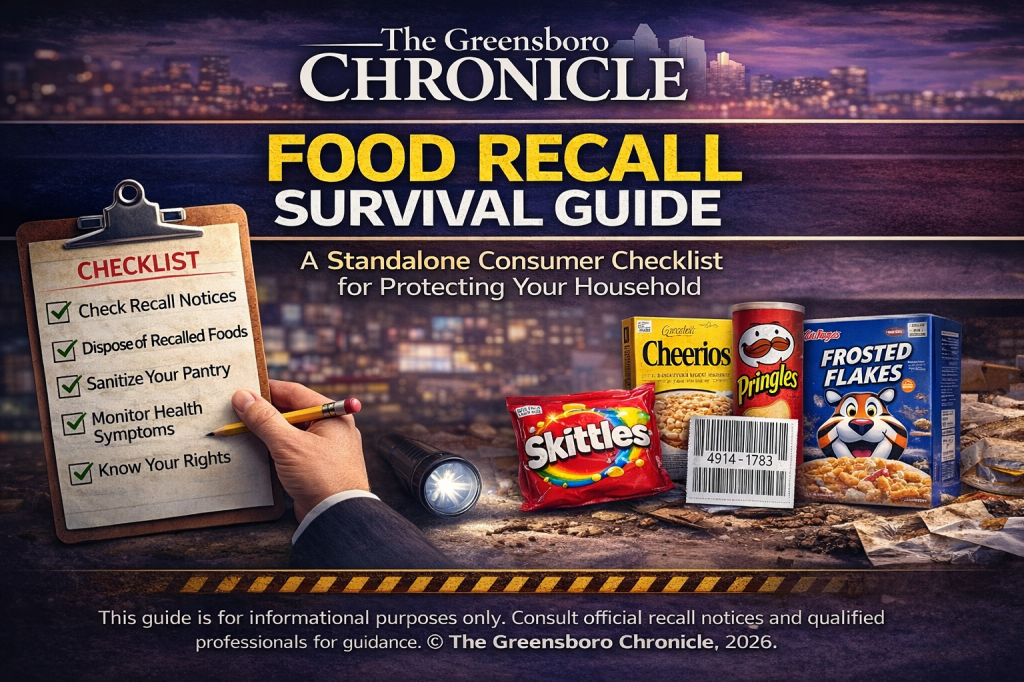
  • Food Recall Survival Guide

    January 30, 2026

    John Lee Staff Writer

    A Standalone Consumer Checklist for Protecting Your Household

    Public-interest consumer safety report

    Food recalls linked to contamination—especially rodent waste—are not rare, isolated events. Public inspection records and recall databases show that sanitation violations routinely occur at manufacturing plants, warehouses, and distribution centers across the United States. When recalls happen, consumers are often left confused about what to do next.

    This standalone checklist is designed to help readers act quickly, protect their families, and assert their rights when a food recall is announced.

    STEP 1: Confirm Whether You’re Affected

    Do not rely on headlines alone. Always verify:

    ☐ Brand name

    ☐ Product name and size

    ☐ UPC or barcode number

    ☐ Lot, batch, or production code

    ☐ “Best by” or expiration date

    ☐ Facility or plant code (if listed)

    Most recalls are overseen by the Food and Drug Administration (FDA). Meat, poultry, or egg products may instead fall under the USDA Food Safety and Inspection Service.

    If any identifier matches—even partially—treat the product as recalled.

    🚫 STEP 2: Do NOT Taste-Test the Product

    ☐ Do not smell, taste, cook, or “check” the food

    ☐ Do not feed it to pets or livestock

    ☐ Do not assume freezing or heating makes it safe

    Rodent contamination can involve urine, droppings, or bacteria invisible to the eye. Food can appear normal and still be unsafe.

    🗑️ STEP 3: Dispose of or Return the Product Safely

    Follow the recall instructions exactly:

    ☐ Seal the item in a bag before discarding

    ☐ Place it in an outdoor trash bin if possible

    ☐ Or return it to the retailer for a refund/replacement

    Many retailers honor recalls even without a receipt.

    🧼 STEP 4: Sanitize Storage Areas

    If recalled food was stored in your home:

    ☐ Remove nearby items

    ☐ Wash shelves, bins, and drawers with hot soapy water

    ☐ Disinfect surfaces that contacted the packaging

    ☐ Wash hands thoroughly afterward

    Rodent contamination can transfer from packaging to surfaces.

    🩺 STEP 5: Monitor Health Symptoms

    Seek medical guidance if anyone experiences:

    ☐ Nausea, vomiting, or diarrhea

    ☐ Fever or chills

    ☐ Abdominal pain

    ☐ Flu-like symptoms after consumption

    Inform healthcare providers of possible food contamination exposure.

    📣 STEP 6: Know Your Rights as a Consumer

    You have the right to:

    ☑ Refunds or replacements for recalled products

    ☑ Accurate recall information from manufacturers and retailers

    ☑ Report illness or contamination concerns to regulators

    ☑ Pursue legal remedies if harm occurred

    Consumer reports help identify repeat violators and trigger enforcement.

    📍 STEP 7: Report Concerns — Especially in North Carolina

    In North Carolina, food safety oversight is shared with the North Carolina Department of Agriculture and Consumer Services (NCDA&CS).

    ☐ File a complaint if you suspect contamination

    ☐ Report unsanitary retail or warehouse conditions

    ☐ Document product details and symptoms if applicable

    North Carolina is a major distribution corridor—local reports can prevent regional or national outbreaks.

    ⚠️ WHY THIS CHECKLIST MATTERS

    Public inspection data consistently show that rodent activity is among the most frequently cited violations in food storage and distribution facilities. Enforcement often begins with warnings and corrective timelines, not immediate shutdowns—meaning contaminated products can reach consumers before recalls are issued.

    Until oversight becomes faster and more preventative, consumer awareness remains the final safeguard.

    Bottom Line

    ✔ Read recall notices carefully

    ✔ Act quickly and cautiously

    ✔ Don’t second-guess disposal instructions

    ✔ Report problems early

    ✔ Protect your household—not the brand reputation

    Food safety is not a marketing promise. It is a public responsibility.

    Legal Disclaimer

    This article is provided for informational and educational purposes only and does not constitute medical, legal, or regulatory advice. The Greensboro Chronicle relies on publicly available inspection records, recall notices, and regulatory disclosures available at the time of publication. Recall classifications, findings, and enforcement actions may change. Readers should consult official recall announcements, healthcare providers, and qualified professionals for guidance specific to their individual circumstances.

    Copyright Notice

    © The Greensboro Chronicle, 2026. All rights reserved.

    This article may not be reproduced, distributed, republished, or transmitted in whole or in part without the prior written permission of The Greensboro Chronicle, except for brief quotations used for news reporting, commentary, or educational purposes with proper attribution.

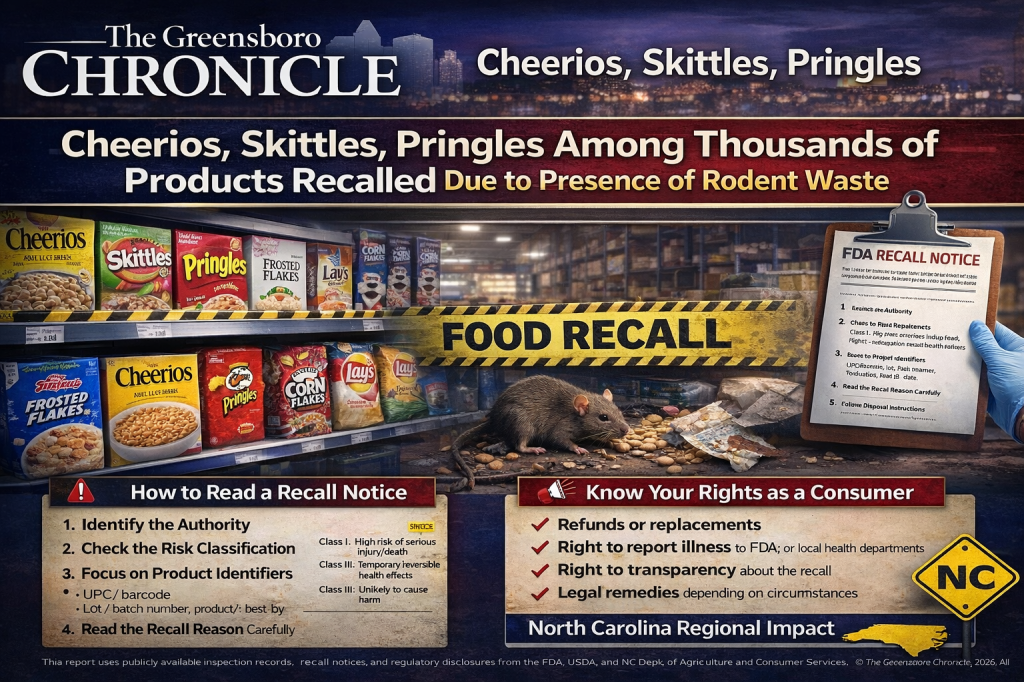
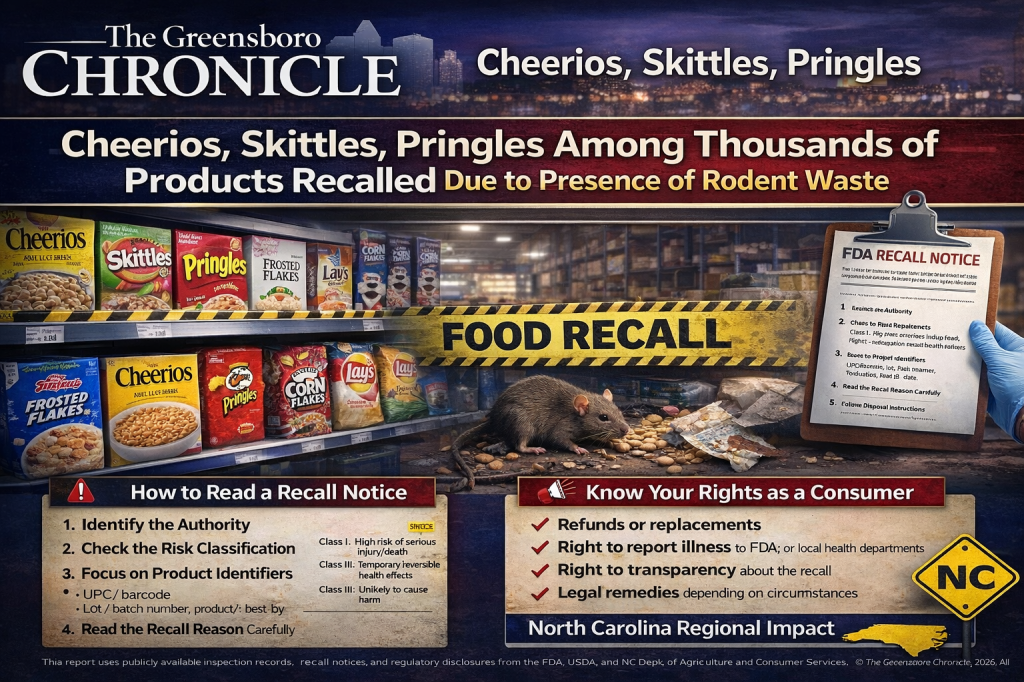
  • Cheerios, Skittles, Pringles Among Thousands of Products Recalled Due to Presence of Rodent Waste

    An in-depth, boldly cautionary public-interest report

    A Recall That Reached the American Pantry

    Cereal in the morning. Chips after school. Candy grabbed at checkout. These are the everyday foods many families trust without hesitation. That trust was shaken after thousands of food products, including items associated with familiar brands such as Cheerios, Skittles, and Pringles, were pulled into recall actions tied to rodent contamination at food manufacturing or distribution facilities.

    While the brand names dominate headlines, the deeper concern is systemic: inspection records and recall notices show rodent activity persisted in food-handling environments, in some cases after regulators had already flagged sanitation failures. By the time recalls were issued, affected products had already entered homes across the country.

    What Inspectors Found — and Why It Triggered Recalls

    Publicly available inspection reports and regulatory disclosures document conditions that meet the federal definition of food adulteration. Findings included:

    Rodent droppings near and on food-contact surfaces Urine residue along walls, pallets, and storage areas Gnaw marks on food packaging Nesting material found close to ingredients and finished goods Repeated rodent activity despite prior warnings

    Rodent contamination is not a minor violation. Even trace exposure can introduce dangerous pathogens into food or onto packaging, especially in facilities handling high-volume, shelf-stable products.

    The Health Risks Behind Rodent Waste Contamination

    Rodents are known carriers of bacteria and viruses capable of causing serious illness, including Salmonella, E. coli, Leptospira, and Hantavirus. Contamination may be invisible to consumers, meaning food can appear normal while still posing a health risk.

    Children, older adults, pregnant individuals, and those with weakened immune systems face heightened risk. Because symptoms may appear days later, illnesses are not always immediately traced back to a recalled product.

    Read Full article Online

    How Contaminated Products End Up on Store Shelves

    Food safety oversight in the United States is primarily enforced by the Food and Drug Administration (FDA), which conducts inspections on a periodic basis—not continuous monitoring.

    A recurring pattern appears in rodent-related recalls:

    Inspectors identify rodent activity Facilities receive citations or warning letters Companies are given time to implement corrective measures Production or distribution continues Recalls are issued only after contamination risk cannot be ruled out

    This enforcement gap allows potentially contaminated products to circulate before consumers are notified.

    Why Major Brands Are Still Affected

    Well-known brands do not always manufacture or store their products directly. Many rely on:

    Third-party manufacturers Contract packaging facilities Regional warehouses and logistics hubs

    As a result, products associated with companies such as General Mills, Mars Incorporated, and Kellogg’s may be recalled when any link in the supply chain fails to meet sanitation standards.

    When contamination is possible, companies often recall all products that passed through the affected facility, leading to thousands of items listed in a single recall action.

    Read full story online at The Greensboro Chronicle

    🧾 How to Read a Recall Notice (What Actually Matters)

    Recall notices are technical by design. Here’s how consumers can quickly identify whether action is required.

    1. Identify the Authority

    Most food recalls are overseen by the Food and Drug Administration. Meat, poultry, and egg products may instead fall under the USDA Food Safety and Inspection Service.

    2. Check the Risk Classification

    Class I – High risk of serious injury or death Class II – Temporary or reversible health effects Class III – Unlikely to cause harm

    Rodent waste contamination is frequently classified as Class II, but can escalate depending on pathogen risk.

    3. Focus on Product Identifiers

    Ignore headlines and check:

    UPC or barcode Lot or batch number Production or “best by” date Facility or plant code

    4. Read the Recall Reason Carefully

    Language such as “potential contamination” or “cannot rule out exposure” signals that safety cannot be guaranteed.

    5. Follow Disposal Instructions

    Do not taste, wash, or cook recalled food. Discard or return it as instructed.

    📣 KNOW YOUR RIGHTS AS A CONSUMER

    If you purchased recalled food, you have protections.

    Refunds or replacements: Most retailers and manufacturers must honor recalls even without a receipt. Right to report illness: Consumers can file reports with the Food and Drug Administration or local health departments. Right to transparency: You are entitled to know why a product was recalled and which facility was involved. Legal remedies: If contamination caused illness, medical costs, or lost wages, affected consumers may have grounds for civil claims depending on circumstances.

    Consumer reporting plays a critical role in identifying repeat violators and triggering enforcement.

    Legal Disclaimer

    This article is provided for informational and educational purposes only and does not constitute medical, legal, or regulatory advice. The Greensboro Chronicle relies on publicly available inspection reports, recall notices, and regulatory disclosures available at the time of publication. Recall status, findings, and enforcement actions may change. Readers should consult official recall announcements, healthcare providers, and qualified professionals for guidance specific to their situation.

    Copyright Notice

    © The Greensboro Chronicle. All rights reserved.

    This article may not be reproduced, distributed, republished, or transmitted in whole or in part without the prior written permission of The Greensboro Chronicle, except for brief quotations used for news reporting, commentary, or educational purposes with proper attribution.

    Pages: 1 2