
Greensboro Chronicle Staff Writer
“You Can’t Read, You Can’t Drive!” — Sunshine State’s Shocking New Rule Throws Immigrants, Seniors, and Non-English Speakers Into High-Stakes Test Chaos
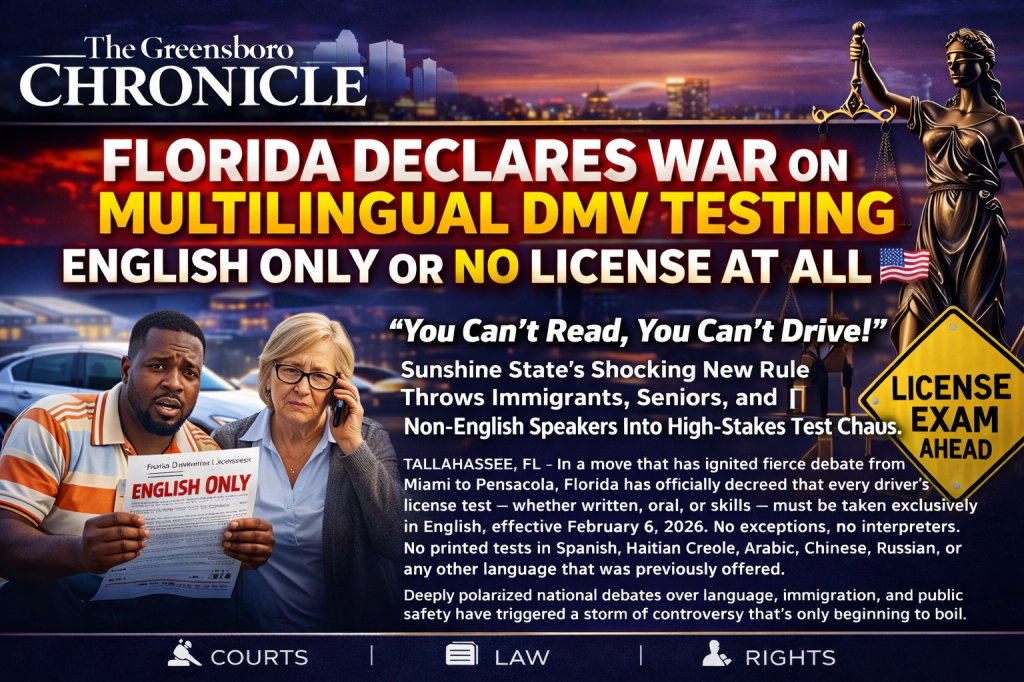
TALLAHASSEE, FL — In a move that has ignited fierce debate from Miami to Pensacola, Florida has officially decreed that every driver’s license test — whether written, oral, or skills — must be taken exclusively in English, effective February 6, 2026. No exceptions. No interpreters. No printed tests in Spanish, Haitian Creole, Arabic, Chinese, Russian, or any other language that was previously offered.
The Florida Department of Highway Safety and Motor Vehicles has updated its statewide testing system so that all driver license knowledge and skills exams are administered only in English — even oral portions that once allowed bilingual support. Translation services are banned, and all non-English printed exams are being pulled from circulation.
Florida’s policy shift comes amid deeply polarized national debates over language, immigration, and public safety — and has triggered a storm of controversy that’s only beginning to boil.

🚗 “I No English? No License!” — New Reality for Millions
Before this January 30 announcement, Florida DMV allowed multiple languages on the Class E Knowledge Exam and other tests. Immigrants and long-time residents routinely used Spanish, Haitian Creole, Chinese, Arabic, and more to navigate licensing requirements.
But starting this February, prospective drivers who cannot demonstrate English proficiency will be outright denied a license — even if they can safely operate a vehicle. The FLHSMV claims the policy enhances highway safety by ensuring drivers can understand road signs, emergency alerts, and law enforcement instructions — nearly all of which are in English.
According to local reports, nearly 37% of behind-the-wheel exams in 2025 were conducted in languages other than English, a testament to Florida’s linguistic diversity — and a key reason why critics are calling this a devastating blow to minority communities.
🔥 Reaction: Outrage, Fear & Fury
Advocates for immigrant rights and language access blasted the move as discriminatory and exclusionary, with one Tampa community organizer warning that long-time residents who never mastered English could be shut out of basic mobility and even jobs.
“This isn’t just a test — it’s a barrier to participation in life, work, and family obligations,” said one community leader, noting many newcomers juggle full-time work and children without English as a first language.
On the political front, supporters are cheering it as a bold step toward common-sense safety standards. Some state lawmakers and figures have even suggested going further — threatening to revoke existing licenses if they were not obtained in English.
📊 Population Trends Fuel the Fire
Florida is one of America’s most linguistically diverse states: well over 30% of residents speak a language other than English at home, with Spanish, Haitian Creole, Portuguese, and French prevalent across many counties.
These demographic trends have made the state a battleground for debates about culture, assimilation, and identity — and now, language proficiency has become a flashpoint in the licensing process.

⚖️ Legal & Policy Backdrop
Federal agencies have also weighed in on English proficiency standards, especially for commercial drivers. In 2025, the U.S. Department of Transportation tightened English language enforcement for commercial truckers to bolster safety on U.S. highways. Critics say Florida’s policy may be influenced by similar nationwide pressures, but opponents claim it unfairly penalizes everyday citizens, not just commercial drivers.
🚨 WHAT’S NEXT?
With language tests now scrapped and interpreters banned, countless aspiring drivers are scrambling for English tutoring, translator services, or are simply giving up their dreams of legal driving in Florida.
For seniors, new immigrants, and multilingual households across the state, this bold policy heralds an uncertain future.
Florida is revving into a new era — but at what social cost?
⚖️ LEGAL DISCLAIMER
This article is published by The Greensboro Chronicle for informational and opinion purposes only. It does not constitute legal advice. Laws and policies can change; individuals seeking legal guidance should consult a licensed professional.
© 2026 The Greensboro Chronicle. All Rights Reserved.
Unauthorized reproduction or redistribution in whole or in part without permission is prohibited.
 Greensboro Chronicle
Leave a comment