
A cautionary tale about fame, fear, and what happens when a children’s franchise grows faster than its safeguards.
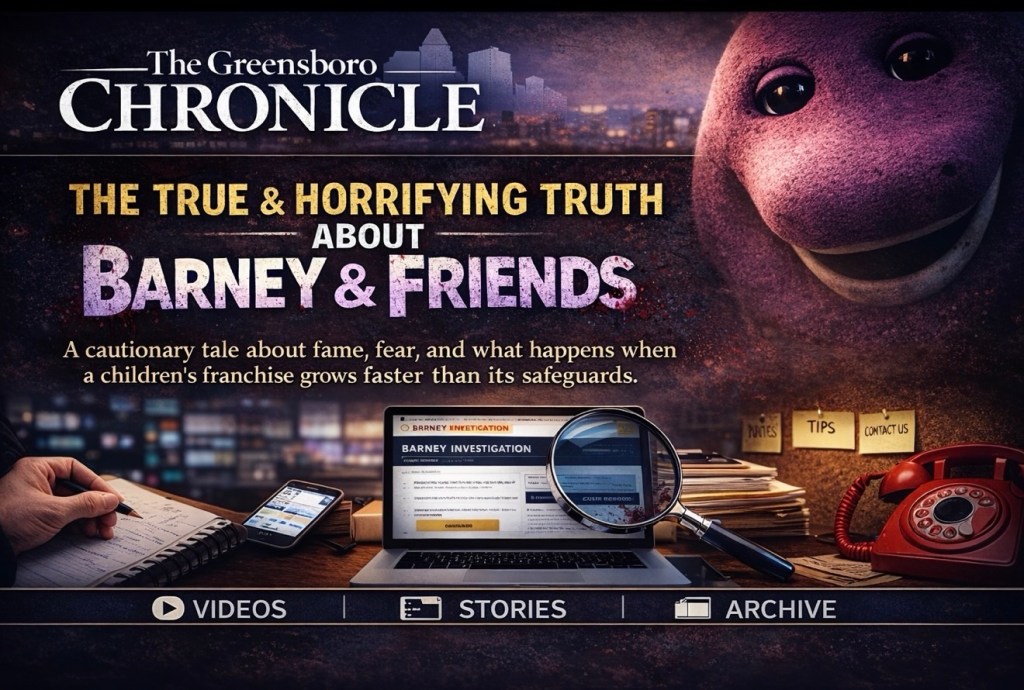
For millions of families, Barney & Friends was a pastel-colored refuge: gentle songs, big hugs, and lessons about kindness. But behind the purple smile sits a far more unsettling story—one pieced together from public court records, police reports, sworn testimony, and years of press coverage. This is not an urban legend. It’s a sober look at how a wholesome brand collided with real-world risks, how warning signs surfaced, and what the legacy looks like today.
How It Started: A Preschool Dream Becomes a National Machine
The concept was born in the late 1980s as Barney & the Backyard Gang, created by former teacher Sheryl Leach. Its core promise—safe, repetitive learning for toddlers—found a perfect home on PBS in 1992. Within a few years, the show was a merchandising juggernaut, licensed worldwide through HIT Entertainment.
That success brought speed. Auditions scaled. Live appearances multiplied. Touring casts expanded. And like many fast-growing children’s brands of the era, systems designed for a small local production were suddenly responsible for a national workforce—often part-time, rotating, and operating under uneven supervision standards common to the 1990s entertainment industry.

When Trouble Became Apparent: The Cracks No One Wanted to See
By the mid-1990s, the first serious alarms sounded—not about the show’s content, but about people around it.
Criminal cases that pierced the illusion
Public records confirm that multiple individuals associated with the broader Barney ecosystem (including former cast or affiliates, not the central production leadership) were later charged or convicted of violent crimes unrelated to the show’s storylines. These cases—widely reported at the time—created a chilling contrast between the brand’s innocence and the reality that performers are ordinary adults subject to the same risks and failures as anyone else.
Crucially, no evidence ever established that the program itself promoted harm, nor that its creators condoned misconduct. But the optics were devastating. Headlines don’t parse nuance; they juxtapose images. A smiling dinosaur beside a mugshot changes how parents feel—instantly.
Harassment, threats, and the darker side of fame
Court filings and sworn statements also document threats and stalking directed at people associated with the show, including performers. The costume that symbolized safety became a lightning rod. Law enforcement involvement increased. Security measures quietly expanded. None of this made it into the opening theme song—but it reshaped daily operations.
The Effect on the Series: From Open Arms to Locked Doors
As the 1990s wore on, the production hardened.
Audition and background-check procedures tightened, reflecting industry-wide changes after high-profile scandals elsewhere in children’s media. Public appearances became more controlled, with stricter access rules and less spontaneous interaction. Creative tone subtly shifted—fewer unscripted moments, more rigid staging, and clearer boundaries between cast and audience.
Ratings held for a time, but the cultural mood changed. Irony replaced earnestness. Barney became a punchline for older kids and teens—an edge sharpened by the unsettling news cycles that periodically resurfaced.
Court Records vs. Internet Myth: Separating Fact from Fear
It’s important to be precise:
Verified facts: There were real criminal prosecutions involving individuals once connected to the Barney brand in peripheral roles. There were documented threats and security incidents. These appear in public court dockets and police reports. Unverified myths: Viral claims of secret messages, cult symbolism, or coordinated abuse conspiracies tied to the show itself do not withstand scrutiny and are unsupported by evidence.
The danger lies in conflation. When fear fills gaps that facts don’t, misinformation spreads—often faster than corrections.
Where Do We Stand Now: Legacy, Lessons, and Accountability
Barney & Friends ended its original run in 2010. The character persists through reboots and reimaginings, but under a different cultural contract—one shaped by decades of hard lessons.
Today’s children’s productions operate with:
Mandatory background checks On-set child-safety officers Clear reporting pipelines Trauma-informed standards unthinkable in the early 1990s
Barney didn’t invent these reforms—but its history helped justify them.
The Real Horror Isn’t the Dinosaur
The unsettling truth isn’t that a children’s show was “evil.” It’s that good intentions don’t substitute for structural safeguards. When a brand built on trust grows too quickly, the cost of oversight failures is measured not just in lawsuits or ratings—but in shaken confidence.
In that sense, Barney & Friends is a warning. Not about purple dinosaurs—but about what happens when innocence becomes an industry.

Legal Disclaimer
This article is an investigative, educational, and journalistic analysis based on publicly available records, court filings, contemporaneous news reporting, and historical documentation. It does not allege wrongdoing by any individual or entity beyond what has been established in verified public sources. No claims are made beyond the evidentiary record. Readers are encouraged to consult original court documents and primary sources for full context.
Copyright
© 2026 The Greensboro Chronicle. All rights reserved.
No part of this article may be reproduced, distributed, or transmitted in any form or by any means without prior written permission from the publisher, except for brief quotations used for news reporting, scholarship, or review.


Leave a Reply