By The Greensboro Chronicle | Consumer & Legal Affairs
In North Carolina, many companies lose lawsuits—and public trust—not because of dramatic fraud or intentional wrongdoing, but because of something far simpler: they get the basics wrong at the beginning.
Under long-standing North Carolina legal doctrines, refusing payment, blocking compliance, misidentifying parties, or mishandling responsibility can transform an otherwise routine transaction into a legal and reputational disaster. These doctrines are not obscure loopholes. They are settled law, repeatedly enforced by courts, regulators, and insurers.
This article explains—in plain language—how the doctrines of Compliance Prevention, Refusal of Payment, Contributory Negligence, Vicarious Liability, and Respondeat Superior operate, and why businesses that ignore them often end up paying twice: once in court, and again in public credibility.
1. Compliance Prevention: When a Company Causes Its Own Violation
What it means:
A party cannot profit from preventing another party from complying with the law or a contract.
In North Carolina, if a business blocks, refuses, interferes with, or makes compliance impossible—and then claims breach, default, or violation—it has created what courts call compliance prevention.
Common examples include:
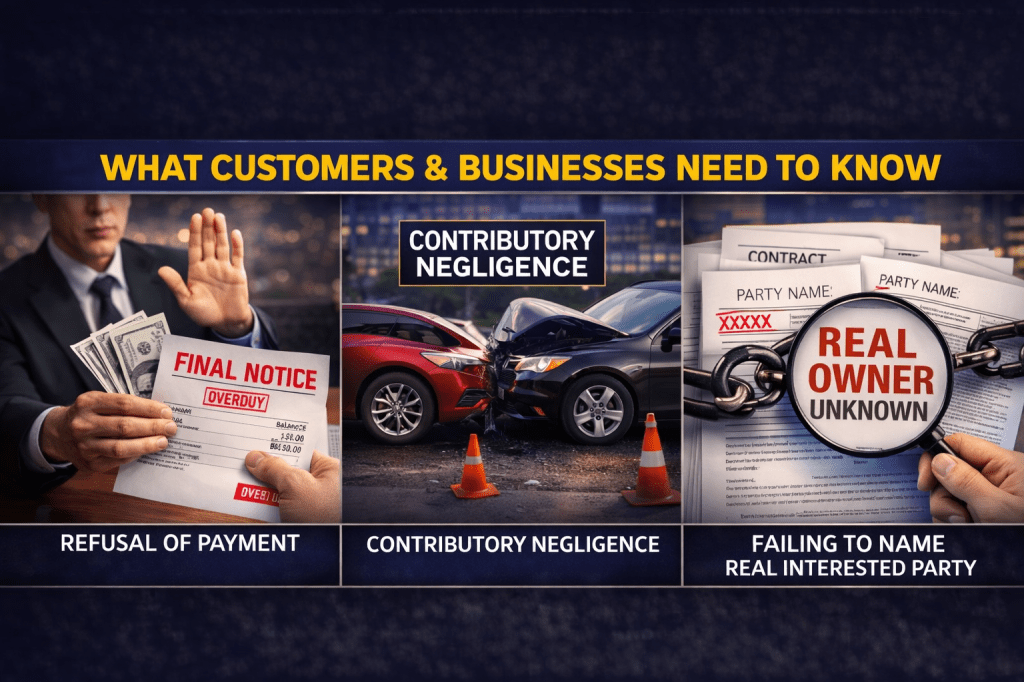
Refusing to accept timely payment, then declaring default Providing incomplete or misleading payment instructions Failing to identify the proper party to pay Ignoring written attempts to resolve or cure an issue
Why this backfires:
Courts view this as self-inflicted harm. Once compliance prevention is shown, the company’s claims often collapse entirely. Worse, evidence of prevention frequently supports consumer protection violations, fee-shifting, and punitive exposure.
Bottom line:
If a business slams the door on compliance, it cannot later complain that someone didn’t walk through it.
2. Refusal of Payment: The Quiet Trigger for Liability
What it means:
A business that refuses lawful, timely payment may forfeit its ability to claim nonpayment.
Under North Carolina law, a creditor or merchant generally cannot:
Reject payment, and Still claim the payer is in default
Why this matters:
Refusal of payment often becomes the linchpin fact that:
Defeats breach claims Undermines collection efforts Exposes the company to unfair or deceptive trade practice allegations
Even worse for businesses, written refusals, call logs, or recorded communications frequently become exhibits—not defenses.
In practice:
Many companies believe refusing payment strengthens leverage. In reality, it often destroys it.
3. Contributory Negligence: When One Mistake Bars Recovery
North Carolina remains one of the few states that still applies pure contributory negligence.
What it means:
If a party contributes even slightly to the harm it complains about, it may be barred from recovery entirely.
How businesses trip over this rule:
Giving incorrect instructions Failing to verify identities or ownership Sending contradictory communications Allowing internal confusion between departments or agents
If a company’s own conduct helps cause the dispute, courts may rule that the company caused its own loss.
Why insurers care:
Contributory negligence findings frequently trigger coverage disputes and reservation-of-rights letters—because preventable conduct is not the same as unavoidable risk.
4. Vicarious Liability: You Own What Your Agents Do
What it means:
Businesses are legally responsible for the acts of their agents when those acts occur within the scope of their work.
That includes:
Employees Contractors Collection agencies Servicers Property managers Vendors acting on the company’s behalf
A company cannot escape liability by saying:
“That wasn’t us—that was our vendor.”
If the vendor was acting for the business, the liability follows the business.
Real-world consequence:
Companies routinely discover too late that outsourcing misconduct does not outsource responsibility.
5. Respondent Superior: The Doctrine That Protects the Public
Closely related to vicarious liability, respondeat superior holds employers accountable for employee actions performed during employment.
Why courts enforce it strictly:
This doctrine exists to protect the public—not companies. The law assumes businesses are in the best position to:
Train workers Supervise conduct Prevent systemic abuse
When companies fail to do so, courts do not excuse the harm—they assign it.
How Companies End Up “Handing Over Money”
When these doctrines combine, the result is predictable:
A business refuses payment or blocks compliance An agent or employee escalates improperly The wrong party is named or identified The company’s own conduct contributes to the dispute Liability attaches automatically under agency law Defense costs rise Insurers push for settlement Reputational harm follows
At that point, many cases are resolved not because the company was “wrong,” but because it can no longer prove it was right.
What Customers Should Verify from the Start
Consumers and businesses alike should document and verify the following early—before disputes arise:
Who is the real, legally interested party? Who is authorized to accept payment? What methods of payment are permitted? Are payment refusals documented? Are communications consistent and traceable? Are agents properly identified and supervised?
Paper trails protect both sides—but only if they exist before conflict begins.
Why This Matters Now
As regulators, courts, and consumers become more sophisticated, sloppy compliance is no longer invisible. Routine business shortcuts increasingly appear in court filings, investigative reports, and public records.
The companies most at risk are not always the biggest offenders—but often the ones who assume:
“This is how it’s always been done.”
In North Carolina, that assumption can be very expensive.
Legal Disclaimer
This article is provided for informational and educational purposes only and does not constitute legal advice. Reading this article does not create an attorney-client relationship. Laws and interpretations may change, and readers should consult a licensed North Carolina attorney regarding specific legal questions or situations.
Copyright & Publication Notice
© 2026 The Greensboro Chronicle. All rights reserved.
No portion of this article may be reproduced, distributed, or republished without express written permission, except for brief quotations used for commentary, criticism, or news reporting consistent with fair-use principles.
 Greensboro Chronicle
Leave a comment