By The Greensboro Chronicle | Consumer & Legal Affairs
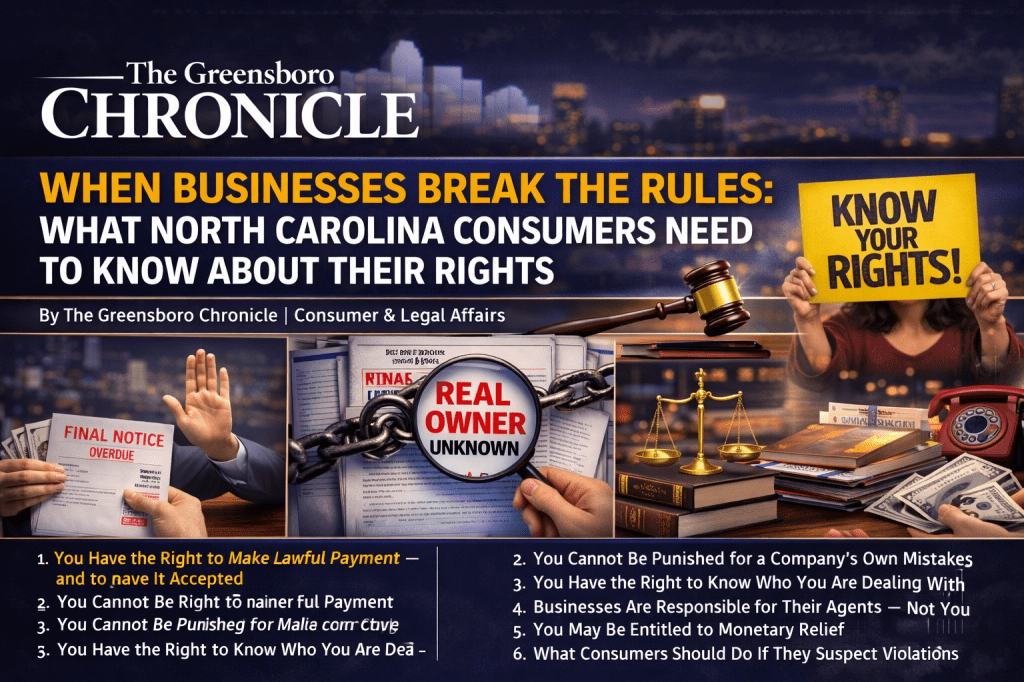
When a company refuses payment, blocks compliance, misidentifies who actually owns a debt or account, or allows its agents to act improperly, consumers often assume they are powerless.
That assumption is wrong.
North Carolina law provides meaningful protections and remedies when businesses engage in prohibited conduct such as compliance prevention, wrongful payment refusal, contributory negligence, or agency misconduct. These protections exist not to punish commerce—but to ensure fairness, accountability, and transparency.
This article explains, in plain language, what your rights are, what relief may be available, and what steps matter most when a business crosses legal lines.
1. You Have the Right to Make Lawful Payment — and to Have It Accepted
If you tender timely, lawful payment using an authorized method, a business generally cannot refuse it and then penalize you.
If a company:
Rejects payment without legal justification Fails to provide clear payment instructions Creates barriers that make payment impossible
you may have defenses against:
Default claims Collection efforts Late fees and penalties Adverse credit reporting
In some circumstances, wrongful refusal of payment becomes evidence of unfair or deceptive conduct.
What you may be entitled to:
Reversal of claimed default Removal of penalties Correction of account status Compensation if harm resulted
2. You Cannot Be Punished for a Company’s Own Mistakes
Under North Carolina law, a business cannot cause a problem and then blame you for it.
If a company’s actions contributed to the situation—by:
Giving conflicting instructions Naming the wrong party Failing to respond to cure attempts Interfering with compliance
that conduct may bar the company from recovery and shift responsibility back to the business.
Consumer protection laws recognize this as unfair conduct, particularly when the consumer acted in good faith.
3. You Have the Right to Know Who You Are Dealing With
One of the most common—and most serious—violations involves failing to identify the real interested party.
Consumers have the right to know:
Who actually owns the account or debt Who has legal authority to collect or enforce Whether an agent is acting on behalf of someone else
If a business or collector cannot clearly identify the real party in interest, its claims may be legally defective.
Potential consumer remedies include:
Dismissal of improper claims Challenges to enforcement actions Recovery of damages for misrepresentation
4. Businesses Are Responsible for Their Agents — Not You
Consumers are not required to untangle corporate relationships.
If a company’s:
Employee Contractor Servicer Property manager Collection agency
acts improperly while performing company business, the company remains responsible.
This means consumers may pursue remedies against the business itself, even if the misconduct was carried out by a third party.
5. You May Be Entitled to Monetary Relief
Depending on the facts, consumers may be entitled to:
Actual damages Statutory damages Recovery of improperly collected amounts Compensation for emotional distress (where supported) Attorney’s fees and costs (in qualifying cases)
In North Carolina, unfair or deceptive trade practices may also allow enhanced damages in certain circumstances.
Importantly, entitlement depends on evidence, timing, and how the conduct is documented.

6. Documentation Is Your Strongest Protection
Consumers who succeed in enforcing their rights usually do one thing well: they document everything.
Helpful records include:
Payment attempts and receipts Written refusals Emails, letters, and notices Call logs and recordings (where lawful) Screenshots and account statements
Documentation often determines whether a dispute becomes a quick correction—or a costly legal fight.
7. What Consumers Should Do If They Suspect Violations
If you believe a business has engaged in prohibited conduct:
Do not ignore the issue Preserve all communications Request written clarification Avoid verbal-only resolutions Seek qualified legal guidance early
Silence or delay often benefits the party that created the problem.
Why These Rights Matter
These protections exist because compliance failures harm more than individual consumers. They undermine trust, distort markets, and reward careless or abusive practices.
North Carolina law places responsibility where it belongs—on the party with power, information, and control.
When consumers understand their rights, unlawful conduct becomes harder to hide.
Legal Disclaimer
This article is provided for general informational purposes only and does not constitute legal advice. Reading this article does not create an attorney-client relationship. Laws vary by circumstance, and readers should consult a licensed North Carolina attorney regarding specific legal questions or disputes.
Copyright & Publication Notice
© 2026 The Greensboro Chronicle. All rights reserved.
This publication may not be reproduced, distributed, or republished in whole or in part without prior written permission, except for brief quotations used in news reporting, commentary, or criticism consistent with fair-use principles
 Greensboro Chronicle
Leave a comment