
An inquisitive, boldly cautionary examination of a children’s icon that unsettled a generation
In the mid-1980s, living rooms across America welcomed a plush storyteller designed to read bedtime tales and teach gentle lessons. Parents saw innovation. Marketers saw magic. Children, however, often saw something else entirely.
For many, Teddy Ruxpin wasn’t comforting. He was unsettling—sometimes terrifying. Decades later, adults still swap stories about racing out of dark rooms, unplugging cassette players mid-sentence, or waking to the sound of a mechanical voice continuing a story long after it should have stopped.
This article explores why Teddy Ruxpin became feared—not as folklore, but as a convergence of technology limits, psychological triggers, and a cultural moment that underestimated how children actually perceive “friendly” machines.

The Promise vs. the Reality
Teddy Ruxpin debuted as a breakthrough: an animatronic toy that synchronized mouth and eye movements to cassette tapes. The goal was intimacy—stories told to the child, not at them.
But intimacy requires trust. And trust is fragile when a toy doesn’t quite behave like a toy—or a living thing.
Children expected warmth and predictability. What they often got instead was something that hovered in an uncomfortable in-between state: not alive, not inert.
The Uncanny Valley Effect (Before We Had the Name)
Long before “uncanny valley” became common language, Teddy Ruxpin lived there.
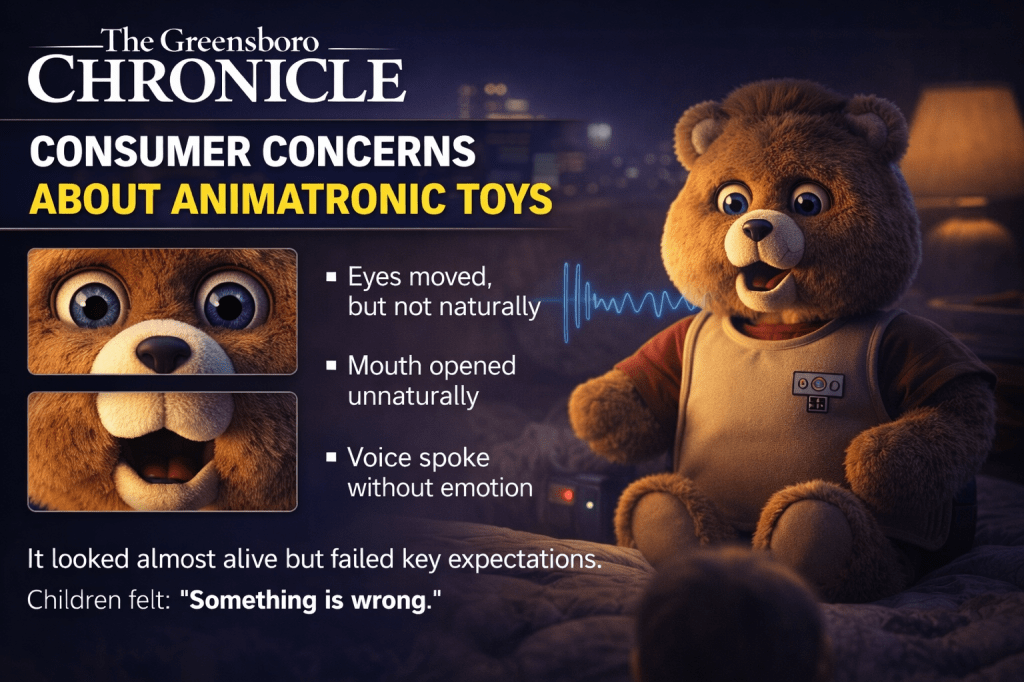
His eyes moved, but not smoothly His mouth opened, but not naturally His voice spoke, but without emotional cadence
Human brains—especially developing ones—are extremely sensitive to faces and voices. When something looks almost alive but fails key expectations, the brain interprets it as a threat.
Children didn’t think, “This toy is malfunctioning.”
They felt, “Something is wrong.”
That feeling sticks.
Mechanical Failures That Felt Supernatural
Publicly documented user experiences and product reviews from the era repeatedly describe:
Tape desynchronization, causing delayed or mismatched speech Motor wear, producing grinding or clicking sounds Eyes opening without sound when tapes jammed Stories continuing after power switches failed
To an adult, these are mechanical issues.
To a child in a dark room, they’re proof the bear is alive—and not obeying rules.
Fear thrives when cause and effect break down.

Nighttime + Voice = Vulnerability
Teddy Ruxpin wasn’t a daytime toy. He was marketed for bedtime.
That matters.
Bedtime is when:
Lights are low Imagination is high Cognitive defenses are tired
A disembodied voice emerging from a plush figure, especially one that doesn’t blink or emote correctly, can easily override a child’s sense of safety.
Many parents later admitted they didn’t witness the fear—because it happened after the door closed.
Loss of Control: The Hidden Trigger
Traditional toys stop when you stop playing.
Teddy Ruxpin did not.
Once the cassette rolled, the child was no longer in control. They couldn’t interrupt easily. They couldn’t predict pauses. They couldn’t make it stop without adult help.
Psychologists note that loss of agency is one of the fastest ways to induce fear in children. Teddy Ruxpin unintentionally embodied that loss.

Cultural Timing Made It Worse
The 1980s were filled with public anxiety about:
Automation entering homes Talking machines replacing human interaction Technology behaving unpredictably
Against that backdrop, a talking bear with moving eyes wasn’t neutral. It symbolized something adults were excited about—but children weren’t ready for.
In hindsight, Teddy Ruxpin arrived too early for the emotional maturity of both the technology and its audience.
Why the Fear Lasted
What makes Teddy Ruxpin different from other “creepy toy” stories is longevity.
People remember:
Where they were How old they were What the voice sounded like The exact moment fear set in
That’s because early childhood fear, especially when mixed with confusion rather than danger, imprints deeply. The brain doesn’t file it as “memory.” It files it as warning.
A Cautionary Lesson, Not a Villain
Teddy Ruxpin was not malicious. He was ambitious.
He represents what happens when:
Technology moves faster than emotional design Adults project comfort onto children without listening “Innovative” replaces “developmentally appropriate”
Modern designers study these failures carefully now. User-centered design exists because of toys like Teddy Ruxpin—not in spite of them.
Final Thought
Fear doesn’t require harm.
It only requires uncertainty, vulnerability, and silence when something feels wrong.
Teddy Ruxpin didn’t mean to scare a generation.
But he taught one a lasting lesson:
If something talks to children, it must first understand them.

Legal Disclaimer — The Greensboro Chronicle
This article is published for informational, historical, and educational purposes only. The Greensboro Chronicle does not allege criminal conduct, intent, or wrongdoing by any manufacturer, distributor, or individual referenced herein. All observations reflect publicly reported information, documented consumer experiences, cultural analysis, and commentary protected under the First Amendment. Interpretations are presented in good faith and do not constitute product safety claims, psychological diagnoses, or legal conclusions.
Copyright Notice
© 2026 The Greensboro Chronicle.
All rights reserved. No portion of this publication may be reproduced, distributed, transmitted, or republished in any form without prior written permission, except for brief quotations used with proper attribution for news reporting, commentary, or educational purposes.
 Greensboro Chronicle
Leave a comment