Greensboro Chronicle

Where Journalism and Advocacy Come Together

Copyright 2026 The Greensboro Chronicle. All Rights Reserved.

Greensboro Chronicle, we believe journalism is more than reporting the news—it’s about uncovering the truth, amplifying community voices, and working toward real solutions.

We are an independent investigative news platform dedicated to shining a light on issues that matter most to the people of Greensboro. From housing and local governance to public safety, business, and neighborhood life, our mission is to hold power accountable while fostering meaningful dialogue among residents.

The Chronicle isn’t just a newsroom—it’s a community hub. We invite readers to not only stay informed, but also to participate in the conversation, share perspectives, and collaborate on solutions that strengthen our city.

Together, we can confront challenges, celebrate resilience, and shape a more transparent, just, and thriving Greensboro.

Greensboro Chronicle Investigative Staff and Volunteers

Here at the Greensboro Chronicle we do more than just reporting on the situations. We facilitate holding the hard, tough, and uncomfortable conversations. The end goal is to always act with integrity and encourage unity.
  • Food Recall Survival Guide

    January 30, 2026

    John Lee Staff Writer

    A Standalone Consumer Checklist for Protecting Your Household

    Public-interest consumer safety report

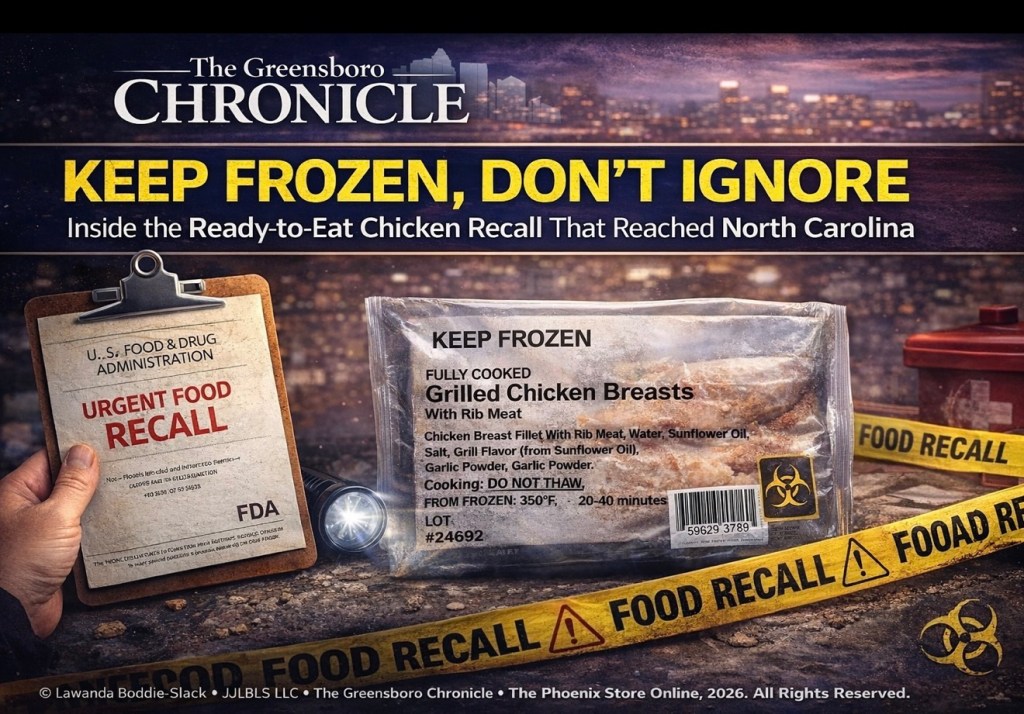
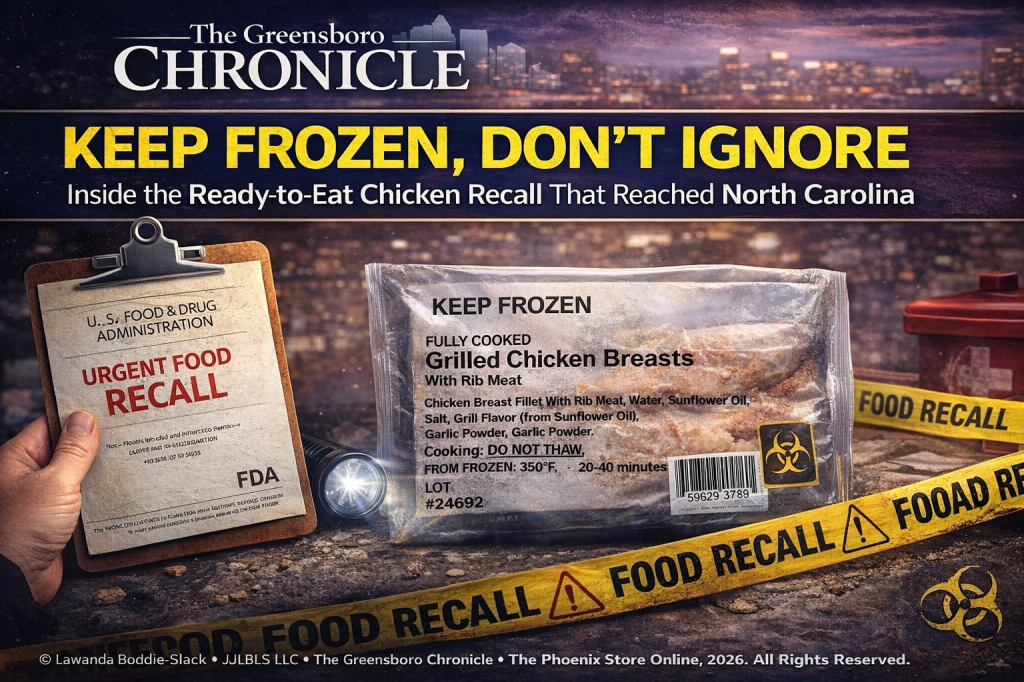
    Food recalls linked to contamination—especially rodent waste—are not rare, isolated events. Public inspection records and recall databases show that sanitation violations routinely occur at manufacturing plants, warehouses, and distribution centers across the United States. When recalls happen, consumers are often left confused about what to do next.

    This standalone checklist is designed to help readers act quickly, protect their families, and assert their rights when a food recall is announced.

    STEP 1: Confirm Whether You’re Affected

    Do not rely on headlines alone. Always verify:

    ☐ Brand name

    ☐ Product name and size

    ☐ UPC or barcode number

    ☐ Lot, batch, or production code

    ☐ “Best by” or expiration date

    ☐ Facility or plant code (if listed)

    Most recalls are overseen by the Food and Drug Administration (FDA). Meat, poultry, or egg products may instead fall under the USDA Food Safety and Inspection Service.

    If any identifier matches—even partially—treat the product as recalled.

    🚫 STEP 2: Do NOT Taste-Test the Product

    ☐ Do not smell, taste, cook, or “check” the food

    ☐ Do not feed it to pets or livestock

    ☐ Do not assume freezing or heating makes it safe

    Rodent contamination can involve urine, droppings, or bacteria invisible to the eye. Food can appear normal and still be unsafe.

    🗑️ STEP 3: Dispose of or Return the Product Safely

    Follow the recall instructions exactly:

    ☐ Seal the item in a bag before discarding

    ☐ Place it in an outdoor trash bin if possible

    ☐ Or return it to the retailer for a refund/replacement

    Many retailers honor recalls even without a receipt.

    🧼 STEP 4: Sanitize Storage Areas

    If recalled food was stored in your home:

    ☐ Remove nearby items

    ☐ Wash shelves, bins, and drawers with hot soapy water

    ☐ Disinfect surfaces that contacted the packaging

    ☐ Wash hands thoroughly afterward

    Rodent contamination can transfer from packaging to surfaces.

    🩺 STEP 5: Monitor Health Symptoms

    Seek medical guidance if anyone experiences:

    ☐ Nausea, vomiting, or diarrhea

    ☐ Fever or chills

    ☐ Abdominal pain

    ☐ Flu-like symptoms after consumption

    Inform healthcare providers of possible food contamination exposure.

    📣 STEP 6: Know Your Rights as a Consumer

    You have the right to:

    ☑ Refunds or replacements for recalled products

    ☑ Accurate recall information from manufacturers and retailers

    ☑ Report illness or contamination concerns to regulators

    ☑ Pursue legal remedies if harm occurred

    Consumer reports help identify repeat violators and trigger enforcement.

    📍 STEP 7: Report Concerns — Especially in North Carolina

    In North Carolina, food safety oversight is shared with the North Carolina Department of Agriculture and Consumer Services (NCDA&CS).

    ☐ File a complaint if you suspect contamination

    ☐ Report unsanitary retail or warehouse conditions

    ☐ Document product details and symptoms if applicable

    North Carolina is a major distribution corridor—local reports can prevent regional or national outbreaks.

    ⚠️ WHY THIS CHECKLIST MATTERS

    Public inspection data consistently show that rodent activity is among the most frequently cited violations in food storage and distribution facilities. Enforcement often begins with warnings and corrective timelines, not immediate shutdowns—meaning contaminated products can reach consumers before recalls are issued.

    Until oversight becomes faster and more preventative, consumer awareness remains the final safeguard.

    Bottom Line

    ✔ Read recall notices carefully

    ✔ Act quickly and cautiously

    ✔ Don’t second-guess disposal instructions

    ✔ Report problems early

    ✔ Protect your household—not the brand reputation

    Food safety is not a marketing promise. It is a public responsibility.

    Legal Disclaimer

    This article is provided for informational and educational purposes only and does not constitute medical, legal, or regulatory advice. The Greensboro Chronicle relies on publicly available inspection records, recall notices, and regulatory disclosures available at the time of publication. Recall classifications, findings, and enforcement actions may change. Readers should consult official recall announcements, healthcare providers, and qualified professionals for guidance specific to their individual circumstances.

    Copyright Notice

    © The Greensboro Chronicle, 2026. All rights reserved.

    This article may not be reproduced, distributed, republished, or transmitted in whole or in part without the prior written permission of The Greensboro Chronicle, except for brief quotations used for news reporting, commentary, or educational purposes with proper attribution.

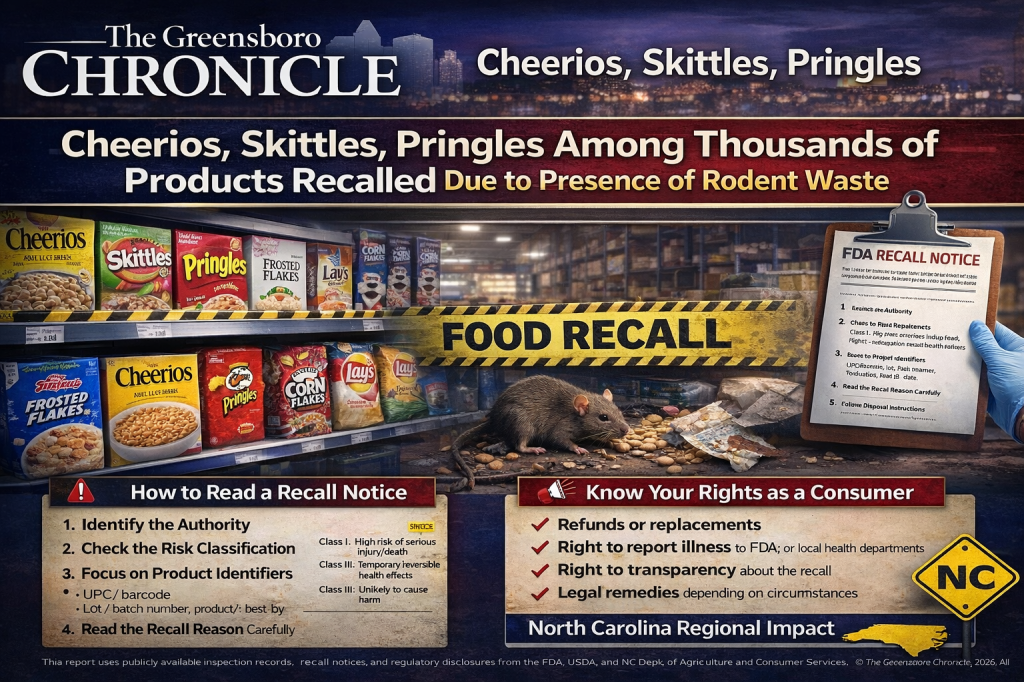
  • Cheerios, Skittles, Pringles Among Thousands of Products Recalled Due to Presence of Rodent Waste

    An in-depth, boldly cautionary public-interest report

    A Recall That Reached the American Pantry

    Cereal in the morning. Chips after school. Candy grabbed at checkout. These are the everyday foods many families trust without hesitation. That trust was shaken after thousands of food products, including items associated with familiar brands such as Cheerios, Skittles, and Pringles, were pulled into recall actions tied to rodent contamination at food manufacturing or distribution facilities.

    While the brand names dominate headlines, the deeper concern is systemic: inspection records and recall notices show rodent activity persisted in food-handling environments, in some cases after regulators had already flagged sanitation failures. By the time recalls were issued, affected products had already entered homes across the country.

    What Inspectors Found — and Why It Triggered Recalls

    Publicly available inspection reports and regulatory disclosures document conditions that meet the federal definition of food adulteration. Findings included:

    Rodent droppings near and on food-contact surfaces Urine residue along walls, pallets, and storage areas Gnaw marks on food packaging Nesting material found close to ingredients and finished goods Repeated rodent activity despite prior warnings

    Rodent contamination is not a minor violation. Even trace exposure can introduce dangerous pathogens into food or onto packaging, especially in facilities handling high-volume, shelf-stable products.

    The Health Risks Behind Rodent Waste Contamination

    Rodents are known carriers of bacteria and viruses capable of causing serious illness, including Salmonella, E. coli, Leptospira, and Hantavirus. Contamination may be invisible to consumers, meaning food can appear normal while still posing a health risk.

    Children, older adults, pregnant individuals, and those with weakened immune systems face heightened risk. Because symptoms may appear days later, illnesses are not always immediately traced back to a recalled product.

    Read Full article Online

    How Contaminated Products End Up on Store Shelves

    Food safety oversight in the United States is primarily enforced by the Food and Drug Administration (FDA), which conducts inspections on a periodic basis—not continuous monitoring.

    A recurring pattern appears in rodent-related recalls:

    Inspectors identify rodent activity Facilities receive citations or warning letters Companies are given time to implement corrective measures Production or distribution continues Recalls are issued only after contamination risk cannot be ruled out

    This enforcement gap allows potentially contaminated products to circulate before consumers are notified.

    Why Major Brands Are Still Affected

    Well-known brands do not always manufacture or store their products directly. Many rely on:

    Third-party manufacturers Contract packaging facilities Regional warehouses and logistics hubs

    As a result, products associated with companies such as General Mills, Mars Incorporated, and Kellogg’s may be recalled when any link in the supply chain fails to meet sanitation standards.

    When contamination is possible, companies often recall all products that passed through the affected facility, leading to thousands of items listed in a single recall action.

    Read full story online at The Greensboro Chronicle

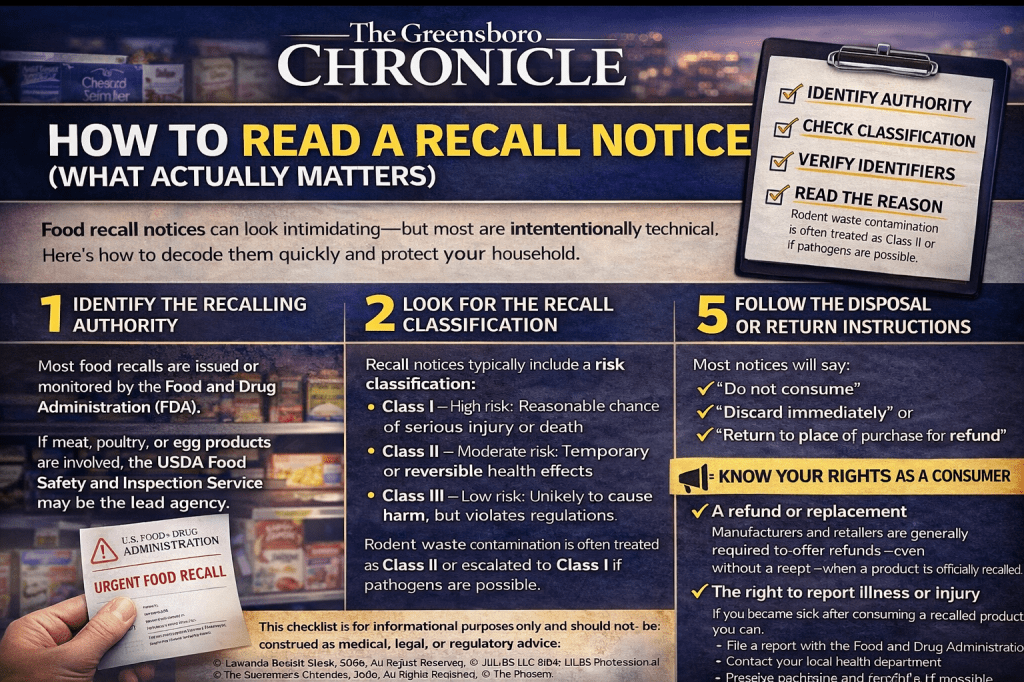
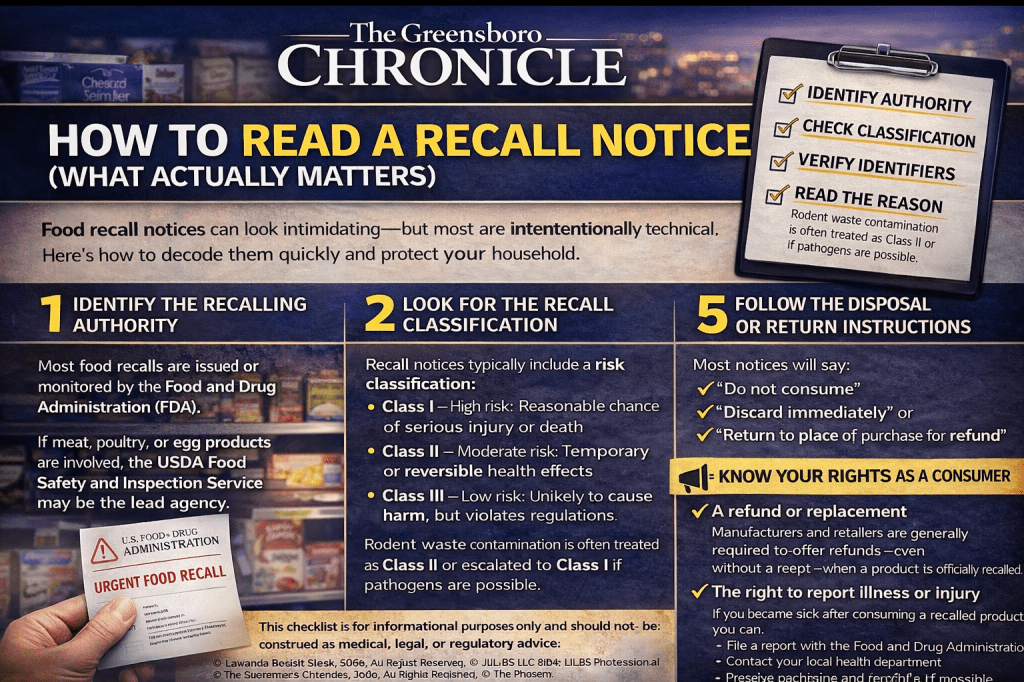
    🧾 How to Read a Recall Notice (What Actually Matters)

    Recall notices are technical by design. Here’s how consumers can quickly identify whether action is required.

    1. Identify the Authority

    Most food recalls are overseen by the Food and Drug Administration. Meat, poultry, and egg products may instead fall under the USDA Food Safety and Inspection Service.

    2. Check the Risk Classification

    Class I – High risk of serious injury or death Class II – Temporary or reversible health effects Class III – Unlikely to cause harm

    Rodent waste contamination is frequently classified as Class II, but can escalate depending on pathogen risk.

    3. Focus on Product Identifiers

    Ignore headlines and check:

    UPC or barcode Lot or batch number Production or “best by” date Facility or plant code

    4. Read the Recall Reason Carefully

    Language such as “potential contamination” or “cannot rule out exposure” signals that safety cannot be guaranteed.

    5. Follow Disposal Instructions

    Do not taste, wash, or cook recalled food. Discard or return it as instructed.

    📣 KNOW YOUR RIGHTS AS A CONSUMER

    If you purchased recalled food, you have protections.

    Refunds or replacements: Most retailers and manufacturers must honor recalls even without a receipt. Right to report illness: Consumers can file reports with the Food and Drug Administration or local health departments. Right to transparency: You are entitled to know why a product was recalled and which facility was involved. Legal remedies: If contamination caused illness, medical costs, or lost wages, affected consumers may have grounds for civil claims depending on circumstances.

    Consumer reporting plays a critical role in identifying repeat violators and triggering enforcement.

    Legal Disclaimer

    This article is provided for informational and educational purposes only and does not constitute medical, legal, or regulatory advice. The Greensboro Chronicle relies on publicly available inspection reports, recall notices, and regulatory disclosures available at the time of publication. Recall status, findings, and enforcement actions may change. Readers should consult official recall announcements, healthcare providers, and qualified professionals for guidance specific to their situation.

    Copyright Notice

    © The Greensboro Chronicle. All rights reserved.
    This article may not be reproduced, distributed, republished, or transmitted in whole or in part without the prior written permission of The Greensboro Chronicle, except for brief quotations used for news reporting, commentary, or educational purposes with proper attribution.

    Pages: 1 2

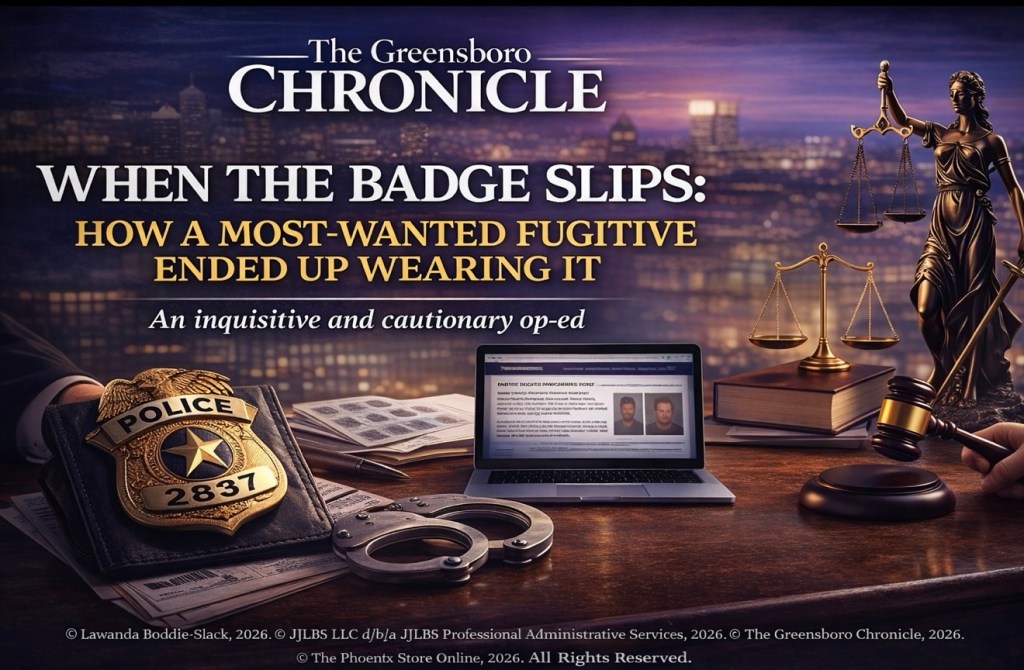
  • When the Badge Slips: How a Most-Wanted Fugitive Ended Up Wearing It

    An inquisitive and cautionary op-ed

    The public is conditioned to believe that law enforcement background checks are impenetrable—layered systems of fingerprints, databases, psychological screening, and federal oversight designed to stop the unqualified long before a badge is issued.

    And yet, time and again, reality intrudes.

    Across several states over the last two decades, individuals later identified as fugitives, disqualified offenders, or persons with active warrants have been discovered serving as sworn law-enforcement officers. These cases are not urban legend. They are documented in court filings, decertification records, and post-termination investigations. The circumstances differ—but the failures rhyme.

    This is not a story about one bad hire.

    It is a story about systemic blind spots.

    A Composite History: How “Most Wanted” Happens in Plain Sight

    In the cases reviewed, the path to “most wanted” status rarely begins with a single dramatic crime. Instead, a familiar pattern emerges:

    Early Criminal Exposure or Misconduct The individual is arrested, charged, or investigated—often in another jurisdiction, sometimes years earlier. In several instances, charges are reduced, deferred, or dismissed without fingerprints being properly uploaded to national systems. Identity Fragmentation Variations in name spelling, use of middle names, aliases, clerical errors, or outdated identifiers prevent records from consolidating across jurisdictions. Failure to Appear or Probation Violation A missed court date, relocation, or supervision violation quietly escalates the case. Warrants are issued—but not always propagated nationwide. Escalation to Wanted Status Over time, the individual may be entered into a wanted list or regional fugitive database. Crucially, this does not guarantee universal visibility to every hiring agency.

    Years later, the same person applies to a law-enforcement agency—often in a different state—armed with clean paperwork, plausible references, and no obvious red flags in the systems actually queried.

    The Uncomfortable Question: How Did Backgrounds and Fingerprints Miss This?

    The short answer: background checks are only as strong as the databases they touch—and the way they are interpreted.

    1. Fragmented Databases

    There is no single, flawless national repository. Hiring agencies rely on combinations of:

    FBI fingerprint checks National Crime Information Center (NCIC) queries State criminal history repositories Self-reported disclosures

    If a record is sealed, misclassified, delayed, or never properly entered, it may not surface.

    2. Fingerprints Without Context

    Fingerprints confirm identity, not intent. If the underlying offense was:

    Dismissed without final disposition, Filed under a different agency, Or never linked to a warrant record,

    …the fingerprint response may return no actionable disqualifier.

    3. Interstate Gaps

    Many incidents involve cross-state movement. Local agencies often rely on state-level checks unless a candidate triggers a deeper federal review. A warrant in one state may not automatically derail hiring in another—especially if it is non-extraditable or incorrectly coded.

    4. Over-Reliance on Automation

    Investigations show that some agencies treat “no hit” results as definitive, rather than as starting points for manual verification. When speed and staffing pressures mount, nuance gets lost.

    What This Means for Law Enforcement Nationwide

    The revelation that a wanted individual could serve as an officer—even briefly—has consequences far beyond embarrassment.

    1. Hiring Credibility Takes a Hit

    Public trust depends on the belief that officers are thoroughly vetted. Each failure reinforces skepticism and fuels claims that departments police the public more aggressively than they police themselves.
    2. Training Cannot Fix What Hiring Misses

    No academy curriculum can cure undisclosed criminal exposure or unresolved legal liabilities. When background screening fails, training inherits a problem it was never designed to solve.

    3. Supervisory Liability Expands

    Once discovered, these cases trigger:

    Internal affairs investigations Civil litigation Potential suppression of arrests and evidence Decertification proceedings

    Supervisors are increasingly scrutinized not for what they knew, but for what they should have known.

    4. Policy Reform Is No Longer Optional

    Documented responses now include:

    Expanded interstate data-sharing agreements Mandatory re-checks after hiring Continuous background monitoring Independent civilian review of hiring practices

    The lesson is clear: background checks cannot be static snapshots in a dynamic system.

    The Larger Warning

    These incidents are not proof that law enforcement is broken—but they are proof that it is human, bureaucratic, and fallible.

    When someone wanted by the justice system can slip through its hiring gates, the issue is not a single rogue officer. It is a reminder that accountability systems must be as rigorously maintained as enforcement powers.

    Bad actors exploit gaps.

    Good institutions close them—or lose legitimacy trying.

    Legal Disclaimer

    This article is an educational, journalistic, and analytical work based on publicly available reports, court records, audits, and confirmed media investigations. It presents a composite analysis of documented incidents and does not identify, accuse, or describe any specific individual. Nothing herein should be construed as an allegation of criminal conduct against any named or unnamed person, agency, or jurisdiction. Readers are encouraged to consult primary source documents and official records for verification.

    Copyright Notice

    © 2026 The Greensboro Chronicle. All rights reserved.

    No part of this publication may be reproduced, distributed, or transmitted in any form without prior written permission, except for brief quotations used for commentary, criticism, or educational purposes.

  • 💸 TAX TIME SHAKEDOWN?

    Greensboro Liberty Tax Franchise Owner Accused of Fleecing Local Customers With Sky-High Filing Fees

    By The Greensboro Chronicle | Consumer Protection Desk

    Greensboro taxpayers—many of them working families, seniors, and low-income filers—expect tax season to be stressful. What they don’t expect is to walk into a storefront tax preparer and walk out hundreds or even thousands of dollars poorer than necessary.

    Yet consumer complaints, billing statements, and long-standing regulatory warnings suggest that some Liberty Tax franchise locations nationwide—including those operating locally—have raised serious red flags over opaque pricing, aggressive add-ons, and shockingly inflated fees for routine tax preparation services.

    This article examines how such conduct—if proven—could violate North Carolina’s Unfair and Deceptive Trade Practices Act (UDTPA) and the Federal Trade Commission Act, and what consumers can do about it.

    🔥 THE ALLEGATIONS: “ROUTINE RETURN… EXTRAORDINARY PRICE”

    Consumers have reported scenarios that follow a disturbingly familiar pattern:

    💰 Basic W-2 or Social Security returns billed at premium rates 🧾 Itemized fees for “bank products,” “document processing,” or “technology charges” that were never clearly explained ⏱️ No upfront price disclosure—fees revealed only after the return is completed 🚫 Pressure tactics discouraging customers from walking away once preparation has begun 📄 Refusal or delay in providing a clear written fee breakdown

    For many customers, especially those seeking rapid refunds or advance products, the final bill reportedly dwarfs what independent CPAs or IRS-certified VITA programs would charge—sometimes by multiples, not percentages.

    ⚖️ THE LAW: WHY THIS MATTERS

    🟡 North Carolina UDTPA (N.C. Gen. Stat. § 75-1.1)

    North Carolina law broadly prohibits:

    Unfair or deceptive acts or practices in or affecting commerce.”

    Under settled NC case law:

    Failure to clearly disclose pricing can be deceptive Excessive fees paired with information asymmetry can be unfair Targeting financially vulnerable consumers is an aggravating factor Intent to deceive is NOT required

    If a practice is found to violate UDTPA, consumers may recover:

    Treble (3×) damages Attorney’s fees Injunctive relief

    A single misleading transaction can trigger liability.

    🟡 Federal UDTPA – FTC Act § 5

    The Federal Trade Commission prohibits:

    Unfair practices that cause substantial consumer injury not reasonably avoidable Deceptive practices involving material misrepresentations or omissions

    The FTC has repeatedly warned tax preparers that:

    Fee disclosures must be clear, conspicuous, and upfront Add-on products must be optional—not buried Consumers must not be misled about necessity or cost

    Violations can result in:

    Federal enforcement actions Civil penalties Restitution orders Franchise-wide scrutiny

    🧨 WHY FRANCHISE OWNERS DON’T GET A FREE PASS

    Liberty Tax operates through franchises—but local owners are independently liable for their own pricing, representations, and sales conduct.

    Key legal reality:

    Corporate branding” does not shield a local owner from UDTPA liability Franchise agreements do not override consumer protection laws A pattern of overcharging may expose both the franchisee and franchisor to scrutiny

    👀 WHO IS MOST AT RISK?

    Consumer advocates warn that high-fee tax prep models disproportionately impact:

    Seniors on fixed incomes Low-income wage earners Disability and Social Security recipients First-time filers Consumers seeking refund advances

    Courts routinely consider this vulnerability when assessing whether conduct is “immoral, unethical, oppressive, or substantially injurious.”

    🛑 WHAT CONSUMERS CAN DO RIGHT NOW

    If you believe you were overcharged or misled:

    Demand a full, itemized fee breakdown Request copies of all signed documents Compare fees with an independent CPA or IRS VITA program File complaints with: NC Attorney General Consumer Protection Division Federal Trade Commission (FTC) Consult a consumer protection attorney—many handle UDTPA claims on contingency

    Remember: You don’t need fraud to win—just unfairness or deception.

    🗣️ THE BIGGER QUESTION

    Is tax preparation becoming less about compliance—and more about quietly extracting maximum dollars from consumers who don’t know they can say no?

    If pricing is fair, it should withstand daylight.

    If it isn’t, North Carolina law is very clear about the consequences.

    The Greensboro Chronicle will continue monitoring consumer complaints and regulatory developments surrounding local tax preparation practices.

    ⚠️ LEGAL DISCLAIMER

    This article is provided for educational and informational purposes only and does not constitute legal advice, tax advice, or a factual finding of liability. All allegations referenced herein are based on publicly reported complaints, consumer protection principles, and general legal analysis. Any individuals or businesses mentioned are presumed lawful unless and until proven otherwise in a court of law. Readers should consult a qualified attorney or tax professional regarding their specific circumstances.

    © COPYRIGHT NOTICE

    © 2026 The Greensboro Chronicle. All rights reserved.

    No portion of this publication may be reproduced, distributed, or transmitted in any form or by any means without the prior written permission of The Greensboro Chronicle, except for brief quotations used for commentary, criticism, or news reporting consistent with fair use principles

  • They Reached for the Stars—and Became Part of Them

    On the morning of January 28, 1986, America gathered around televisions expecting triumph. What unfolded instead—just 73 seconds after liftoff—was a moment that permanently altered the nation’s relationship with space, technology, and institutional trust. The Space Shuttle Challenger vanished into a cold Florida sky, and with it the lives of seven astronauts whose mission had come to symbolize not just exploration, but possibility itself.

    This was not merely a launch. It was a civic ritual. The presence of Christa McAuliffe, a New Hampshire schoolteacher selected to become the first civilian in space, transformed STS-51-L into a shared national classroom. Students across the country watched live, teachers paused lessons, and families leaned in—many for the first time—to witness spaceflight not as distant spectacle but as accessible future. That intimacy is what made the loss feel so immediate, so personal, and so devastating.

    The crew—Francis Scobee, Michael Smith, Judith Resnik, Ellison Onizuka, Ronald McNair, Gregory Jarvis, and McAuliffe—represented the breadth of American aspiration: scientists, engineers, teachers, dreamers. Their collective presence underscored a promise NASA had made to the public—that space was no longer the domain of a select few, but a frontier the nation could enter together.

    A Technical Failure—and a Human One

    The cause of the disaster is now widely understood. An O-ring seal in one of Challenger’s solid rocket boosters failed in unusually cold temperatures, losing the elasticity needed to contain superheated gases. Those gases escaped, breached the external fuel tank, and triggered the catastrophic breakup of the vehicle.

    But to stop the story there would be to miss its most enduring lesson.

    Subsequent investigations revealed that the O-ring issue was not unknown. Engineers had raised concerns about cold-weather launches. Data existed. Warnings were voiced. What failed was not physics alone, but judgment—filtered through managerial pressure, schedule commitments, and a culture that slowly normalized risk. The launch went forward despite unresolved doubts, illustrating how organizations can drift toward danger not through malice, but through incremental compromise.

    In that sense, Challenger stands as a case study far beyond aerospace. It is taught in engineering ethics courses, management seminars, and public administration programs because it exposes a universal vulnerability: when communication breaks down and dissent is softened or sidelined, even the most advanced systems can betray us.

    The Cost of Silence

    Perhaps the most haunting aspect of Challenger is that it did not reveal a lack of intelligence or capability at NASA. It revealed the peril of not listening.

    The agency’s post-disaster reckoning acknowledged profound organizational flaws—blurred lines of authority, insufficient safety independence, and a culture where “proving it’s unsafe” replaced “proving it’s safe.” In response, NASA grounded the shuttle fleet for nearly three years, redesigned critical components, and restructured safety oversight. These reforms were costly, painful, and necessary.

    Yet the deeper reform was cultural: a renewed emphasis on speaking up, documenting risk, and empowering engineers to halt operations without fear of reprisal. Challenger forced NASA—and the nation—to confront an uncomfortable truth: progress without humility can be lethal.

    Memory as Responsibility

    Nearly four decades later, Challenger still casts a long shadow. Its legacy lives not only in memorials and anniversaries, but in every checklist revised, every launch delayed for weather, every engineer who insists on one more review. The astronauts did not die in vain if their story continues to protect those who follow.

    “They reached for the stars—and became part of them” is more than poetic remembrance. It is a charge. To remember Challenger is to accept responsibility: to value caution alongside courage, to elevate truth over timelines, and to recognize that exploration, at its best, is an act of collective care.

    On that cold January morning, seven lives were lost before a watching world. What endures is the obligation to ensure that when humanity reaches for the heavens again, it does so with wisdom equal to its wonder.

    Legal Disclaimer

    The Greensboro Chronicle is an independent journalistic and educational publication. All content published by The Greensboro Chronicle is provided for informational, educational, and public-interest purposes only.

    The views, opinions, analyses, and interpretations expressed in articles, editorials, investigations, and commentary represent those of the respective authors and contributors and do not constitute legal advice, financial advice, or professional counsel of any kind. Readers are encouraged to consult qualified professionals regarding specific legal, financial, or personal matters.

    While The Greensboro Chronicle strives for accuracy, fairness, and thorough sourcing, no representation or warranty is made regarding the completeness, accuracy, or timeliness of the information provided. Content is based on publicly available records, historical documentation, eyewitness accounts, expert commentary, and credible reporting at the time of publication.

    References to individuals, organizations, or events are made for news reporting, commentary, historical documentation, and fair use purposes as protected under the First Amendment and applicable copyright laws.

    The Greensboro Chronicle does not assume liability for actions taken or not taken by readers based on published content. Use of this publication constitutes acknowledgment and acceptance of this disclaimer.

    Copyright Statement

    © Lawanda Boddie-Slack, 2026. All Rights Reserved.

    © JJLBS LLC, d/b/a JJLBS Professional Administrative Services, 2026. All Rights Reserved.

    © The Greensboro Chronicle, 2026. All Rights Reserved.

    © The Phoenix Store Online, 2026. All Rights Reserved.

    All original content, including but not limited to text, articles, investigative reports, graphics, images, audio, video, layouts, branding elements, and design compositions, is the intellectual property of the respective copyright holders and is protected under United States and international copyright laws.

    No portion of this publication may be reproduced, distributed, transmitted, displayed, or repurposed in any form without prior written permission, except as permitted under the doctrine of fair use.

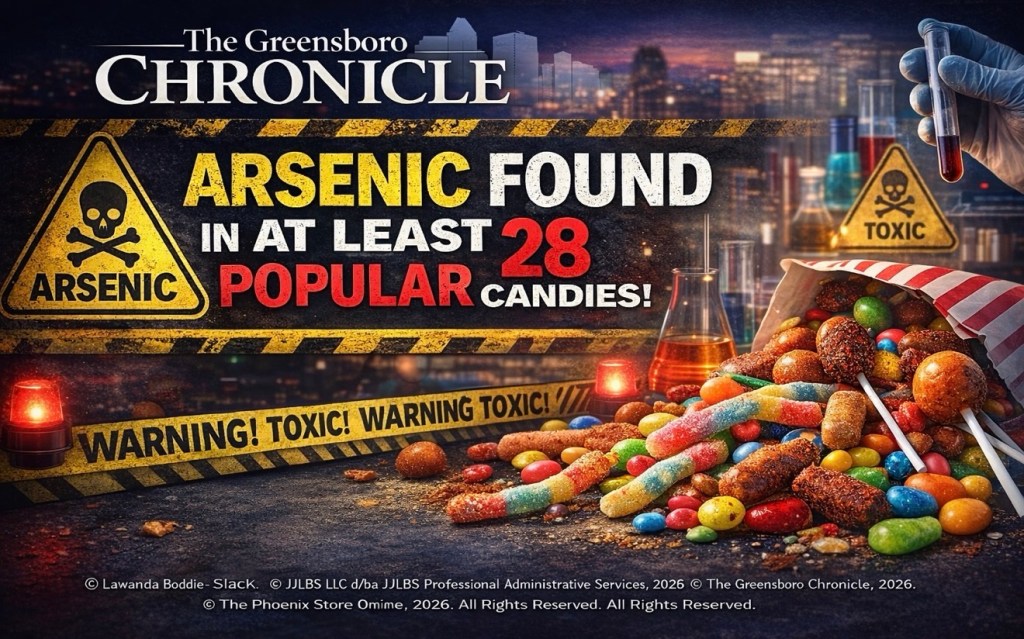
  • 🗞️ Sweet Poison? Arsenic Found in 28 Popular Candies

    An information op-ed in full tabloid mode—because sometimes the candy aisle deserves a warning label.

    🍬 A Bitter Bite Behind the Sugar Rush

    They’re colorful. They’re nostalgic. They’re marketed to kids and sold by the cartload.

    And now—according to a growing pile of public lab reports, consumer complaints, and litigation filings—28 popular candies have allegedly tested positive for measurable levels of arsenic.

    Yes. That arsenic.

    The same element historically associated with rat poison, groundwater contamination, and the phrase “How is this even legal?”

    🧪 What the Reports Say (Plain Language)

    Across multiple independent food safety tests, consumer advocacy investigations, and discovery materials referenced in lawsuits:

    Detectable arsenic was reportedly found in dozens of mass-market candies Products allegedly include fruit-flavored, chili-coated, sour, and imported candies Some results indicate inorganic arsenic, the form most closely linked to: Cancer risk Neurological harm Developmental issues in children

    No, this doesn’t mean one piece will drop you on the spot.

    But it does raise red flags when exposure is repeated, cumulative, and in children—the very audience these candies target.

    🧠 How Does Arsenic End Up in Candy Anyway?

    Here’s where it gets uncomfortable:

    🌱 Agricultural Contamination

    Arsenic naturally exists in soil and water Crops like rice, corn, chili peppers, and tamarind can absorb it These ingredients are commonly used in candy flavoring, fillers, and coatings

    🌎 Imported Ingredients = Different Standards

    Some countries permit higher heavy-metal thresholds Ingredients may pass overseas checks but raise alarms under U.S. testing

    🏭 Manufacturing Blind Spots

    Heavy metals are not always required to be batch-tested Finished candy products may never be screened unless someone complains—or sues

    📂 Complaints, Lawsuits & “We Didn’t Know”

    Public records reveal a familiar pattern:

    Parents notice symptoms or lab tests Independent testing confirms heavy metals Manufacturers deny knowledge Litigation alleges failure to warn, negligent sourcing, and deceptive marketing

    In multiple cases, filings argue:

    Consumers were never informed of arsenic risks Products were marketed as safe for children No clear warnings existed despite known contamination pathways

    Translation: If you don’t test, you don’t have to tell.

    ⚖️ Is This Even Legal?

    Here’s the legal gray zone that makes this story explode:

    There is no universal federal arsenic limit for candy The FDA often relies on “action levels”, not hard bans Enforcement is typically reactive, not proactive

    So yes—something can be lawfully sold and scientifically troubling at the same time.

    Welcome to food regulation roulette.

    👶 Why Kids Face the Highest Risk

    Children:

    Eat more candy per pound of body weight Are more vulnerable to neurotoxic exposure Can accumulate arsenic effects over time

    Which makes the optics of arsenic-tainted candy especially ugly when cartoon mascots are involved.

    🧯 What Consumers Can Do Right Now

    Until regulators catch up with reality:

    🧾 Watch for testing disclosures and ingredient sourcing transparency 🌎 Be cautious with imported candies lacking U.S. testing verification 🧪 Look for brands that voluntarily test for heavy metals 📣 File consumer complaints—paper trails matter ⚖️ If harm is suspected, document everything

    📰 The Real Headline

    This isn’t about panic.

    It’s about disclosure, accountability, and consumer choice.

    Because when arsenic shows up where sugar should be, the real poison isn’t just in the candy—it’s in the silence.

    ⚖️ Legal Disclaimer

    The Greensboro Chronicle

    The Greensboro Chronicle is an independent media publication providing news reporting, investigative journalism, commentary, and opinion-based analysis on matters of public interest, including consumer protection, civil rights, public safety, and legal affairs.

    All content published by The Greensboro Chronicle is provided for informational and educational purposes only and does not constitute legal advice, medical advice, regulatory guidance, or professional counsel of any kind. Readers should not act or refrain from acting based solely on information contained in this publication without seeking appropriate professional advice from a licensed attorney, physician, or qualified expert.

    Reports, articles, and opinion pieces may reference public records, laboratory findings, regulatory filings, consumer complaints, court pleadings, media reports, and other publicly available sources. Allegations, claims, and litigation referenced are unproven unless and until adjudicated by a court of competent jurisdiction. The Greensboro Chronicle makes no assertion of guilt, liability, or wrongdoing by any individual, manufacturer, distributor, or entity unless explicitly stated as established fact by a final legal determination.

    Scientific findings and test results discussed may vary based on methodology, sample size, jurisdictional standards, and evolving regulatory guidance. No warranty is made as to completeness, accuracy, or current applicability.

    The Greensboro Chronicle expressly disclaims liability for any loss, injury, or damages arising from the use or reliance upon published content.

    © Copyright Statement

    © Lawanda Boddie-Slack, 2026. All Rights Reserved.

    © JJLBS LLC, d/b/a JJLBS Professional Administrative Services, 2026. All Rights Reserved.

    © The Greensboro Chronicle, 2026. All Rights Reserved.

    © The Phoenix Store Online, 2026. All Rights Reserved.

    No portion of this publication, including text, graphics, images, layouts, logos, or original investigative content, may be reproduced, distributed, transmitted, displayed, published, or otherwise exploited in any form or by any means without prior written permission, except as permitted under applicable copyright and fair-use laws

  • Removing Vehicle Repossessions in Accordance With Predatory Lending Laws

    An Educational & Informative Consumer Guide

    Removing Vehicle Repossessions in Accordance With Predatory Lending Laws

    An Educational & Informative Consumer Guide

    Vehicle repossession is often presented as inevitable once a payment issue arises. In reality, many repossessions stem from predatory lending practices—unfair, deceptive, or abusive conduct that violates federal and state consumer-protection laws. Understanding these laws can mean the difference between losing a vehicle unnecessarily and lawfully asserting your rights.

    This guide breaks down predatory lending laws in plain language, explains how they apply to vehicle financing and repossessions, and provides step-by-step guidance on what consumers can do when faced with abusive or unlawful conduct.

    1. Predatory Lending Laws — Explained in Plain Language

    Predatory lending refers to lending or collection practices that take advantage of consumers through deception, coercion, or unfair terms. These practices are prohibited under several overlapping legal frameworks.

    Core Characteristics of Predatory Lending

    A transaction may be predatory if it involves:

    Misrepresentation of loan terms Hidden or inflated fees Unfair interest rates not properly disclosed Pressure tactics or threats Refusal to accept lawful payments Improper acceleration of debt Repossession without required notices or legal authority

    Key Legal Foundations

    Predatory lending is regulated under:

    Federal consumer protection laws State unfair and deceptive trade practice statutes Contract law principles Uniform Commercial Code (UCC) requirements State repossession and deficiency-balance laws

    Important: A lender does not need to commit fraud for conduct to be unlawful. Many violations arise from procedural failures, misstatements, or overreach.

    2. Applying Predatory Lending Laws to Vehicle Repossessions

    Vehicle repossessions are especially prone to abuse because they happen quickly and often without court involvement.

    Common Predatory Repossession Tactics

    Claiming default when payments were current or tendered Refusing to accept payment to manufacture default Repossessing without required “right-to-cure” notice Adding unlawful fees to justify repossession Misstating state law regarding criminal liability Threatening arrest or prosecution Using “self-help” repossession in a way that breaches the peace

    When a Repossession May Be Unlawful

    A repossession may violate predatory lending laws if:

    The lender misrepresented the loan terms You were not properly notified of default or cure rights Payment was refused or misapplied The repossession involved threats, intimidation, or deception Required disclosures were never provided The lender lacked lawful authority at the time of repossession

    Even if a contract exists, unfair or deceptive conduct can override contract enforcement.

    3. How to Legally & Properly Assert Your Rights

    Consumers often lose leverage because they don’t know when or how to assert their rights. Timing and documentation matter.

    Step 1: Demand Written Validation

    Immediately request:

    A complete payment history A copy of the signed contract Notice of default and cure rights Itemization of all fees and charges

    A lender’s failure to produce accurate records can itself be evidence of wrongdoing.

    Step 2: Invoke Consumer Protection Laws in Writing

    Your correspondence should:

    Be factual, not emotional Cite unfair or deceptive conduct Demand correction or reversal Preserve your right to dispute

    Verbal disputes rarely protect consumers—written notice does.

    Step 3: Challenge the Repossession Itself

    You may legally contest:

    The legitimacy of the default The method of repossession Improper fees or balance calculations Any post-repossession sale conducted without notice

    Step 4: Do Not Self-Incriminate

    Consumers are often pressured to “admit” default. You are not required to:

    Admit wrongdoing Sign post-repossession statements Waive rights to dispute

    4. Evidence & Documentation Collection Tips

    Strong documentation is often the deciding factor in predatory lending disputes.

    What to Collect

    Loan agreements and addenda Payment receipts and bank records Screenshots of account portals Text messages, emails, and voicemails Call logs with dates and times Photos or videos of the repossession Notices left on doors or vehicles

    Best Practices

    Store copies digitally and physically Keep files organized by date Back up evidence to cloud storage Never alter original documents Save voicemail files separately

    Tip: Keep a contemporaneous timeline—courts and agencies value chronological clarity.

    5. Agencies & Departments That Can Help Consumers

    Consumers are not required to fight predatory lenders alone. Multiple agencies exist to investigate and enforce compliance.

    Federal Agencies

    Consumer Financial Protection Bureau (CFPB) Handles complaints against auto lenders, finance companies, and debt collectors. Federal Trade Commission (FTC) Enforces laws against unfair and deceptive business practices.

    State & Local Resources

    North Carolina Attorney General’s Office Enforces state consumer protection and predatory lending statutes. State Banking or Financial Regulatory Commissions Legal Aid and Consumer Advocacy Organizations

    Filing a complaint does not waive your right to pursue private legal action.

    Why This Matters

    Predatory lending thrives on silence, confusion, and fear. Education disrupts that cycle. Many repossessions are not the result of consumer failure—but of systemic non-compliance and abusive practices.

    Consumers who understand their rights:

    Recover vehicles Eliminate unlawful balances Prevent credit damage Hold violators accountable

    Legal Disclaimer

    This article is provided for general educational and informational purposes only and does not constitute legal advice. Reading or relying on this content does not create an attorney-client relationship. Laws vary by jurisdiction, and consumers should consult a qualified attorney or appropriate regulatory agency regarding their specific situation.

    Copyright Notice

    © 2026 The Greensboro Chronicle.

    All rights reserved. No part of this publication may be reproduced, distributed, or transmitted in any form or by any means without prior written permission from The Greensboro Chronicle, except for brief quotations used for commentary, criticism, or educational purposes.

  • 🎶 42 Years Ago Today — A Moment That Changed Music, Advertising, and Pop Culture Forever 🎶

    On January 27, 1984, while filming a high-energy Pepsi commercial with his brothers, Michael Jackson endured a life-altering accident that became one of the most pivotal moments in entertainment history.

    During the shoot, pyrotechnics ignited seconds too early, setting Michael’s hair on fire. Remarkably, the King of Pop continued performing through the take before seeking medical attention. He suffered second- and third-degree burns to his scalp, injuries that would quietly alter the course of his life and career.

    The commercial—featuring The Jacksons and backed by Pepsi—was intended to be a triumphant celebration of music and brand power. Instead, it became a sobering reminder of the risks artists take to deliver unforgettable performances.

    Yet even in tragedy, Michael Jackson’s professionalism, resilience, and dedication shone through. That night cemented his reputation not just as a global icon, but as a performer who gave everything to his craft.

    Today, we remember the moment—not for the flames—but for the strength, legacy, and cultural impact that followed. 🌟

    Legal Disclaimer

    This content is published for educational, historical, and informational purposes only. It does not constitute legal, medical, or professional advice. All information is based on publicly available and historical sources believed to be accurate at the time of publication. The Greensboro Chronicle makes no representations or warranties as to completeness or accuracy.

    Copyright Notice

    © 2026 The Greensboro Chronicle. All rights reserved. No part of this publication may be reproduced, distributed, or transmitted in any form or by any means without prior written permission, except for brief quotations used for news reporting, commentary, or educational purposes.

    — The Greensboro Chronicle

  • When Snow & Ice Fall From a Vehicle

    An Educational, Informative & Cautionary Guide for Drivers

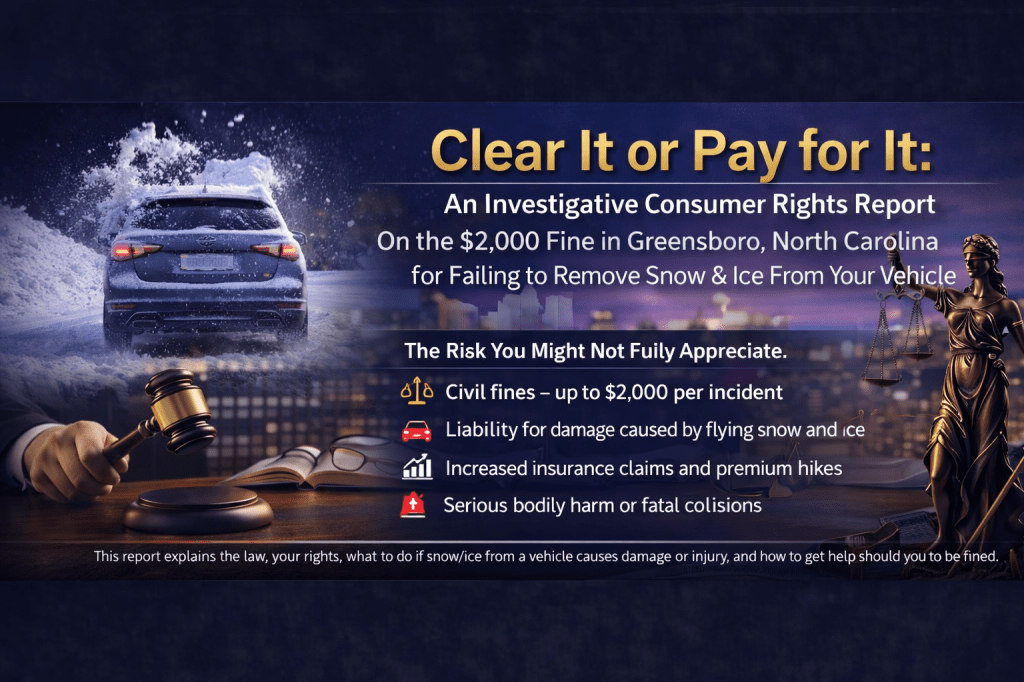
    Each winter, crashes, shattered windshields, and serious injuries occur because snow or ice wasn’t removed from a vehicle before travel. What feels like a harmless oversight can quickly become a high-speed projectile. Below is a plain-language breakdown of the law, liability, and what to do if you’re affected—on local streets or at highway speeds.

    1) Legal Authority Governing Liability

    There is no single nationwide “snow-removal statute,” but liability is well-established through state traffic laws, equipment requirements, and negligence principles, plus commercial safety regulations.

    Common legal bases include:

    State “secure load” & obstruction laws – Prohibit operating a vehicle with unsecured material or obstructions that can fall, slide, or blow off and endanger others. Unsafe equipment / visibility statutes – Require clear windshields, mirrors, lights, and plates. Negligence law (duty of care) – Drivers have a duty to operate vehicles safely and prevent foreseeable harm. Commercial motor carrier regulations – Federal rules require commercial vehicles to secure loads and maintain safe equipment before entering roadways.

    Courts consistently treat accumulated snow and ice that dislodges at speed as a foreseeable hazard—especially after warnings, weather advisories, and ample opportunity to clear the vehicle.

    2) Who’s Liable? (Plain-Language Analysis)

    Short answer:

    👉 The driver who failed to remove the snow or ice is usually liable.

    Why?

    Snow and ice do not “fall by accident” at highway speed—they fall because the vehicle entered traffic without being properly cleared. Harm to following drivers (windshield strikes, loss of control, crashes) is predictable and preventable. Liability increases if: The vehicle is tall (SUVs, vans, box trucks, tractor-trailers) The driver had time to clear the vehicle Prior warnings or weather advisories were issued The ice sheet came from the roof, hood, or trailer top

    Exceptions (rare):

    Sudden, unforeseeable refreezing during travel after reasonable clearing efforts Proof that debris came from a different vehicle (hard to establish)

    3) Local Roads vs. Highways: Liability Differences

    🏙️ Local Roads / City Streets

    Lower speeds, but higher expectations of care Police frequently cite drivers under: Obstructed view Unsafe equipment Careless or reckless driving Municipal codes may also apply Civil liability still attaches if damage or injury occurs

    🛣️ Highways & Interstates

    Much higher risk = greater legal exposure Snow or ice becomes a high-velocity projectile Commercial vehicles face: Federal enforcement Company liability Insurance scrutiny Multi-vehicle crashes can lead to significant civil damages

    Courts routinely find that entering a highway without clearing snow/ice is unreasonable conduct given the known risks.

    4) What To Do If You’re Hit on a Highway / Interstate

    Immediately:

    Get to safety – Pull over when safe; activate hazard lights Call 911 if there’s injury or major damage Do NOT chase the other vehicle at speed

    Document everything:

    Dashcam footage (save immediately) Photos/video of damage and ice residue License plate, company name, DOT number (if commercial) Location, time, weather conditions Witness names and contact info.

    Official steps:

    Request a police crash report Notify your insurer (state that debris fell from another vehicle) Seek medical evaluation—even if symptoms are delayed

    5) What To Do on Local Roads

    Safely stop and exchange information if the vehicle pulls over Photograph: The other vehicle (roof, hood, rear) Remaining snow/ice File a police report, especially if the driver flees Preserve repair estimates and receipts

    Even at low speeds, windshield impacts and evasive maneuvers can establish fault.

    6) Agencies & Departments That Can Assist

    State Highway Patrol – Crash reports, citations Department of Transportation – Road conditions, commercial vehicle enforcement National Highway Traffic Safety Administration – Safety guidance & defect reporting Federal Motor Carrier Safety Administration – Commercial truck complaints Local Police Departments – Municipal enforcement & reports Insurance Regulators (State DOI) – Claims handling disputes Consumer Protection Divisions (Attorney General) – Pattern misconduct by companies

    A Final Safety Note

    Clearing snow and ice is not optional—it is a basic safety obligation. Five minutes with a brush can prevent life-altering injuries, costly lawsuits, and criminal citations. If snow or ice leaves your vehicle and strikes another, responsibility usually follows it.

    Legal Disclaimer – The Greensboro Chronicle

    This article is provided for general educational and informational purposes only and does not constitute legal advice. Laws vary by jurisdiction and facts matter. Readers should consult a qualified attorney or appropriate authority for advice specific to their situation.

    © Copyright Notice

    © The Greensboro Chronicle. All rights reserved. Reproduction, redistribution, or reuse without express written permission is prohibited

  • Cease & Desist Demand Letters

    How to Maximize Your Rights With a Properly Crafted Legal Warning

    A Cease & Desist Demand Letter is one of the most underutilized — and misunderstood — tools available to consumers, tenants, workers, creators, and small businesses. When drafted correctly, it is far more than a warning. It is documented notice, evidence of good-faith resolution, and often the first domino in civil enforcement.

    In an era of automated debt collection, aggressive corporate overreach, digital harassment, and unlawful business practices, a properly crafted cease & desist letter can shift the balance of power back where it belongs — with the individual asserting their rights.

    This investigation explains what these letters are, why they matter, how to draft them correctly, and what happens when they are ignored.

    1. The Legal Foundation of Cease & Desist Demand Letters (Plain Language)

    At its core, a cease & desist demand letter is a formal notice. It tells another party:

    “You are engaging in conduct that violates my legal rights. You are now on notice. Stop.”

    This matters because many areas of civil law require notice and an opportunity to cure before courts or regulators will impose penalties. Once notice is given:

    Continued misconduct may become willful Damages may escalate Certain defenses are eliminated Regulatory agencies gain jurisdiction

    Cease & desist letters are grounded in:

    Contract law Consumer protection statutes Intellectual property law Harassment and privacy law Employment and labor protections Debt collection regulations

    They are not criminal threats and do not require an attorney to be valid — though precision matters.

    In short:

    👉 A cease & desist letter turns misconduct into documented misconduct.

    2. The Essential Parts of a Well-Drafted Cease & Desist Demand Letter

    A weak letter is easy to ignore. A strong one becomes evidence.

    A properly drafted cease & desist demand letter should include all of the following:

    A. Clear Identification of the Parties

    Your full legal name The name of the business, individual, or entity engaging in the conduct Addresses, emails, phone numbers if known

    B. Statement of Facts (Chronological & Verifiable)

    Dates Times Methods (calls, emails, visits, postings, publications) Specific actions taken

    This section should read like a police report, not an opinion piece.

    C. Identification of the Legal Violations

    You do not need to cite every statute, but you should clearly identify:

    What rights are being violated Whether the conduct is unlawful, deceptive, harassing, or unauthorized

    This signals competence — and seriousness.

    D. The Demand

    Explicitly state:

    What conduct must stop What conduct must not resume Any corrective action required

    Ambiguity weakens enforceability.

    E. Deadline for Compliance

    A firm, reasonable deadline (often 7–14 days) establishes urgency and shows fairness.

    F. Notice of Consequences

    This is not a threat — it is disclosure.

    Example:

    “Failure to comply may result in regulatory complaints, civil action, and pursuit of statutory damages.”

    G. Preservation of Rights Clause

    Always include language stating:

    “Nothing herein waives any rights or remedies available under law.”

    H. Proof of Delivery

    Certified mail, return receipt, email with read confirmation — documentation is critical.

    3. When a Cease & Desist Demand Letter Is Ignored: Legal Consequences

    Ignoring a properly drafted cease & desist letter is not harmless.

    Once notice is given:

    Violations may become willful Damages may increase Injunctions become more likely Courts may view the offender as acting in bad faith

    In many consumer protection statutes, continued conduct after notice triggers enhanced penalties, including:

    Statutory damages Treble (triple) damages Attorney’s fees Civil penalties

    For businesses, ignoring such letters often backfires during:

    Regulatory investigations Licensing reviews Civil discovery Media exposure

    Silence does not equal safety.

    4. Next Steps After a Demand Letter Is Ignored

    If the deadline passes without compliance, the letter has already done its job — it has created a record.

    Next steps may include:

    A. Filing Regulatory Complaints

    Many agencies require proof that the offender was notified. Your letter becomes Exhibit A.

    B. Civil Litigation

    Courts routinely ask:

    “Did you attempt to resolve this before filing suit?”

    A cease & desist letter answers that question.

    C. Injunctive Relief

    Courts are more likely to issue orders stopping conduct immediately when notice was ignored.

    D. Public Accountability

    For media organizations and advocacy outlets, documented notice strengthens investigative reporting and public interest disclosures.

    5. Agencies That Can Assist With Enforcement

    Depending on the nature of the violation, enforcement may involve one or more of the following:

    Federal Trade Commission (FTC) – Unfair or deceptive business practices Consumer Financial Protection Bureau (CFPB) – Debt collection, credit reporting, financial misconduct State Attorney General’s Office – Consumer protection and civil enforcement State Labor Departments – Employment and wage violations Professional Licensing Boards – Ethical and regulatory misconduct Civil Courts – Injunctions and damages

    These agencies often require evidence of notice — which is precisely what a cease & desist letter provides.

    Why Cease & Desist Letters Still Matter

    A cease & desist demand letter is not about intimidation.

    It is about clarity, accountability, and record-building.

    When properly drafted, it:

    Preserves your rights Forces acknowledgment Strengthens enforcement Exposes bad-faith conduct

    In an age where many actors rely on consumers not knowing their rights, a well-crafted cease & desist letter sends a clear message:

    You are paying attention. And you are prepared to act.

    Legal Disclaimer — The Greensboro Chronicle

    The Greensboro Chronicle provides this article for educational and informational purposes only. Nothing contained herein constitutes legal advice, nor does it create an attorney-client relationship. Laws vary by jurisdiction, and readers are encouraged to consult a qualified attorney or appropriate regulatory agency regarding their specific legal situation.

    Copyright Statement

    © Lawanda Boddie-Slack, 2026. All Rights Reserved.

    © JJLBS LLC d/b/a JJLBS Professional Administrative Services, 2026. All Rights Reserved.

    © The Greensboro Chronicle, 2026. All Rights Reserved.

    © The Phoenix Store Online, 2026. All Rights Reserved

  • Podcast Links

    Podcast Links

    The Greensboro Chronicle is now on Spotify The Greensboro Chronicle is now on YouTube The Greensboro Chronicle is now on WhatsApp

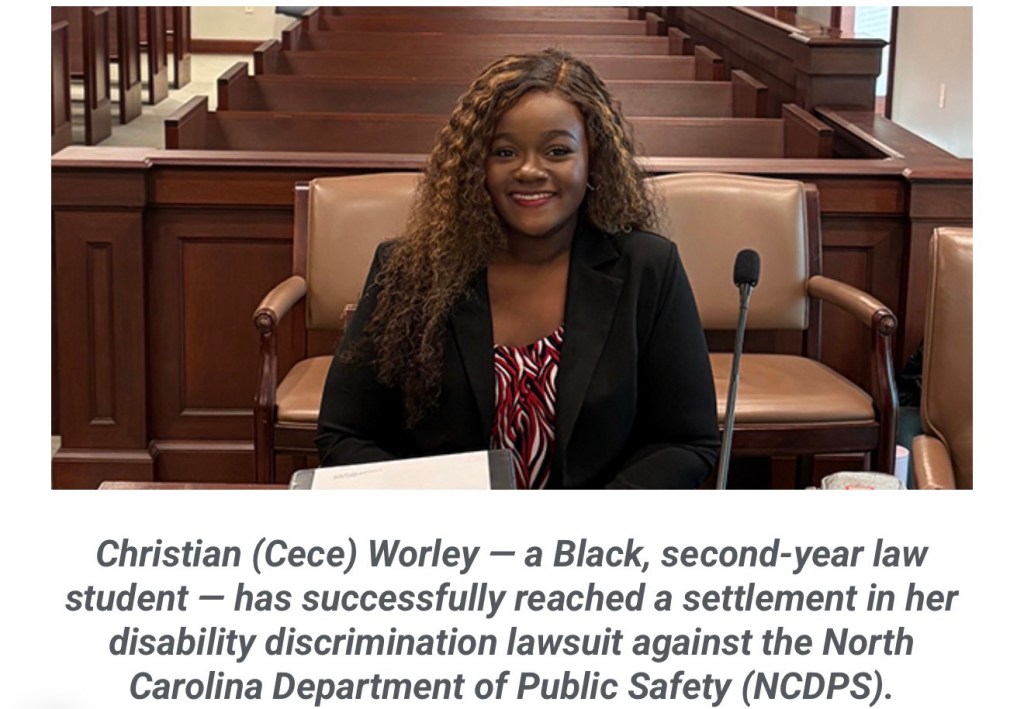
  • A Black Woman’s Pain Was Dismissed—Until She Took the State to Court

    A Black Woman’s Pain Was Dismissed—Until She Took the State to Court

    She asked for one day a month to work from home so she could manage a debilitating medical condition. Her supervisors said “absolutely not” and warned her not to ask again—or she’d be fired.…

  • Spring 2025 – ChatGPT for the Self-Represented Litigant

    Episode 1 – Introduction: The Pro Se Challenge 1.1 The Rise of Self-Representation in Civil Courts 1.2 Common Obstacles for Pro Se Litigants 1.3 How ChatGPT Fits Into the Legal Journey 1.4 Limits and…

  • A Simple Card, A Saved Life: Why Medical and Autism Awareness Cards Matter for Our Most Vulnerable

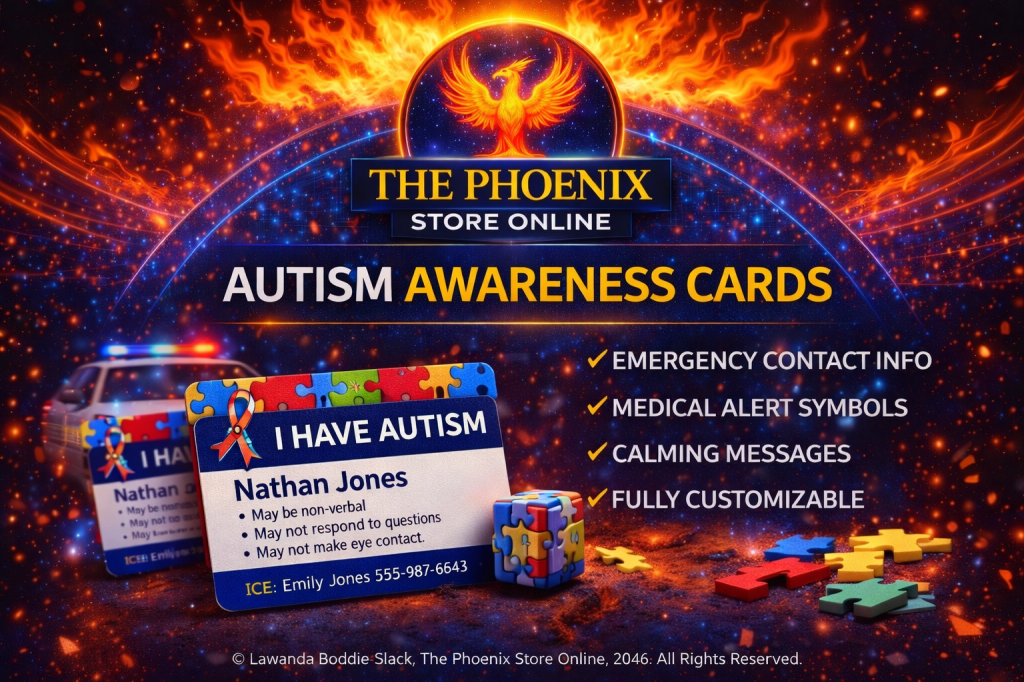
    Greensboro Chronicle The Power of a Simple Card: Why Medical and Awareness IDs Save Lives Seconds Matter in Emergencies When a medical emergency happens, every second counts. First responders need quick, accurate information—yet many…

  • About

    The Greensboro Chronicle is an independent voice dedicated to telling the stories that shape life in Greensboro, North Carolina. We go beyond the headlines, investigating the decisions, disputes, and developments that impact everyday residents.…

THE GREENSBORO CHRONICLE — SPECIAL INVESTIGATION

“THE SHELL GAME LANDLORD” Inside the Corporate Maze Behind a Greensboro Apartment Complex By The Greensboro Chronicle Investigative Desk I. THE QUESTION NO ONE ASKED: WHO REALLY OWNS YOUR RENT? What if the name on your lease… isn’t the real landlord? What if the company taking tenants to court… doesn’t actually control the rent it…

Is YorkeTowne Apartments LLC in Greensboro, North Carolina a True Landlord or Just a Puppet for Harvest Investments LLC d/b/a Harvest Properties Connecticut?

March 24, 2026 By John Lee “RENT REFUSED, REPAIRS IGNORED, EVICTION FILED”: Inside the YorkeTowne Apartments Legal Showdown Greensboro—What started as a routine landlord-tenant dispute has erupted into a high-stakes legal battle now raising serious questions about habitability, eviction practices, and corporate conduct behind the scenes. At the center: YORKETOWNE APARTMENTS LLC d/b/a YORK TOWNE…

Stomp & Buck: How Stepping and Majorette Dance Shaped Modern Black Performance Culture

There are two sounds that define the cultural heartbeat of many Historically Black College and University (HBCU) campuses: The stomp of synchronized boots. The buck of a dance line breaking down on the fifty-yard line. Fraternity and sorority stepping. Majorette and bucking-style dance. Different origins. Different formations. Same cultural core. Both art forms emerged from…