Copyright 2026 The Greensboro Chronicle. All Rights Reserved.
Where investigative journalism comes together with the community to find viable solutions to the issues.
About Us
Greensboro Chronicle, we believe journalism is more than reporting the news—it’s about uncovering the truth, amplifying community voices, and working toward real solutions.
We are an independent investigative news platform dedicated to shining a light on issues that matter most to the people of Greensboro. From housing and local governance to public safety, business, and neighborhood life, our mission is to hold power accountable while fostering meaningful dialogue among residents.
The Chronicle isn’t just a newsroom—it’s a community hub. We invite readers to not only stay informed, but also to participate in the conversation, share perspectives, and collaborate on solutions that strengthen our city.
Together, we can confront challenges, celebrate resilience, and shape a more transparent, just, and thriving Greensboro.
Greensboro Chronicle Investigative Staff and Volunteers
Here at the Greensboro Chronicle we do more than just reporting on the situations. We facilitate holding the hard, tough, and uncomfortable conversations. The end goal is to always act with integrity and encourage unity.
The Greensboro Chronicle
January 18, 2025
Lorene Hardy Staff Writer
UNSOLVED. UNANSWERED. UNFORGIVEN.
Rocky Mount Mass Shooting Leaves One Young Man Dead — and a Community Demanding Truth
The Unsolved Murder of Kedar Darden, Rocky Mount, NC
The Benvenue Road Killing Authorities Won’t Explain
In the early darkness of September 21, 2025, gunfire shattered the quiet of a residential stretch of Benvenue Road in Rocky Mount. By sunrise, police tape sealed off a crime scene, five people lay wounded by bullets, and one young man — Kedar Darden — was dead.
Weeks later, the case remains cold.
No arrests.
No suspects publicly named.
No clear answers.
THE DEADLY TIMELINE
According to police reports included in the article:
Date: September 21, 2025 Time: Approximately 6:00 a.m. Location: 2100 block of Benvenue Road Incident: Reports of shots fired
When officers arrived, they encountered multiple victims suffering from gunshot wounds. Kedar Darden, age 25, was pronounced dead at the scene.
Four others survived:
Two women, ages 27 and 28 Two men, ages 24 and 32
All were transported for medical treatment.
A YOUNG LIFE CUT SHORT
Kedar Darden was a young man from Rocky Mount. At just 25 years old, his life ended on a residential street — not in secrecy, but in a violent burst of gunfire that investigators say involved multiple victims and multiple shots.
Yet despite the scale of the violence, no suspect information has been released.
Connect with us on your time!
THE SILENCE THAT SCREAMS
Despite weeks of investigation, authorities have confirmed:
❌ No arrests announced ❌ No suspect descriptions released ❌ No motive disclosed
For a case involving five shooting victims, the lack of public progress has fueled frustration, fear, and anger in the community.
Residents are asking:
Who opened fire? Why hasn’t anyone been named? Is the public safe?
So far, answers remain locked behind closed doors.
WHAT POLICE ARE SAYING — AND NOT SAYING
The Rocky Mount Police Department acknowledges the case remains under investigation. Officials confirm the facts of the shooting — but have released no further details about suspects, persons of interest, or arrests.
For now, police are relying on the public to help break the case open.
CALLS FOR JUSTICE
The article carries a clear message splashed across the page:
#JUSTICEFORKEDAR
#SPEAKUP
This is not just a plea — it is a demand.
HOW TO PROVIDE INFORMATION (CONFIDENTIAL & ANONYMOUS OPTIONS)
Anyone with any information, no matter how small, is urged to contact:
Have a story that needs to be heard? The Greensboro Chronicle invites community members, advocates, and organizations to connect with us and share their experiences directly. Whether you’re raising awareness, seeking accountability, or highlighting local impact, your voice matters. Submit your story securely through our contact form and help shape the conversations that affect our community:
Thank you for reaching out to The Greensboro Chronicle. This contact form is provided to facilitate general inquiries, community engagement, media collaboration, and administrative support requests.
By submitting this form, you acknowledge and agree to the following:
Communications submitted through this form may be reviewed by The Greensboro Chronicle and its administrative partner, JJLBS Professional Administrative Services, for the purpose of responding to your inquiry or routing it appropriately.
Submission of this form does not create an attorney-client relationship, professional-client relationship, or guarantee of services.
Please do not submit sensitive personal information, confidential legal matters, medical information, or financial details through this form.
Response times may vary based on inquiry volume and subject matter.
Official Contact Channels
You may also connect with us directly through the following verified platforms:
By using this form or contacting us through any listed platform, you consent to receive responses via electronic communication, including email, social media messaging, or text message where applicable.
The Greensboro Chronicle Community. Accountability. Access.
January 16, 2026
Greensboro Chronicle Staff Writer
Regarding Subscription Practices of All Star VIP Club
Why This Petition Exists
This petition has been created to gather and document consumer experiences involving All Star VIP Club, an online subscription-based “mystery box” retailer. Multiple consumers have reported issues involving automatic subscription charges, delayed or missing deliveries, lack of customer response, and unclear refund processes.
The purpose of this petition is to:
Aggregate affected consumers Document patterns of conduct Seek transparency, refunds, and corrective business practices Assess the viability of a potential class action lawsuit
Reported Consumer Concerns Include:
Automatic subscription charges without timely delivery of merchandise Advertised delivery timelines (e.g., within 14 days) not being met Orders remaining in “processing” status for extended periods Unanswered customer communications after payment Lack of a clear, functional, and verifiable refund policy Difficulty identifying the true operating company or responsible parties
These concerns are particularly serious in a subscription billing model, where consumers may continue to be charged while prior issues remain unresolved.
What This Petition Asks For
By signing this petition, consumers are calling for:
Transparent and accurate advertising Timely delivery of subscription merchandise or prompt refunds Clear, accessible customer service channels Public disclosure of the legitimate operating company and contacts Restitution for affected customers Legal review to determine whether class action litigation is appropriate
Who Should Sign
Please sign if you:
Were charged for an All Star VIP Club subscription or mystery box Did not receive your items within the advertised timeframe Had difficulty obtaining a response or refund Were charged more than once while prior orders were unresolved
Signing does not obligate you to participate in a lawsuit. It simply allows your experience to be counted and reviewed.
Transparency Statement
This petition does not allege criminal conduct. It is a consumer-led effort to promote accountability, transparency, and lawful business practices based on reported experiences.
Below is an in-depth, plain-language explanation and analysis of the case, written to be accessible to non-lawyers while still conveying why this litigation matters legally, procedurally, and historically—especially because every major victory was achieved pro se.
1. What This Case Is Really About (In Plain Language)
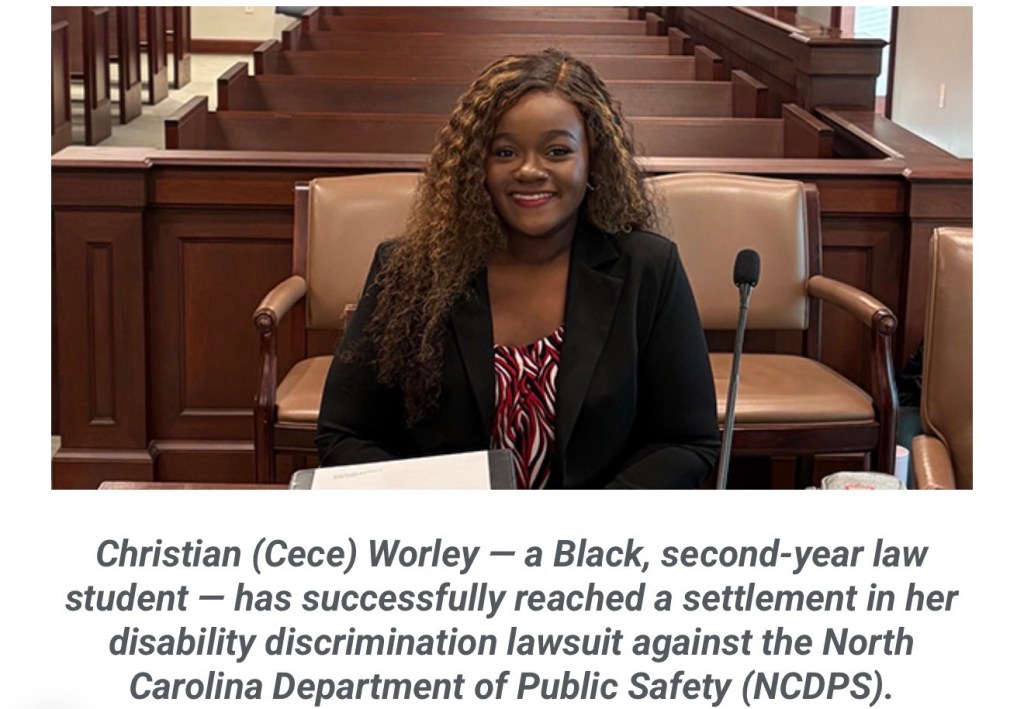
At its core, this case is about whether a woman with a serious, chronic reproductive condition has the right to ask for a modest workplace adjustment—and whether an employer can legally dismiss that request by treating women’s pain as inconvenient or interchangeable.
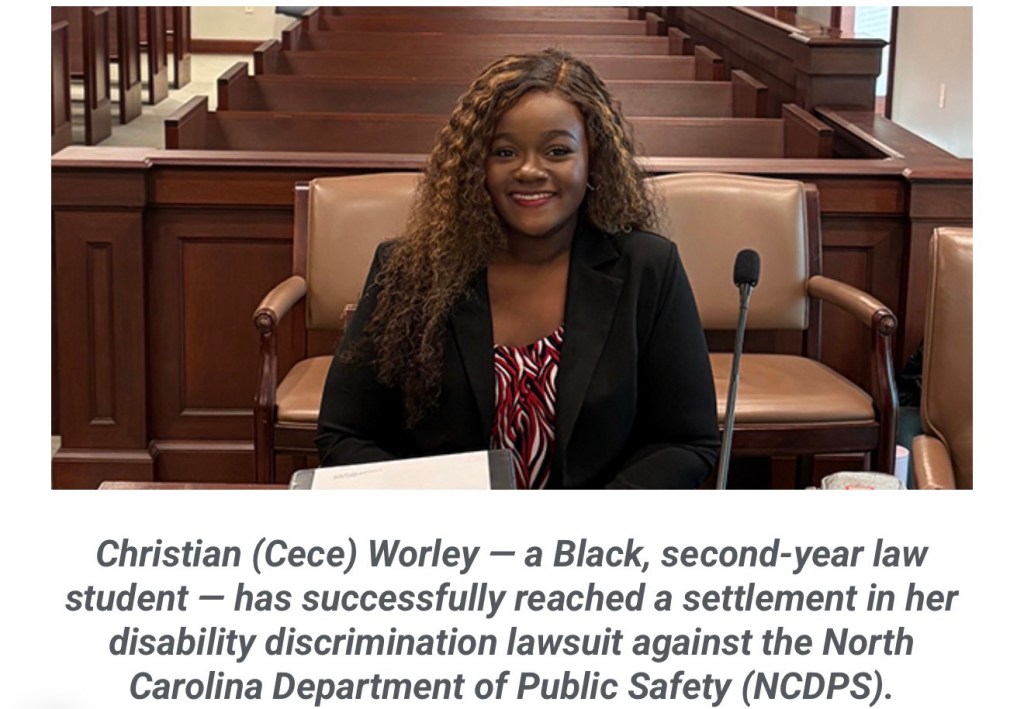
Christian “Cece” Worley was not asking for a permanent change, special privileges, or reduced job standards. She asked for telework on one single day per month—the first day of her menstrual cycle—because her endometriosis caused severe symptoms that interfered with basic functioning. Endometriosis is a medically recognized, chronic condition that can cause debilitating pain, fatigue, gastrointestinal distress, and neurological symptoms.
What followed was not a neutral employment decision. According to the record, it was a categorical refusal, paired with gender-based assumptions (“I’d have to do this for every woman”), threats of termination, discouragement from using accrued leave, and an ultimatum that effectively forced her resignation.
This case asks a simple but powerful question:
If an employer refuses even to consider an accommodation for a serious medical condition—and instead pressures an employee to quit—does that violate the ADA?
For the first time in North Carolina, and likely the first time nationally at this stage of litigation, the federal courts answered: a jury could reasonably say yes.
2. Why This Case Is Extraordinary: She Did It Pro Se
One of the most important facts cannot be overstated:
Cece Worley did this without a lawyer.
She filed her case pro se—meaning she represented herself—after multiple attorneys declined representation, telling her that the law around endometriosis and the ADA was “too underdeveloped” or “too uncertain.”
That matters because:
Less than 3% of pro se civil cases survive summary judgment Government defendants, especially state agencies, are among the hardest defendants to defeat ADA cases are legally complex, fact-intensive, and procedurally unforgiving
Despite all of that, Worley not only survived—she won repeatedly at every procedural stage that normally ends pro se cases early.
3. Procedural Victories That Most Plaintiffs Never Reach
A. Surviving a Motion to Dismiss
Early in the case, NCDPS tried to end the lawsuit before evidence was even exchanged. Worley defeated that effort, meaning the court found her allegations legally sufficient on their face.
Why this matters:
Many civil rights cases die here. Courts often dismiss ADA claims before discovery if they think the disability or accommodation theory is weak. This court did not.
B. Winning Discovery Battles Against a State Agency
Discovery is where pro se litigants are most often overwhelmed. Worley:
Preserved her claims through contested discovery disputes Navigated procedural rules without counsel Took and defended depositions Elicited admissions from agency witnesses
Why this matters:
Discovery is not about storytelling—it is about rules, deadlines, objections, and strategy. The fact that a self-represented plaintiff not only survived but used discovery effectively is rare.
C. Defeating a Late-Stage Attempt to Depose Her
Perhaps one of the most telling moments in the case was procedural rather than substantive.
NCDPS waited nearly eight months into the discovery period before attempting to depose Worley, then asked the court to extend discovery after it had already closed.
Worley opposed the motion—arguing that the delay was unjustified and strategic. The court agreed.
The judge:
Found the request dilatory Refused to reward NCDPS for its own delay Denied the extension
Why this matters:
Courts rarely side with pro se plaintiffs on procedural timing disputes against government defendants. This ruling signaled that the court was scrutinizing the agency’s litigation conduct—and taking Worley seriously as a litigant.
D. Surviving Summary Judgment — The Rarest Victory of All
Summary judgment is where most cases die, especially ADA cases and especially pro se cases.
On July 18, 2025, Magistrate Judge Robert T. Numbers II ruled that:
Endometriosis can qualify as a disability under the ADA Worley’s symptoms were severe enough to meet that standard Her request to telework one day per month could be found reasonable A jury could conclude NCDPS unlawfully denied accommodation
District Judge Terrence Boyle later adopted the ruling in full.
Why this matters:
This ruling did not merely allow the case to continue—it created a legal foothold where none clearly existed before in North Carolina, and possibly anywhere in the country at this procedural stage.
4. Why the Endometriosis Ruling Is So Important
Before this case, employers often dismissed endometriosis-based accommodation requests by arguing:
The condition is “temporary” or “cyclical” Symptoms are “subjective” Menstrual-related impairments are not serious enough Accommodations would open the floodgates for all women
The court rejected that logic.
It recognized that:
A condition does not have to be constant to be disabling Chronic, recurring impairments can substantially limit major life activities Gendered disabilities are not exempt from ADA protection
This shifts the legal landscape. Employers can no longer safely assume that reproductive or menstrual disorders fall outside ADA coverage.
5. Constructive Discharge: When “You Can Quit” Means “You Must”
The facts also support a constructive discharge theory—meaning Worley did not leave voluntarily in any meaningful sense.
According to the record, she was told:
There would “absolutely not” be accommodations She would not be retained at the end of training Mentioning accommodations again could lead to immediate termination
Her resignation date coincided precisely with the onset of her next menstrual cycle—the very condition she had sought to manage.
In plain terms:
She was forced to choose between her health and her job. The law does not allow employers to manufacture that choice.
6. Why This Case Matters Beyond One Person
A. For Women and Reproductive Health
Hundreds of women have come forward with similar stories—termination, threats, retaliation, or dismissal after disclosing menstrual or reproductive health conditions.
This case validates what many have experienced privately:
Workplaces have systematically minimized, mocked, or punished women for gendered disabilities.
B. For Black Women in Particular
Black women face:
Lower diagnosis rates for endometriosis Longer delays in treatment Greater dismissal of pain Compounded race- and gender-based bias
That Worley—a Black woman—forced legal recognition of this condition makes the case especially significant.
C. For Access to Justice
This case exposes a structural problem:
Lawyers declined representation The law was deemed “too risky” Yet the claims were legally sound
If Worley had accepted that advice, this precedent would not exist.
Her success demonstrates that access to justice is often limited not by merit, but by gatekeeping—and that pro se litigants, when given fair consideration, can change the law.
7. The Settlement and Its Systemic Impact
The December 19, 2025 settlement included:
Favorable monetary terms A commitment by NCDPS to implement department-wide ADA training
That training obligation is critical. It means this case did not just compensate harm—it reduced the likelihood of future harm to others.
8. Why This Case Will Be Remembered
This case stands at the intersection of:
Disability rights Gender justice Racial equity Access to courts
It shows how legal change often begins:
With one person Acting without institutional backing Refusing to accept that the law is “not ready” for their reality
Cece Worley did not just survive the system.
She forced it to listen.
And by doing so—pro se—she turned an individual act of resistance into a blueprint for systemic change.
Series Introduction:
Escalation, Authority, and Accountability in North Carolina
This op-ed series was created to address a growing, real-world problem: how everyday disputes escalate into dangerous encounters—and how the law assigns responsibility when they do. Centered in North Carolina, the series translates complex legal doctrines into clear, accessible explanations so readers can understand what the law actually protects, what it condemns, and why outcomes so often surprise the loudest voices.
Purpose of the Series
The purpose of this series is threefold:
Education To explain, in plain language, how North Carolina law treats: Fighting words (including racial slurs), Stand Your Ground rights (far beyond firearms), Contributory negligence, Reckless disregard, Knowing, willing, and intentional conduct, False imprisonment and unlawful restraint, Municipal and HOA liability. Context To show how these doctrines interlock in real life, especially in situations involving: Karen & Ken confrontations, Weaponized law enforcement calls, Racialized complaints, HOA overreach, Contractor “enforcement,” Selective and discriminatory rule enforcement. Prevention and Accountability To demonstrate how escalation choices—not just outcomes—drive legal consequences, and how de-escalation, respect for boundaries, and lawful limits protect everyone involved.
What This Series Is (and Is Not)
This series is:
✔️ Educational and informational ✔️ Grounded in North Carolina legal principles ✔️ Focused on behavior, consequences, and accountability ✔️ Designed for residents, guests, HOAs, board members, contractors, advocates, and the general public
This series is not:
❌ Legal advice ❌ A call to confrontation ❌ Anti-law-enforcement or anti-community
It is a rule-of-law series—one that insists power must be lawful, speech must be responsible, and authority must be real, not assumed.
Why This Series Matters Now
Across communities, disputes increasingly follow the same pattern:
Words escalate into provocation, Authority is assumed rather than granted, Exit is denied, Police are weaponized, Video tells a different story than the complaint, Claims collapse—or liability explodes.
This series explains why that happens.
It shows how:
Words can be actionable on their face, Racial slurs qualify as fighting words, Blocking retreat changes everything, Stand Your Ground protects defense—not dominance, Reckless disregard and intent open the door to punitive exposure, Patterns of conduct become proof, HOAs and municipalities inherit liability when escalation is normalized.
Our Commitment to Readers
We are committed to:
Breaking down legal myths that fuel unnecessary conflict, Exposing how entitlement and ego undermine legal positions, Highlighting the legal cost of discrimination and selective enforcement, Encouraging lawful, humane, and accountable conduct, Continuing to educate on these subjects and more as the series expands.
Every installment is written to help readers recognize the moment where speech becomes conduct, authority becomes overreach, and disagreement becomes liability—so those moments can be avoided.
The Core Message
Across every topic in this series, one principle remains constant:
The law rewards restraint, not escalation.
It protects defense, not domination.
And it holds accountable those who create danger and ignore the consequences.
This series exists to make that principle visible, understandable, and impossible to ignore.
Educational series for public awareness and discussion. Not legal advice.
Millions of consumers rely on Spectrum for essential services like internet and mobile access. Yet buried inside Spectrum’s Residential Terms is a sweeping indemnification clause requiring customers to defend and protect Charter Communications and its affiliates from liability.
This investigation explores:
Whether the clause is overly broad or unfair Whether branding obscures the true legal service provider Whether consumers lack meaningful choice Whether these practices raise concerns under North Carolina consumer protection law
This is journalism, not litigation.
🔹 KEY FINDINGS (SUMMARY PAGE)
What We’ve Found So Far
“Spectrum” is a brand, not a standalone legal entity Customers contract under non-negotiable terms The indemnification clause applies to “any and all” claims Liability may survive cancellation of service Consumer communications rarely identify the actual responsible entity Individual complaints show repeating patterns
Patterns—not isolated stories—are what trigger accountability.
🔹 SERIES INDEX
The Investigative Series
Part I: Spectrum Isn’t a Company
Part II: The Fine Print That Makes Customers Pay
Part III: What North Carolina Law Says About Unfair Contracts
Part IV: Real Consumers, Real Harm
Part V: Is This How Class Actions Begin?
Part VI: Regulators Are Watching
🔹 KNOW YOUR RIGHTS (CONSUMER TOOLKIT)
What Every Spectrum Customer Should Know
A contract does not override the law Essential services receive heightened scrutiny Unfair or deceptive practices may violate NC law You cannot be forced to waive statutory protections Branding does not erase responsibility
[ Download the Consumer Toolkit (PDF) ]
🔹 SUBMIT YOUR STORY (INTAKE PAGE)
Tell Us What Happened
If you are a current or former Spectrum customer and experienced billing issues, service disruptions, or responsibility being shifted to you unfairly, we want to hear from you.
✔ Confidential
✔ Optional anonymity
✔ No obligation
✔ Journalistic purposes only
[ SUBMISSION FORM ]
(Includes disclaimer + upload section)
🔹 WHAT HAPPENS AFTER YOU SUBMIT
Your submission is reviewed for:
Repeated contract language Common consumer experiences Geographic clustering Public-interest significance
We do not provide legal advice.
We do not initiate lawsuits.
We investigate patterns.
🔹 REGULATORY ACTION HUB
Concerned? You Can File a Complaint
If you believe Spectrum’s contract or practices were unfair or deceptive, you may file complaints with:
North Carolina Attorney General – Consumer Protection Division Federal Communications Commission (FCC)
Templates are provided for your convenience.
[ FILE A COMPLAINT – TEMPLATES ]
🔹 LEGAL & ETHICAL DISCLAIMERS (FOOTER)
Greensboro Chronicle Investigates is a journalistic publication.
This site is for informational purposes only and does not constitute legal advice or legal representation.











 Greensboro Chronicle