Greensboro Chronicle

Where Journalism and Advocacy Come Together

Copyright 2026 The Greensboro Chronicle. All Rights Reserved.

Greensboro Chronicle, we believe journalism is more than reporting the news—it’s about uncovering the truth, amplifying community voices, and working toward real solutions.

We are an independent investigative news platform dedicated to shining a light on issues that matter most to the people of Greensboro. From housing and local governance to public safety, business, and neighborhood life, our mission is to hold power accountable while fostering meaningful dialogue among residents.

The Chronicle isn’t just a newsroom—it’s a community hub. We invite readers to not only stay informed, but also to participate in the conversation, share perspectives, and collaborate on solutions that strengthen our city.

Together, we can confront challenges, celebrate resilience, and shape a more transparent, just, and thriving Greensboro.

Greensboro Chronicle Investigative Staff and Volunteers

Here at the Greensboro Chronicle we do more than just reporting on the situations. We facilitate holding the hard, tough, and uncomfortable conversations. The end goal is to always act with integrity and encourage unity.
  • **THE 1992 “MORTAL KOMBAT TAPES”

    January 25, 2026

    Lorene Hardy Staff Writer

    Alright—strap in. This one lives squarely in the shadowy overlap of pop culture, rumor, and unresolved internet lore. What follows is a tabloid-style, cautionary exploration, not a declaration of fact.

    DISCLAIMER

    Every claim is framed as allegation, interpretation, or conspiracy theory drawn from public discussion, not proven wrongdoing.
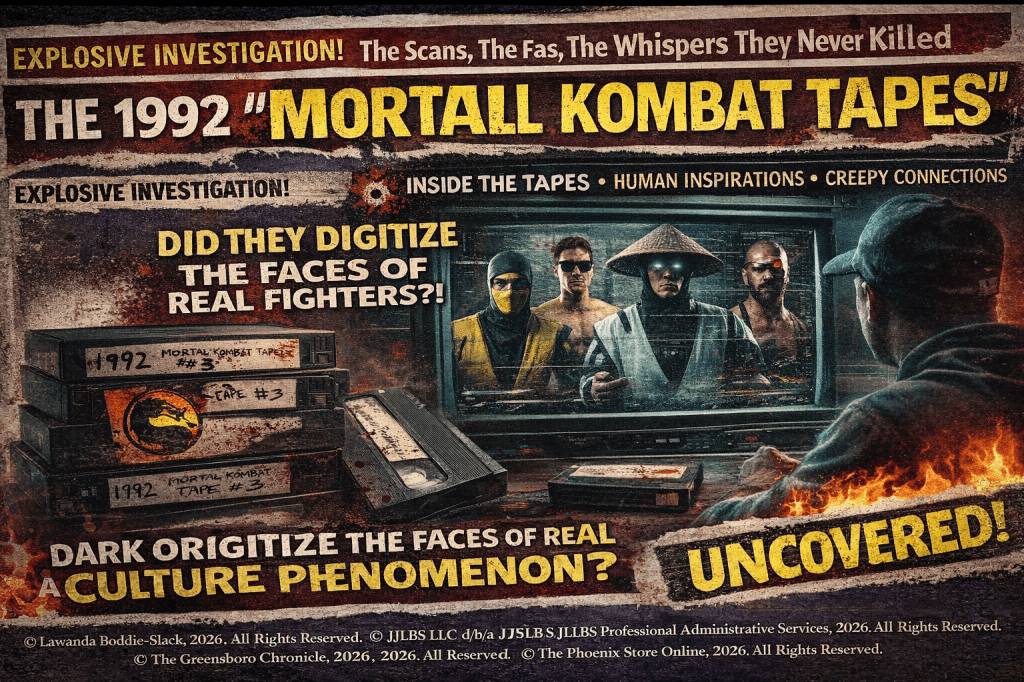
    **THE 1992 “MORTAL KOMBAT TAPES

    The Scans, The Faces, The Whispers They Never Killed**

    “It was just a game… until people started recognizing the faces.”

    In 1992, arcades shook, parents panicked, and a hyper-violent fighting game changed entertainment forever. But decades later, a darker rumor resurfaced—the so-called “Mortal Kombat tapes.” Not cartridges. Not gameplay. Tapes.

    Low-resolution footage, behind-the-scenes recordings, casting reels, and digitization sessions—long discussed in forums, whispered about on message boards, and dissected frame-by-frame by conspiracy theorists who insist something about those early recordings didn’t sit right.

    This is the story they tell.

    I. WHAT THE TAPES ALLEGEDLY SHOW

    According to archived forum posts, early Usenet threads, and retro-gaming communities, the “1992 tapes” are believed to include:

    Full-body digitization sessions of performers used to create the game’s characters Unreleased takes showing repeated motions, combat stances, and facial scans Outtakes where performers allegedly break character—or appear visibly distressed Instructional dialogue some claim sounds more like conditioning than choreography

    No verified master tape has ever surfaced publicly. What has circulated are fragmented clips, still frames, and second-hand descriptions, each adding fuel to speculation.

    Skeptics say it’s nothing more than awkward early motion capture. Believers argue the stiffness, repetition, and intensity hint at something more controlled—almost ritualistic.

    Available at: http://www.jjlbsllc.square.site

    II. THE CHARACTERS… AND THEIR HUMAN INSPIRATIONS

    Unlike hand-drawn sprites of the era, Mortal Kombat used real people. Martial artists, athletes, and performers were filmed, photographed, and digitized.

    Tabloid theorists point to:

    Unnaturally rigid stances that repeat across characters Shared facial proportions between supposedly unrelated fighters Movements that resemble training drills, not choreography

    Rumors claim certain characters were composites—multiple people merged into a single digital fighter—blurring identity and authorship in ways never fully disclosed.

    To conspiracy circles, this wasn’t just efficiency.

    It was erasure.

    III. THE PARTICIPANTS & THEIR ALLEGED CONNECTIONS

    Here’s where speculation intensifies.

    Some online researchers allege that several digitized performers had backgrounds extending beyond entertainment—martial arts schools, military training programs, or private security instruction.

    No evidence of wrongdoing has been substantiated.

    But theorists ask:

    Why were some performers never credited publicly? Why did certain early interviews avoid specifics about the digitization process? Why did a few participants allegedly disappear from the public eye shortly after?

    Again: correlation is not causation—but in conspiracy culture, absence becomes evidence.

    IV. THE GAME AS A “VEIL” FOR THE CONSPIRACY

    Within the theory, the video game itself becomes a mask.

    Believers claim:

    The exaggerated violence normalized repeated exposure to digitized human suffering Fatalities were stylized to distract from the human origin of the animations The arcade cabinet became a distribution system—millions engaging with digitized bodies without questioning their source

    More extreme theories go further, suggesting the tapes were part of a larger experiment in desensitization, using entertainment as the delivery method.

    No credible proof supports this.

    But the theory persists.

    Available at: http://www.jjlbsllc.square.site

    V. THE EERIE REVELATION

    Here’s the part that keeps resurfacing—and refuses to die.

    Conspiracy theorists argue that Mortal Kombat didn’t just reflect culture.

    They claim it set the template:

    Digitized humans as commodities Violence as spectacle Real bodies abstracted into controllable avatars

    From video games to CGI actors, deepfakes, virtual influencers, and AI-generated likenesses—believers insist the seeds were planted in those early tapes.

    If true, the question isn’t what was hidden in 1992.

    It’s how much of modern culture followed the same blueprint—just with better graphics.

    FINAL CAUTION

    There is no verified evidence that the “1992 Mortal Kombat tapes” represent criminal activity, exploitation, or coordinated conspiracy. What exists is a persistent cultural unease—a feeling that when technology first learned to copy the human form, something sacred may have been crossed.

    And once crossed,

    you don’t uncross it.
    Show your support

    LEGAL DISCLAIMER & COPYRIGHT NOTICE

    Transparency matters. Integrity matters. Accountability matters.

    At The Greensboro Chronicle, our investigative reporting is grounded in publicly available records, documented sources, and firsthand accounts submitted by our readers. References to individuals or businesses are made strictly in the public interest and do not constitute findings of liability or wrongdoing.

    All allegations are presented as such and remain subject to verification, response, and adjudication by appropriate legal or regulatory authorities. We welcome factual corrections and the opportunity for response from all parties mentioned.

    Copyright Statement

    © Lawanda Boddie-Slack, 2026. All Rights Reserved.

    © JJLBS LLC d/b/a JJLBS Professional Administrative Services, 2026. All Rights Reserved.

    © The Greensboro Chronicle, 2026. All Rights Reserved.

    © The Phoenix Store Online, 2026. All Rights Reserved.
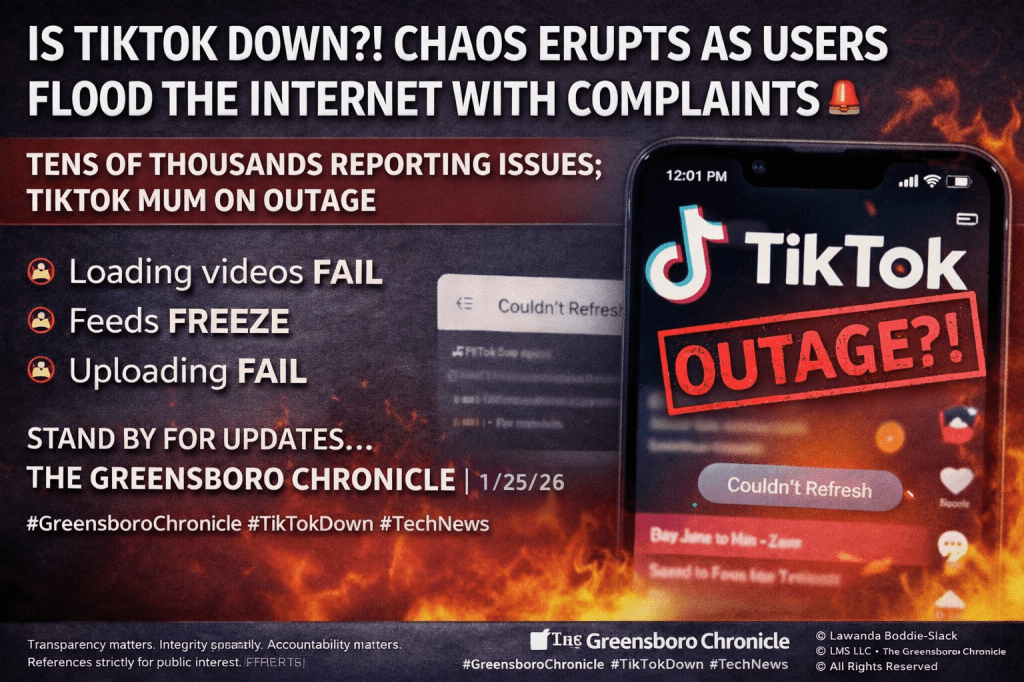
  • 🚨 IS TIKTOK DOWN?! CHAOS ERUPTS AS USERS FLOOD THE INTERNET WITH COMPLAINTS 🚨

    By The Greensboro Chronicle | 1/25/26

    TikTok may be having a major meltdown — and users are NOT staying quiet about it.

    As of today, tens of thousands of users across the U.S. and beyond are reporting widespread issues with the wildly popular social media app. From videos refusing to load, to feeds freezing mid-scroll, to sudden logouts and upload failures, the complaints are stacking up fast.

    🔥 The result? Digital chaos.

    Creators are panicking. Businesses are sweating. And everyday users are asking the same urgent question:

    👉 Is TikTok down right now?

    Available on http://www.kimball.square.site

    What We Know So Far

    📉 A surge in outage reports has been recorded across multiple public tracking platforms. 📱 Users report problems with loading videos, posting content, comments not refreshing, and app crashes. 🕳️ TikTok has not yet released an official statement acknowledging the outage or explaining what’s causing the disruption.

    And in the absence of answers, speculation is running wild.

    Why This Matters

    TikTok isn’t just entertainment — it’s a business platform, marketing engine, news source, and income stream for millions. Even a short outage can mean:

    Lost revenue for creators and small businesses Missed promotions and scheduled campaigns Disrupted communications and engagement

    When TikTok sneezes, the internet catches a cold.

    Now available at http://www.jjlbsllc.square.site

    What Happens Next?

    Right now, users are refreshing, reinstalling, restarting, and waiting. Tech analysts say outages of this scale are often linked to:

    Server disruptions Software updates gone wrong Backend infrastructure issues

    But until TikTok speaks, everything remains unconfirmed.

    🕵🏽‍♀️ The Greensboro Chronicle is monitoring the situation closely and will provide updates as soon as new, verified information becomes available.

    Stay tuned. Stay alert. And maybe… save that draft.

    Show your support

    Legal Disclaimer & Copyright Statement

    Transparency matters. Integrity matters. Accountability matters.

    At The Greensboro Chronicle, our investigative reporting is grounded in publicly available records, documented sources, and firsthand accounts submitted by our readers. References to individuals or businesses are made strictly in the public interest and do not constitute findings of liability or wrongdoing.

    All allegations are presented as such and remain subject to verification, response, and adjudication by appropriate legal or regulatory authorities. We welcome factual corrections and the opportunity for response from all parties mentioned.

    Copyright Notice – 2026

    All content is protected under applicable copyright laws. Unauthorized reproduction, redistribution, or misuse of our original work is strictly prohibited.

    © Lawanda Boddie-Slack

    © JJLBS LLC d/b/a JJLBS Professional Administrative Services

    © The Greensboro Chronicle

    © The Phoenix Store Online

    All Rights Reserved.

    We stand on truth, due process, and responsible journalism.

    👍 Like

    🔁 Share

    💬 Comment

    ➕ Follow & Subscribe

    #GreensboroChronicle #Transparency #InvestigativeJournalism #PublicInterest #CopyrightProtected #IndependentMedia #Accountability #ResponsibleReporting

  • From Tuskegee to Today: Why Many Believe a New Experiment Is Currently Happening

    January 25, 2026

    Lorene Hardy Investigative Journalist

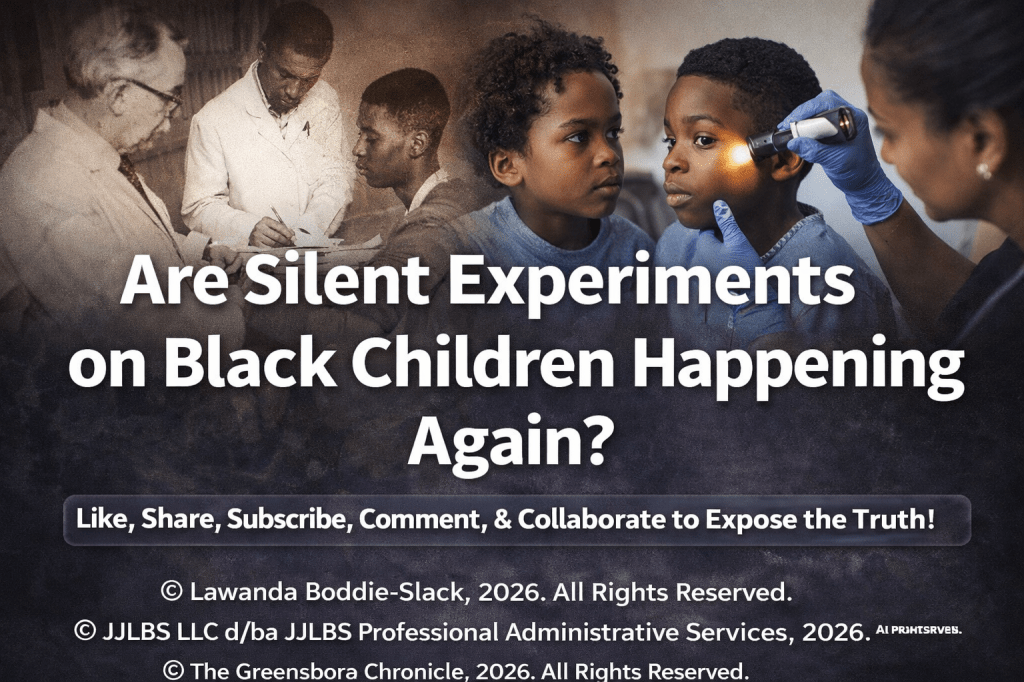
    Is this a modern day Tuskegee Style experiment happening?

    Executive Summary

    For Black Americans, fear of government medical or behavioral “experimentation” is not rooted in conspiracy—it is rooted in history. The Tuskegee Syphilis Study proved that unethical practices can exist for decades under official authority while remaining hidden from public scrutiny.

    Today, no publicly acknowledged federal study mirrors Tuskegee in name or stated purpose. However, an alleged and currently unfolding pattern of policies, pilot programs, and data-driven interventions involving Black children has triggered alarm among civil rights attorneys, parents, ethicists, and public health advocates.

    This report examines:

    What is documented What is alleged Why the comparison to Tuskegee is being raised again And why transparency is urgently needed before harm is normalized

    I. What the Tuskegee Study Was — and Why It Still Matters

    The Tuskegee Study was not a rogue operation. It was:

    Designed and funded by the U.S. government Justified as “public health research” Conducted on a racially isolated population Hidden behind bureaucracy and medical authority

    Participants were never told the truth, never gave informed consent, and were denied treatment even after a cure existed.

    Key lesson:

    Tuskegee was not discovered because the government came clean—it ended because outsiders exposed it.

    II. What Is Alleged to Be Happening Now

    ⚠️ Important Distinction

    There is no confirmed public record of a declared medical experiment targeting Black children.

    What is alleged is something more subtle—and historically familiar.

    Back to the Future Jersey for sale http://www.jjlbsllc.square.site

    III. The Alleged “New Study” — What Advocates Are Pointing To

    Civil rights groups and parents describe a multi-layered system that they argue functions like an experiment, even if it is not labeled as one.

    1. Target Population

    Disproportionately Black children Concentrated in low-income or state-dependent settings Often involved with: Public schools Foster care systems Juvenile justice pipelines Public health or behavioral programs

    This mirrors Tuskegee’s reliance on a population with limited power to refuse.

    2. Interventions Without Clear, Plain-Language Consent

    Allegations include:

    Behavioral or psychological screening embedded in schools Data collection tied to “wellness,” “risk,” or “early intervention” programs Medication practices in foster care with minimal parental oversight Digital tracking, predictive analytics, and “risk scoring”

    Parents report learning after the fact—or not at all.

    3. Data as the New Needle

    Unlike Tuskegee’s physical procedures, today’s alleged experiment is said to rely on:

    Longitudinal data collection Algorithmic modeling Behavioral modification frameworks Public-private data sharing

    The harm, critics argue, may not be immediate—but cumulative and permanent.

    4. Opacity by Design

    Advocates cite:

    Programs launched as “pilots” or “demonstrations” Fragmented oversight across agencies Private contractors shielded from public records laws Consent buried in complex forms or school enrollment paperwork

    As with Tuskegee, complexity becomes camouflage.

    Available on http://www.jjlbsllc.square.site

    IV. Why Black Families See the Warning Signs Early

    Black communities recognize patterns because they have lived them:

    Being told programs are “for their benefit” Being excluded from decision-making Being reassured by experts—until damage is undeniable

    As many advocates say:

    “We’re not saying this is Tuskegee.

    We’re saying this is how Tuskegee started.”

    V. What Transparency Would Require — And Why It’s Missing

    If nothing unethical is happening, transparency should be easy.

    Advocates are calling for:

    Full public disclosure of programs involving children Independent audits with community representation Plain-language explanations of risks and data use Opt-out mechanisms without retaliation Strong whistleblower protections

    Resistance to these requests is what fuels suspicion.

    Mass mediation cases filed in the investigation of DriveTime and Bridgecrest financial

    VI. Why Waiting for Proof Is Dangerous

    Tuskegee ended only after damage was already done.

    History shows that unethical practices are rarely announced—they are:

    Justified Normalized Defended And only later condemned

    The question is not whether history repeats exactly, but whether it rhymes quietly enough to escape notice.

    Call to Action: Stop History Before It Writes Itself

    We do not need another official apology decades from now.

    V. Why Black Families See the Warning Signs Early

    Black communities recognize patterns because they have lived them:

    Being told programs are “for their benefit” Being excluded from decision-making Being reassured by experts—until damage is undeniable

    As many advocates say:

    “We’re not saying this is Tuskegee.

    We’re saying this is how Tuskegee started.”

    VI. What Transparency Would Require — And Why It’s Missing

    If nothing unethical is happening, transparency should be easy.

    Support us on all social media platforms today!

    Advocates are calling for:

    Full public disclosure of programs involving children Independent audits with community representation Plain-language explanations of risks and data use Opt-out mechanisms without retaliation Strong whistleblower protections

    Resistance to these requests is what fuels suspicion.

    VII. Why Waiting for Proof Is Dangerous

    Tuskegee ended only after damage was already done.

    History shows that unethical practices are rarely announced—they are:

    Justified Normalized Defended And only later condemned

    The question is not whether history repeats exactly, but whether it rhymes quietly enough to escape notice.

    Call to Action: Stop History Before It Writes Itself

    We do not need another official apology decades from now.

    Demand action now:

    Ask schools and agencies what data they collect on children Support FOIA and public records requests Insist on community oversight Challenge programs that operate without transparency Speak publicly and collectively

    Black children are not test cases.

    Black families are not collateral.

    And silence has never been neutral.

    Ask schools and agencies what data they collect on children Support FOIA and public records requests Insist on community oversight Challenge programs that operate without transparency Speak publicly and collectively

    Black children are not test cases.

    LEGAL DISCLAIMER & COPYRIGHT NOTICE

    Black families are not collateral.

    And silence has never been neutral.

    Transparency matters. Integrity matters. Accountability matters.

    At The Greensboro Chronicle, our investigative reporting is grounded in publicly available records, documented sources, and firsthand accounts submitted by our readers. References to individuals or businesses are made strictly in the public interest and do not constitute findings of liability or wrongdoing.

    All allegations are presented as such and remain subject to verification, response, and adjudication by appropriate legal or regulatory authorities. We welcome factual corrections and the opportunity for response from all parties mentioned.

    Copyright Notice – 2026

    All content is protected under applicable copyright laws. Unauthorized reproduction, redistribution, or misuse of our original work is strictly prohibited.

    © Lawanda Boddie-Slack

    © JJLBS LLC d/b/a JJLBS Professional Administrative Services

    © The Greensboro Chronicle

    © The Phoenix Store Online

    All Rights Reserved.

    We stand on truth, due process, and responsible journalism.

    👍 Like

    🔁 Share

    💬 Comment

    📰 Follow & Subscribe

    #GreensboroChronicle #Transparency #InvestigativeJournalism #PublicInterest #CopyrightProtected #IndependentMedia #Accountability #ResponsibleReporting

  • Education & Learning

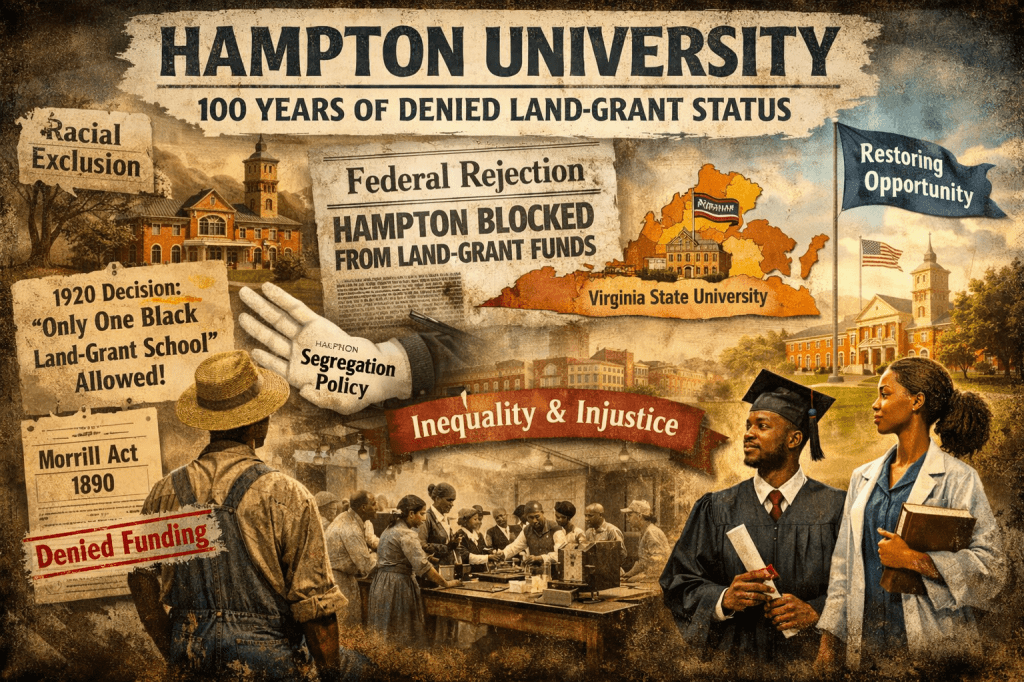
    Restoring What Was Denied: Hampton University, Land-Grant Status, and the Long Shadow of Segregation

    For more than a century, a decision rooted in segregation-era thinking quietly shaped higher education in Virginia: the federal government refused to recognize Hampton University as a land-grant institution, not because it failed to qualify—but because policymakers believed only one Black institution in the state was allowed to receive land-grant funding.

    Now, Virginia lawmakers are attempting to reverse that injustice. Their effort is not simply about money or classification. It is about correcting a historic wrong, modernizing public policy, and confronting how racial exclusion was embedded into federal and state systems for generations.

    This article explains what happened, why it mattered, and what restoring Hampton’s land-grant status could mean today—in clear, plain language.

    What Is a Land-Grant University—and Why It Matters

    Land-grant universities were created under the Morrill Act of 1862, which gave states federal land to fund colleges focused on agriculture, engineering, and practical education. A second law, the Morrill Act of 1890, extended land-grant funding to Black colleges in Southern states that still enforced segregation.

    Land-grant status comes with:

    Ongoing federal funding Research grants and infrastructure investment Cooperative extension programs serving communities statewide Agricultural, scientific, and technical workforce development

    In short: land-grant universities are engines of economic mobility and public service.

    The 1920 Decision: “Only One Black Land-Grant School”

    Virginia’s response to the 1890 Morrill Act was shaped by segregation. Rather than allow multiple Black institutions to share in land-grant resources, state and federal officials designated Virginia State University (then Virginia Normal and Industrial Institute) as the sole Black land-grant institution.

    Hampton University—founded in 1868 and nationally respected for agricultural, industrial, and teacher education—was excluded.

    The rationale was not academic. It was political and racial:

    Funding Black education was seen as a concession, not an investment White-controlled systems wanted strict limits on Black institutional growth Officials feared that multiple well-funded Black universities would threaten segregation’s economic hierarchy

    By 1920, federal authorities formally denied Hampton special land-grant funds on the basis that Virginia had already “fulfilled” its obligation by supporting one Black institution.

    This logic would never have been applied to white colleges.

    The Long-Term Impact of Exclusion

    The denial had consequences that compounded over generations.

    1. Lost Investment

    While white land-grant universities accumulated hundreds of millions of dollars over decades, Hampton was forced to rely on private philanthropy, tuition, and limited state support.

    2. Restricted Research Capacity

    Without land-grant status, Hampton lacked access to federal agricultural experiment stations, extension services, and long-term research pipelines.

    3. Structural Inequality

    The decision reinforced a false hierarchy: that Black institutions had to compete with one another for legitimacy and resources, while white institutions expanded freely.

    4. Generational Harm

    Students, faculty, farmers, and communities that could have benefited from Hampton-led research and outreach simply never received those services.

    This wasn’t accidental. It was policy by design.

    Why Lawmakers Are Acting Now

    Today’s push to restore Hampton’s land-grant status is part of a broader national reckoning with segregation-era laws that were never formally undone—only ignored.

    Lawmakers argue:

    The 1920 decision violates modern principles of equal protection and equity There is no legal or moral basis for limiting land-grant status to one Black institution per state Federal law does not cap the number of eligible institutions

    Importantly, this effort is not about stripping resources from Virginia State University. It is about acknowledging that Hampton was unjustly excluded and deserves parallel recognition.

    What Restoring Land-Grant Status Would Change

    If Hampton’s land-grant status is restored, the effects would be concrete and measurable.

    New Federal Funding Streams

    Hampton would gain access to agricultural research funding, STEM grants, and infrastructure support previously unavailable.

    Community-Based Extension Services

    Programs supporting farmers, entrepreneurs, and families—especially in underserved communities—could expand statewide.

    Workforce Development

    More investment in engineering, environmental science, cybersecurity, and applied research aligned with today’s economy.

    National Precedent

    Restoration would signal that historic discrimination can—and should—be corrected, even decades later.

    This is not symbolic reform. It is structural repair.

    Why This Moment Matters

    Segregation didn’t end simply because laws changed. Many discriminatory policies were never repealed—they were just left standing.

    The effort to restore Hampton University’s land-grant status asks a direct question:

    If a decision was wrong when it was made, and its harm is still measurable today, do we have a responsibility to fix it?

    Virginia lawmakers are saying yes.

    And if successful, this reversal would stand as a reminder that equity isn’t about favoritism—it’s about finally honoring commitments that were denied on the basis of race.

    Bottom Line

    For over 100 years, Hampton University was excluded from land-grant funding not because it failed to qualify, but because policymakers believed Black excellence must be rationed.

    Restoring Hampton’s land-grant status is about more than correcting a footnote in history. It is about dismantling a policy built on exclusion and replacing it with one grounded in opportunity, fairness, and truth.

    History made the wound. Policy has the power to heal it.

    Watch the full video on YouTube

    LEGAL DISCLAIMER & COPYRIGHT NOTICE

    Transparency matters. Integrity matters. Accountability matters.

    At The Greensboro Chronicle, our investigative reporting is grounded in publicly available records, documented sources, and firsthand accounts submitted by our readers. References to individuals or businesses are made strictly in the public interest and do not constitute findings of liability or wrongdoing.

    All allegations are presented as such and remain subject to verification, response, and adjudication by appropriate legal or regulatory authorities. We welcome factual corrections and the opportunity for response from all parties mentioned.

    Copyright Notice – 2026

    All content is protected under applicable copyright laws. Unauthorized reproduction, redistribution, or misuse of our original work is strictly prohibited.

    © Lawanda Boddie-Slack

    © JJLBS LLC d/b/a JJLBS Professional Administrative Services

    © The Greensboro Chronicle

    © The Phoenix Store Online

    All Rights Reserved.

    📢 We stand on truth, due process, and responsible journalism.

    👍 Like

    🔁 Share

    💬 Comment

    📰 Follow & Subscribe

    #GreensboroChronicle #Transparency #InvestigativeJournalism #PublicInterest #CopyrightProtected #IndependentMedia #Accountability #ResponsibleReporting

  • Military and Veteran News

    🚨 Veterans Face Financial Risk After Emergency Care Without Timely VA Notification

    January 24, 2026

    Lorene Hardy Staff Writer

    A missed 72-hour reporting deadline following a non-VA emergency room or urgent care visit can leave veterans and their families responsible for thousands in medical bills—making immediate action, documentation, and awareness critical

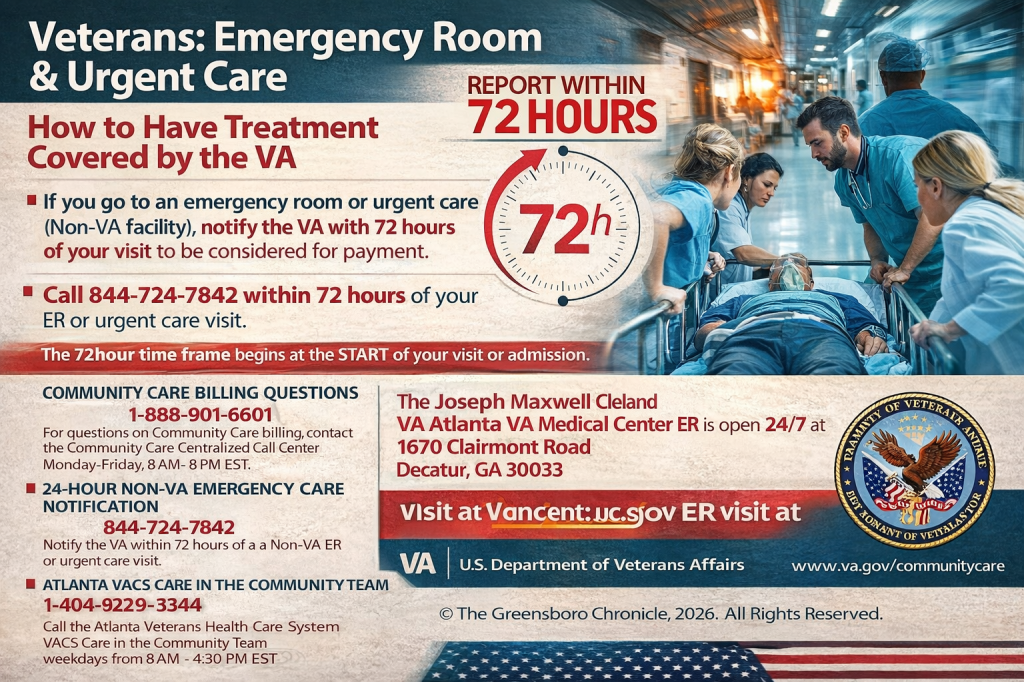
    Veterans have 72 hours from the start of medical care to notify the Department of Veterans Affairs that the veteran s receiving or has received medical care from a non-va facility

    If a Veteran receives emergency room or urgent care treatment at a NON-VA facility, there are critical steps that MUST be taken for the Department of Veterans Affairs to consider covering the bill.

    72-HOUR REPORTING WINDOW

    You must notify the Department of Veterans Affairs within 72 HOURS of the start of the ER or urgent care visit.

    ⚠️ The clock starts when care begins, not when you are discharged.

    📞 WHO TO CONTACT

    • 24-Hour Non-VA Emergency Care Notification: 844-724-7842

    • Community Care Billing Questions: 1-888-901-6601

    (Mon–Fri, 8 AM–8 PM EST)

    • Atlanta VAMC Care in the Community Team: 404-929-3344

    (Weekdays, 8 AM–4:30 PM EST)

    [Veterans are to contact their local representatives to report non-va care]

    Website: www.va.gov/community care

    Now available on http://www.jjlbsllc.square.site

    🏥 LOCAL VA EMERGENCY ROOM

    Joseph Maxwell Cleland Atlanta VA Medical Center

    📍 1670 Clairmont Road, Decatur, GA 30033

    🕐 Open 24/7

    Available on http://www.JJLBSllc.square.site

    ⚠️ WHY THIS MATTERS

    Failure to notify the VA within the 72-hour deadline may result in:

    • Denial of payment

    • The Veteran being personally responsible for thousands of dollars in medical bills

    • Delays or complications in future care coordination

    📝 IMPORTANT PROTECTION TIP

    Veterans and family members should:

    • Write down the date & time you called

    • Record who you spoke with

    • Keep confirmation numbers, call logs, or emails

    • Save hospital paperwork and discharge records

    📌 BOTTOM LINE

    VA payment is NOT guaranteed—but timely reporting is required to even be considered.

    When in doubt, CALL IMMEDIATELY. Your health comes first—but protecting your benefits comes next.

    Watch the full video on YouTube:

    © The Greensboro Chronicle, 2026. All Rights Reserved

    Legal Disclaimer

    The Greensboro Chronicle publishes investigative reporting based on publicly available records, documents, and firsthand accounts submitted by readers. References to individuals or businesses are for public-interest purposes only and do not constitute findings of liability or wrongdoing. Allegations described are presented as such and remain subject to verification, response, and adjudication by appropriate legal or regulatory authorities. The Greensboro Chronicle welcomes factual corrections and the opportunity for response from all parties mentioned.

    COPYRIGHT NOTICE

    © Lawanda Boddie-Slack, 2026. All Rights Reserved.

    © JJLBS LLC d/b/a JJLBS Professional Administrative Services, 2026. All Rights Reserved.

    © The Greensboro Chronicle, 2026. All Rights Reserved.

    © The Phoenix Store Online, 2026. All Rights Reserved.
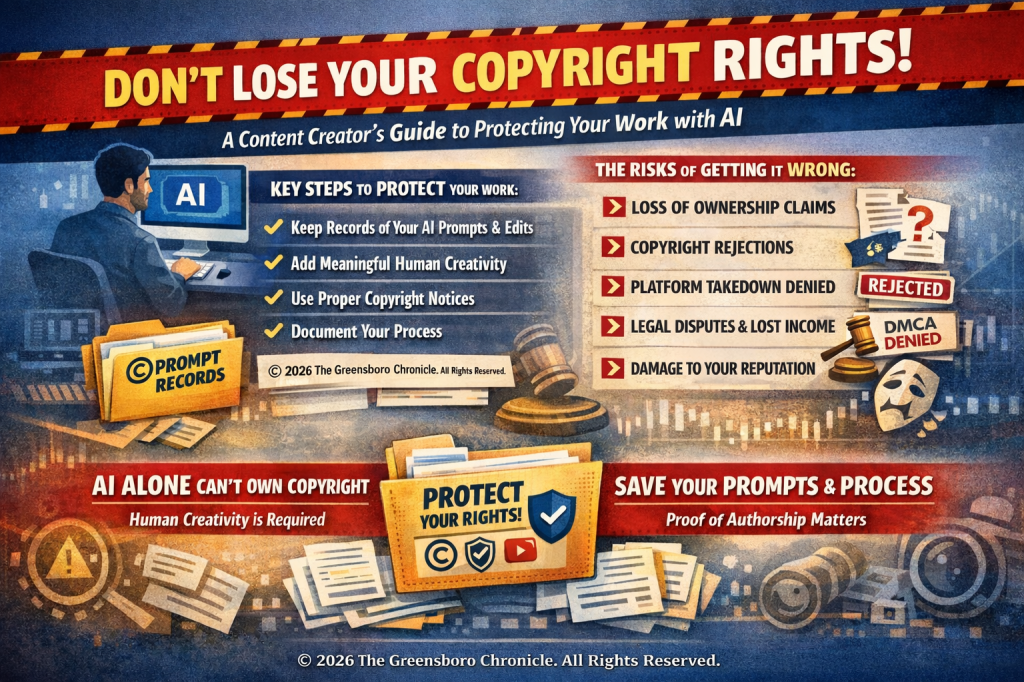
  • Copyright Protection for Content Creators Using AI

    Why Keeping AI Prompt Records Matters

    How Documentation and Human Creativity Protect Your Copyright—and What Happens If You Skip Them

    As AI tools become common in writing, design, photography, journalism, and marketing, creators are learning a hard truth:

    Copyright protection doesn’t just depend on what you publish—it depends on what you can prove.

    Two things now matter more than ever:

    Keeping records of the AI prompts and process used Ensuring meaningful human creative involvement

    Failing to do either can leave your work legally exposed, unenforceable, or even unprotectable.

    Let’s break this down in plain language.

    Why AI Prompt Records Are Important

    When AI is involved, ownership is no longer obvious from the final product alone.

    Prompt records help establish:

    Human intent Creative decision-making Authorship Timeline of creation

    In other words, prompt records help show that you were the creative force—not the machine.

    Think of them as receipts for creativity.

    What Counts as an AI Prompt Record?

    Prompt records can include:

    The original prompts you wrote Follow-up prompts refining tone, structure, or style Instructions directing content purpose or message Iterative changes (“rewrite this with a legal tone,” “add investigative framing,” etc.) Notes explaining why changes were made

    You don’t need anything fancy. Even:

    Saved text files Screenshots Draft histories Time-stamped notes

    can establish authorship.

    Why Prompts Alone Are Not Enough

    Here’s the critical distinction many creators miss:

    Prompting is not the same as authorship.

    Simple prompts like:

    “Write an article about copyright” “Generate an image of a phoenix”

    do not qualify as meaningful human creativity by themselves.

    To secure copyright protection, you must show:

    Creative judgment Original expression Editorial control Substantive modification or selection

    AI can assist—but you must shape the work.

    What “Meaningful Human Interaction” Actually Means

    Meaningful human involvement includes:

    Editing AI output substantially Rewriting sections in your own voice Choosing structure, framing, or narrative Combining AI output with original content Making artistic or journalistic decisions Rejecting and revising multiple drafts

    Put simply:

    You must leave fingerprints on the work.

    If your role stops at “generate” and “publish,” copyright protection is shaky at best.

    Why Documentation + Human Creativity Go Together

    Prompt records alone do not secure copyright.

    Human creativity alone may be hard to prove later.

    Together, they:

    Show your creative process Establish authorship if challenged Strengthen takedown notices Support copyright registration Protect you in disputes or court

    This combination is what turns AI-assisted work into legally defensible creative property.

    Consequences of Failing to Keep Prompt Records

    1. You May Be Unable to Prove Ownership

    If someone copies your AI-assisted work and challenges your claim:

    You may not be able to show how the work was created Others may claim it was fully AI-generated Platforms may deny enforcement requests

    Without records, your word alone may not be enough.

    2. Your Copyright Claim Can Collapse Under Scrutiny

    If you claim human authorship but cannot demonstrate it:

    Registration can be rejected or canceled Courts may rule the work unprotectable Infringers may legally reuse your content

    This is especially dangerous for journalists, advocacy groups, and businesses.

    3. You May Lose the Ability to Enforce Against Theft

    No proof of authorship means:

    Weak DMCA takedown claims Delayed or denied removals Lost revenue and exposure

    Copyright is only as strong as the evidence behind it.

    4. Your Credibility Can Be Damaged

    For professional creators:

    Over-claiming AI work as fully original can backfire Transparency failures undermine trust Audiences and partners may question integrity

    Proper documentation protects not just your rights—but your reputation.

    Best Practices for AI-Assisted Creators

    To protect yourself:

    Save AI prompts and revisions Keep drafts showing edits and changes Add substantial original input Avoid publishing raw AI output Use copyright notices only on final, human-authored versions Be honest and accurate in registrations or disclosures Treat AI like a tool—not a shortcut.

    The Bottom Line

    AI makes creation faster—but proof makes it protectable.

    If you fail to:

    Keep prompt records Add meaningful human creativity Document your process

    You risk losing:

    Ownership Enforcement rights Income Credibility

    In the AI era, copyright protection begins long before publication—it begins with how you create and what you preserve.

    Create thoughtfully. Document carefully. Protect intentionally.

    Watch the full video on YouTube

    ©️2026 The Greensboro Chronicle. All Rights Reserved.
    Pages: 1 2 3

  • Investigative Report

    January 23, 2026

    Lorene Hardy Investigative Journalist

    Department of Veterans Affairs Overhaul: A Turning Point—or Breaking Point—for Veteran Care?

    A turning point or breaking point

    For the first time in nearly 30 years, the Department of Veterans Affairs (VA) is proposing a sweeping structural overhaul of its health care system—one that could fundamentally reshape how veterans access care nationwide. The plan would reduce the VA’s regional Veterans Integrated Service Networks (VISNs) from 18 down to just five, while also eliminating a top executive leadership position intended to centralize authority and streamline decision-making.

    Supporters frame the proposal as long overdue modernization. Critics warn it risks repeating the very failures that past reforms were meant to fix.

    This investigation examines what the overhaul actually changes—and what it could mean for veterans of World War II, Vietnam, Desert Storm, and the War on Terror.

    The Phoenix Store Online now accepts Buy Now Pay Later

    What Is Being Proposed?

    At the core of the plan are two major shifts:

    1. Regional Consolidation

    VISNs currently act as semi-autonomous regional systems. Under the proposal, those 18 networks would be consolidated into five “super-regions.” Decision-making authority would move further away from local VA medical centers and clinics.

    2. Leadership Restructuring

    A senior executive role overseeing veterans’ health administration would be eliminated. Power would be redistributed upward, concentrating authority at VA headquarters.

    VA leadership argues this will:

    Reduce bureaucracy Standardize care delivery Improve efficiency and accountability

    Veteran advocates counter that it could:

    Slow response times Erase regional nuance Reduce local oversight and advocacy

    Impact by Veteran Era

    🪖 World War II Veterans

    Average age: Late 90s to 100+ Primary needs: Geriatric care, long-term care, mobility support, end-of-life services

    Potential Impact:

    Centralization may delay approvals for home-based and community care. Rural WWII veterans—already facing limited VA facility access—may struggle if regional advocacy weakens. Any administrative delay disproportionately affects this population, where time is the most critical factor.

    Risk: A system optimized for efficiency may overlook urgency.

    🎖️ Vietnam Veterans

    Primary needs: Agent Orange–related conditions, cancer care, cardiovascular disease, PTSD

    Potential Impact:

    Vietnam veterans rely heavily on established VA relationships and specialists familiar with toxic exposure claims. Fewer regional networks could mean less flexibility in addressing complex, service-connected conditions. Appeals and claims processing may slow if decision-making becomes more centralized and standardized.
    Risk: One-size-fits-all policy may undermine decades of hard-won recognition for Vietnam-era exposures.

    🏜️ Desert Storm Veterans

    Primary needs: Gulf War Illness, autoimmune conditions, neurological disorders, unexplained chronic symptoms

    Potential Impact:

    Desert Storm veterans already face skepticism and under-recognition of service-related illness. A consolidated system may deprioritize conditions that don’t fit neatly into standardized diagnostic models. Reduced regional autonomy could weaken specialized clinics that currently champion Gulf War research and treatment.

    Risk: Marginalized conditions could be further sidelined.

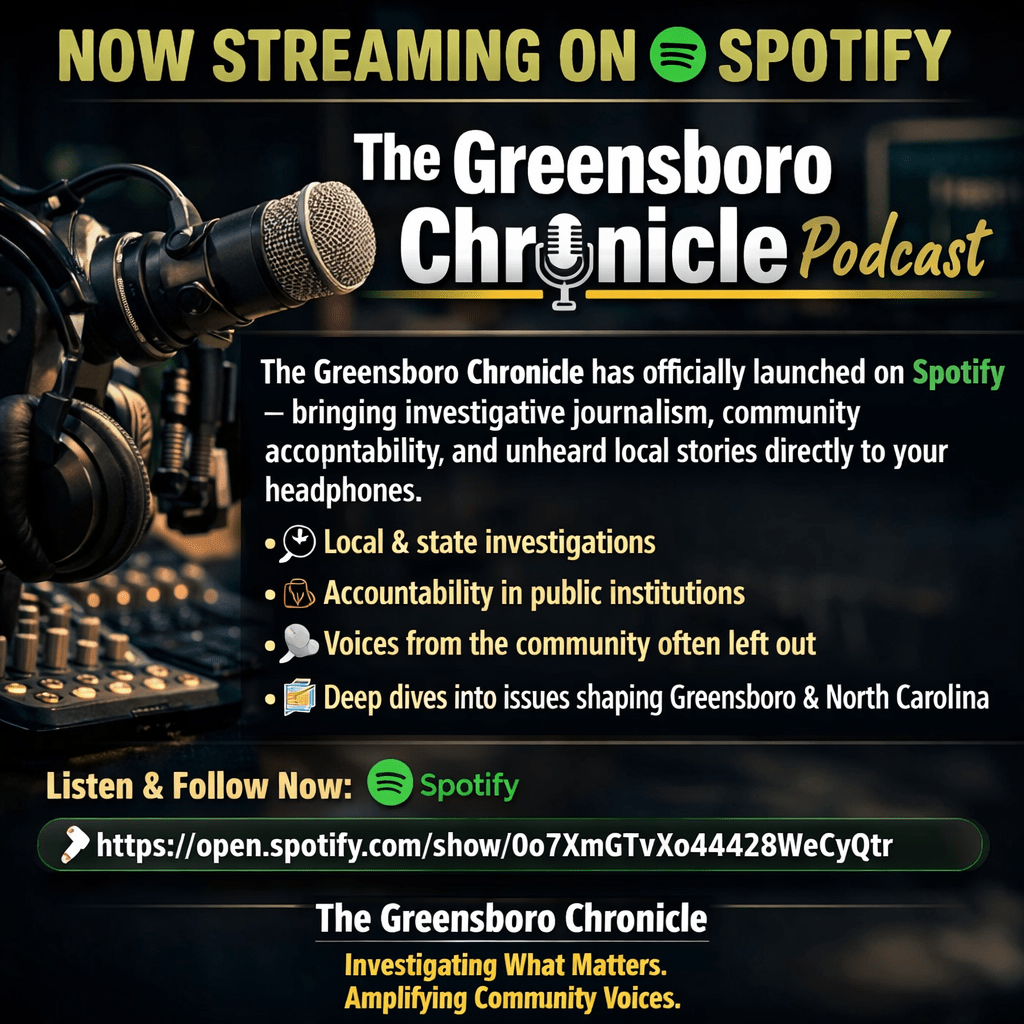
    The Greensboro Chronicle is now Spotify

    ⚔️ War on Terror Veterans (Iraq & Afghanistan)

    Primary needs: Traumatic brain injury (TBI), PTSD, suicide prevention, prosthetics, reintegration services

    Potential Impact:

    Younger veterans often rely on rapid mental health access and crisis intervention. Larger regions may mean longer wait times for specialized behavioral health services. Centralized leadership could struggle to adapt quickly to emerging needs, including moral injury and polytrauma care.

    Risk: Delays in mental health care can be life-threatening.

    The Bigger Question: Efficiency vs. Access

    The VA has pursued reform cycles before—often after scandals involving wait times, accountability, or mismanagement. While consolidation promises cost savings and uniformity, history shows that distance between leadership and patients often correlates with poorer outcomes, not better ones.

    Veterans’ health care is not interchangeable. It is shaped by:

    Era of service Type of warfare Environmental exposure Age and geography

    Reducing regional voices risks silencing the very advocates who understand those distinctions best.

    Accountability Concerns

    Eliminating a senior executive role raises serious oversight questions:

    Who is ultimately responsible when care fails? How will veterans escalate urgent regional issues? Will Congress and watchdogs have clearer—or murkier—lines of accountability?

    Without strong safeguards, consolidation may blur responsibility instead of clarifying it.

    What Happens Next?

    The proposal is still under review, and veteran input will be critical in determining whether this overhaul moves forward—and in what form.

    📣 Call to Action: Veterans & Families—Your Voices Matter

    If you are:

    A veteran from WWII, Vietnam, Desert Storm, or the War on Terror A family member or caregiver A VA employee or provider

    We want to hear from you.

    We want to know how these changes affect the services you [or your loved one].

    How would this overhaul affect your access to care?

    Have regional VA offices helped—or hindered—your experience?

    What must not be lost in the name of efficiency?

    📩 Submit your experiences, concerns, and insights.

    🔒 Confidential tips and firsthand accounts welcome.

    Reform should not happen to veterans—it must happen with them.

    Watch the full video on YouTube

    The Greensboro Chronicle Contact Us
  • The Greensboro Chronicle Investigates – Consumer Protection
    Have a story for us to investigate?

    DriveTime & Bridgecrest Under Scrutiny

    An Investigative Look at Alleged Online Payment Fee Violations and Mass Arbitration Efforts

    DriveTime & Bridgecrest under fire

    A growing wave of consumer complaints and legal scrutiny is placing DriveTime and its affiliated auto-loan servicer Bridgecrest under the microscope. Attorneys investigating the companies’ online payment practices allege that borrowers may have been charged undisclosed or inadequately disclosed convenience fees when making loan payments through Bridgecrest’s online portal—potentially violating state and federal lending and debt-collection laws.

    Now, law firms are organizing mass arbitration claims on behalf of affected borrowers. If you made an online payment through Bridgecrest within the past 12 months, your claim could be worth hundreds of dollars.

    The DriveTime–Bridgecrest Relationship

    DriveTime operates as one of the nation’s largest buy-here-pay-here-style used vehicle retailers, targeting consumers with limited or damaged credit histories. Most DriveTime customers do not receive traditional third-party auto loans. Instead, their financing is commonly serviced by Bridgecrest, a related entity that manages billing, payments, and collections.

    This vertical integration—vehicle sales, financing, and loan servicing under one corporate umbrella—has long raised concerns among consumer advocates about transparency, leverage over borrowers, and fee practices.

    What Borrowers Are Alleging

    At the center of the emerging legal action is a deceptively small line item: online payment fees.

    Borrowers allege that when making payments through Bridgecrest’s online portal:

    Fees were added at checkout without clear advance disclosure The fees were framed as optional or unavoidable without offering a fee-free alternative that was equally accessible Disclosures were buried in fine print, vague language, or post-login screens Consumers were not clearly informed whether fees went to Bridgecrest, a third-party processor, or both

    In many cases, borrowers report discovering the fee only after completing the transaction, leaving them with no realistic opportunity to avoid it.

    Why This May Be Illegal

    Most states have adopted their own version of the UDTPA that mirror the fedeal law.

    Legal experts point to several consumer-protection laws that may be implicated:

    1. Truth in Lending Act (TILA)

    TILA requires lenders and servicers to clearly and conspicuously disclose all finance charges connected to a loan. If online payment fees are effectively mandatory or routinely incurred, they may qualify as finance charges requiring upfront disclosure.

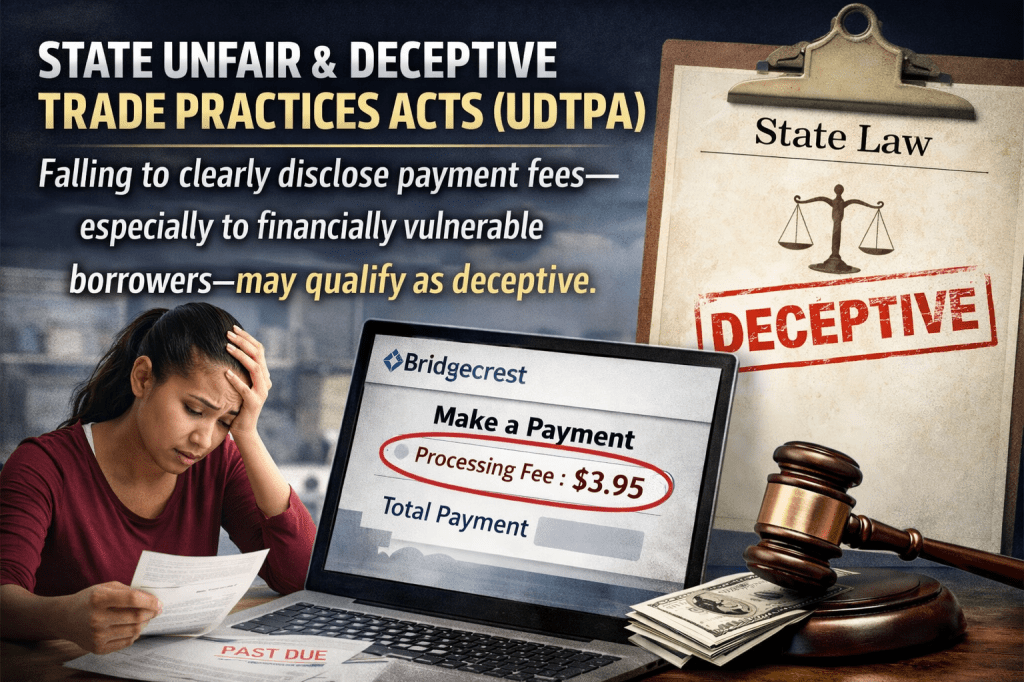
    2. State Unfair and Deceptive Trade Practices Acts (UDTPA)

    Most states prohibit business practices that mislead consumers or omit material information. Failing to clearly disclose payment fees—especially to financially vulnerable borrowers—may qualify as deceptive.

    3. Fair Debt Collection Practices Act (FDCPA)

    While typically applied to third-party collectors, courts have increasingly scrutinized servicing practices that add unauthorized fees or misrepresent amounts owed.

    4. Electronic Fund Transfer Act (EFTA)

    EFTA governs electronic payments and prohibits conditioning payments on fees unless certain disclosures and alternatives are provided.

    Why Mass Arbitration Is Being Used

    Rather than filing a traditional class-action lawsuit, attorneys are pursuing mass arbitration—a strategy increasingly used when companies include arbitration clauses in consumer contracts.

    Under this approach:

    Each borrower files an individual arbitration claim Companies must pay filing and administrative fees for each case When hundreds or thousands of claims are filed simultaneously, costs can escalate rapidly

    This strategy has proven effective in forcing large corporations to settle claims or reform practices, even when class actions are contractually restricted.

    Who May Be Eligible

    Who may be eligible to receive compensation

    You may qualify to participate if:

    You financed a vehicle through DriveTime Your loan was serviced by Bridgecrest You made one or more online payments through Bridgecrest’s portal A fee was charged in connection with that payment The payment occurred within the last year (timeframes vary by state)

    Even small fees—$3, $5, or $10 per payment—can add up to significant statutory damages when consumer-protection laws are violated.

    Potential Compensation

    While outcomes vary, attorneys involved in similar cases report that successful claims may result in:

    Refunds of all fees paid Statutory damages under consumer-protection laws Settlement payments ranging from tens to hundreds of dollars per borrower Policy changes requiring clearer disclosures or fee elimination

    Importantly, participation in mass arbitration typically does not require upfront legal fees for borrowers.

    The Bigger Picture: Subprime Auto Lending Under Fire

    This investigation fits into a broader national reckoning over subprime auto lending, where consumers with few alternatives are often subjected to:

    Aggressive fee structures Limited payment options High-interest rates paired with add-on charges Opaque servicing practices

    Regulators, including the Consumer Financial Protection Bureau, have repeatedly warned that digital payment platforms are not exempt from disclosure requirements simply because transactions occur online.

    What Borrowers Should Do Now

    If you believe you were affected:

    Review your payment history and look for “convenience,” “processing,” or “online payment” fees Save screenshots or statements showing the fees Document how and when the fee was disclosed (if at all) Monitor announcements from consumer-rights law firms gathering DriveTime/Bridgecrest borrowers

    Why This Investigation Matters

    For many borrowers, a few dollars per payment may not seem worth challenging. But consumer advocates stress that systematic small fees, applied across tens of thousands of accounts, can generate millions in revenue—often extracted from consumers least able to absorb the cost.

    If the allegations are proven, this case could force meaningful changes in how auto lenders disclose fees, design payment portals, and treat borrowers navigating already precarious financial situations.

    The Greensboro Chronicle will continue monitoring this developing legal action and its implications for consumer rights nationwide.

    Watch the full video on YouTube

  • Podcast Links
  • Updates & Announcements

    The Greensboro Chronicle webpage serves as the central hub for official announcements, updates, and timely information related to the organization. It provides visitors with clear insight into the outlet’s direction, priorities, and ongoing initiatives.

    The page features updates on new content releases, platform expansions, partnerships, and coverage milestones, keeping readers informed about what’s new and what’s coming next. It also highlights important notices that affect how audiences engage with the Chronicle’s work.

    Designed for transparency and accessibility, the announcements page reinforces The Greensboro Chronicle’s commitment to accountability, consistent communication, and staying closely connected with the community it serves.

    January – March, 2026

    January 18, 2026

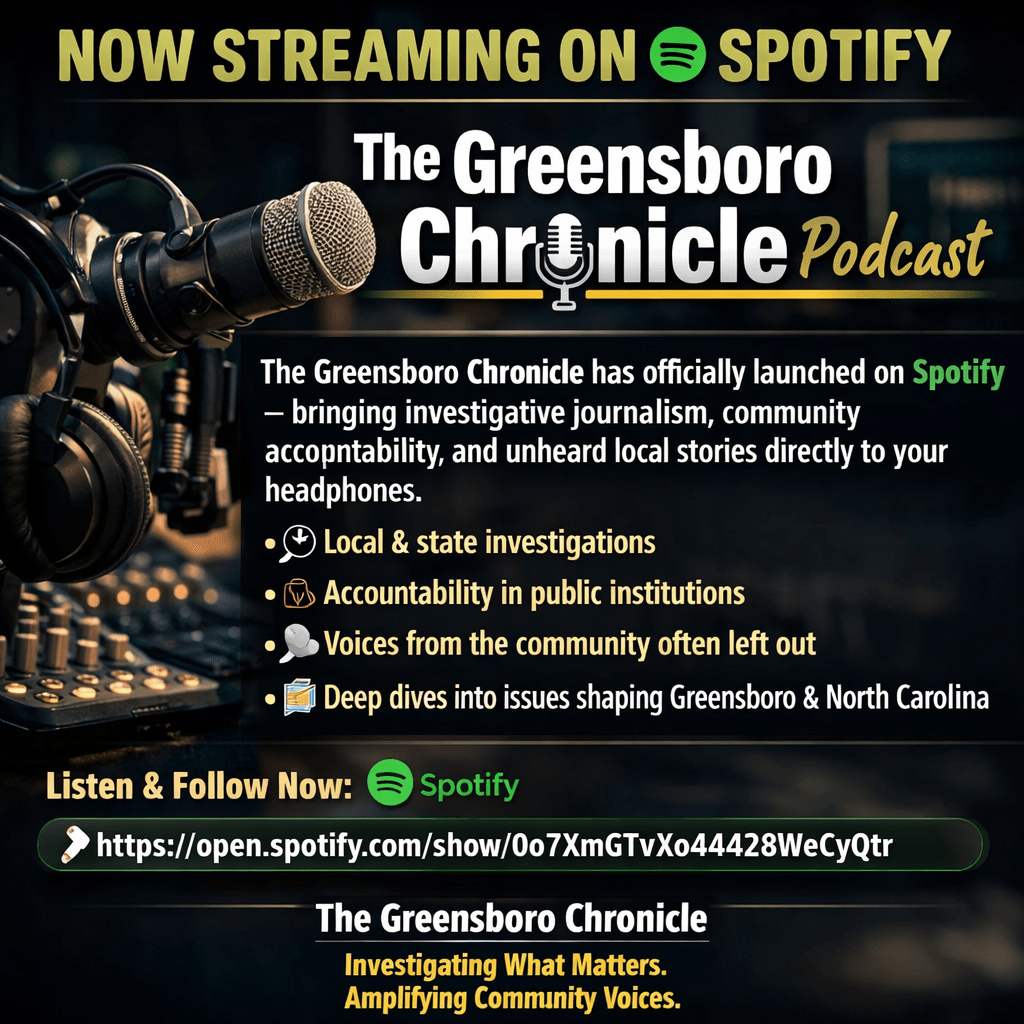
    The Greensboro Chronicle is now on Spotify.