Greensboro Chronicle

Where Journalism and Advocacy Come Together

Copyright 2026 The Greensboro Chronicle. All Rights Reserved.

Greensboro Chronicle, we believe journalism is more than reporting the news—it’s about uncovering the truth, amplifying community voices, and working toward real solutions.

We are an independent investigative news platform dedicated to shining a light on issues that matter most to the people of Greensboro. From housing and local governance to public safety, business, and neighborhood life, our mission is to hold power accountable while fostering meaningful dialogue among residents.

The Chronicle isn’t just a newsroom—it’s a community hub. We invite readers to not only stay informed, but also to participate in the conversation, share perspectives, and collaborate on solutions that strengthen our city.

Together, we can confront challenges, celebrate resilience, and shape a more transparent, just, and thriving Greensboro.

Greensboro Chronicle Investigative Staff and Volunteers

Here at the Greensboro Chronicle we do more than just reporting on the situations. We facilitate holding the hard, tough, and uncomfortable conversations. The end goal is to always act with integrity and encourage unity.
  • North Carolina HBCU Unable to Pay Staff This Month

    A legal victory couldn’t stop the financial freefall—and now the warning signs are flashing red across Black higher education

    By The Greensboro Chronicle

    Investigations & Accountability Desk

    Just weeks ago, there was cautious celebration.

    After a bruising three-year property tax battle, Barber-Scotia College finally secured a ruling preserving its long-standing tax-exempt educational status—a legal win that administrators hoped would stabilize the school’s finances and buy critical time.

    Instead, the victory marked the calm before the collapse.

    This week, the college’s president confirmed what faculty, staff, and students had already begun to fear: Barber-Scotia College has completely run out of money and is unable to pay employees this month.

    The revelation has sent shockwaves through North Carolina’s higher-education community and reignited urgent questions about the fragility of America’s historically Black colleges and universities (HBCUs)—especially smaller, private institutions already operating on razor-thin margins.

    A WIN IN COURT—AND A LOSS IN REAL LIFE

    The tax ruling was expected to ease one of Barber-Scotia’s most persistent financial burdens. For years, the school fought local authorities over property taxes that administrators argued threatened the institution’s survival. The final decision preserved the college’s nonprofit, educational exemption—on paper, a decisive win.

    But court victories do not generate cash flow.

    According to public statements and financial disclosures, Barber-Scotia entered the ruling already deeply cash-strapped, burdened by deferred maintenance, declining enrollment, limited donor pipelines, and restricted access to large-scale endowments that cushion many larger universities.

    The legal relief removed one expense—but it did not replenish empty accounts.
    PAYCHECKS MISSED, TRUST SHAKEN

    The most alarming development is not theoretical.

    Faculty and staff were informed that payroll obligations cannot be met, a moment that often signals an institution has crossed from crisis into existential danger. Missed paychecks ripple outward—triggering housing insecurity, insurance lapses, and resignations that further destabilize operations.

    Higher-education finance experts note that when payroll interruptions occur, accreditation risks often follow, as accrediting bodies closely monitor an institution’s ability to meet basic operational standards.

    A FAMILIAR STORY ACROSS HBCUs

    While Barber-Scotia’s situation is acute, it is not isolated.

    Across the country, many small HBCUs face a dangerous convergence of pressures:

    Declining enrollment tied to demographic shifts Heavy reliance on tuition as primary revenue Aging infrastructure with limited capital investment Donor fatigue and uneven philanthropic attention Rising operational and compliance costs

    Legal wins, emergency fundraising, and short-term loans often provide temporary oxygen, but without sustained structural reform, they rarely change long-term outcomes.

    WHY THIS MATTERS BEYOND ONE CAMPUS

    HBCUs educate a disproportionate share of Black professionals, educators, engineers, and civic leaders. When one falters, the consequences extend far beyond payroll spreadsheets.

    Each closure, suspension, or financial emergency narrows access, erodes trust, and compounds historic inequities in higher education funding.

    And yet, public intervention frequently arrives late—or not at all.

    THE QUIET QUESTION NO ONE WANTS TO ASK

    If a court victory preserving tax-exempt status wasn’t enough to stabilize Barber-Scotia College, the uncomfortable question remains:

    How many other HBCUs are one missed payroll away from the same announcement?

    Financial disclosures, enrollment data, and public audits suggest Barber-Scotia may not be the last to confront this reckoning.

    The warning signs are visible.

    The timelines are tightening.

    And unless systemic funding gaps are addressed, additional HBCUs may soon face the same or strikingly similar crises—with little more than legal victories to show for their fight.

    Legal Disclaimer

    The Greensboro Chronicle publishes investigative and analytical content for informational and public-interest purposes only. All information contained in this article is derived from publicly available records, official statements, and reputable secondary sources believed to be accurate at the time of publication. This report does not constitute legal, financial, or professional advice. Individuals and institutions referenced are presumed to be acting in good faith unless otherwise established by verified evidence. Readers are encouraged to conduct their own independent research.

    Copyright Statement

    © Lawanda Boddie-Slack, 2026. All Rights Reserved.

    © JJLBS LLC d/b/a JJLBS Professional Administrative Services, 2026. All Rights Reserved.

    © The Greensboro Chronicle, 2026. All Rights Reserved.

    © The Phoenix Store Online, 2026. All Rights Reserved.
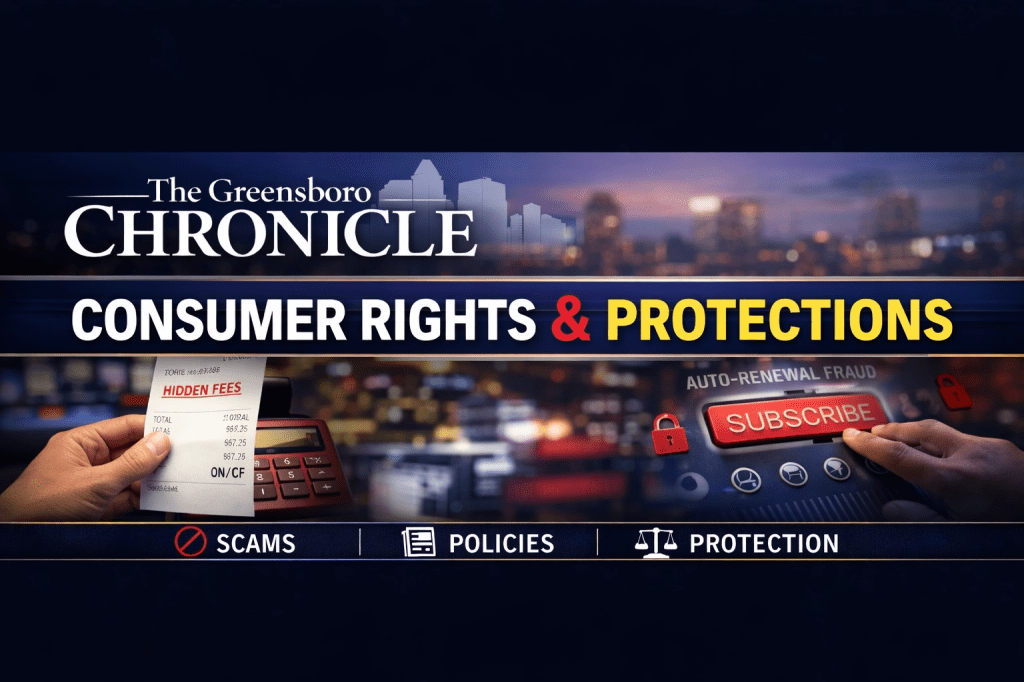
  • Rolling Blackout Scams: How Criminals Are Impersonating Duke Energy to Steal From Customers

    By The Greensboro Chronicle | Public Safety & Consumer Protection Desk

    Across North Carolina and throughout the Southeast, consumers are reporting a surge in fraud schemes falsely claiming to represent Duke Energy. These scams exploit public concern about rolling blackouts, grid strain, extreme weather, and rising energy costs—using fear and urgency to pressure victims into making immediate payments.

    Law enforcement and consumer protection agencies emphasize that these schemes are not associated with Duke Energy itself, but rather with criminals impersonating utility officials to steal money and personal information.

    This article explains how the scam works, how victims are targeted, what warning signs to watch for, and what to do if you or someone you know has been affected.

    1. How the Rolling Blackout Scam Works (Plain Language)

    The scammer pretends to be Duke Energy—or a contractor “working on behalf of the utility”—and tells the victim that:

    Their account is past due, flagged, or under investigation A rolling blackout, service interruption, or emergency disconnection is imminent Immediate payment is required to avoid shutoff or restore priority service

    The scammer often claims the situation is time-sensitive due to:

    Grid overload Severe weather Emergency maintenance “State-mandated rolling outages”

    Victims are pressured to act within minutes, not hours—before they have time to verify the claim.

    2. How Scammers Are Reaching Victims

    Based on public consumer complaints and agency advisories, scammers commonly use:

    📱 Phone Calls (Most Common)

    Caller ID spoofing to display “Duke Energy,” “Utility Billing,” or a local number Robocalls followed by live operators Threatening or authoritative tone

    💬 Text Messages (Smishing)

    Messages stating “FINAL NOTICE” or “Service interruption pending” Links to fake payment portals Requests to “confirm account status”

    📧 Emails (Phishing)

    Fake invoices or disconnection notices Look-alike email addresses and logos Malicious links or attachments

    🚪 In-Person Visits (Less Common, Higher Risk)

    Individuals claiming to be utility workers Requests for payment to “cancel” a disconnect order Demands for cash, prepaid cards, or mobile payments

    3. What to Watch Out For (Red Flags)

    Consumer protection agencies stress that any one of the following should raise concern:

    🚩 Demands for immediate payment

    🚩 Threats of shutoff within minutes or hours

    🚩 Requests for payment via:

    Gift cards Zelle Cash App Venmo Cryptocurrency Wire transfer

    🚩 Requests for Social Security numbers, PINs, or full account credentials

    🚩 Links that do not originate from an official Duke Energy domain

    🚩 Refusal to allow you time to call Duke Energy directly

    Important: Duke Energy does not demand payment through gift cards, cryptocurrency, or peer-to-peer payment apps, and does not threaten instant disconnection without prior written notice.

    4. What to Do If You’ve Been Scammed

    If you believe you have been targeted or victimized:

    Step 1: Stop Communication Immediately

    Hang up Do not click links Do not send additional payments

    Step 2: Contact Duke Energy Directly

    Use the phone number on your actual bill or official website Ask them to verify your account status

    Step 3: Report the Fraud

    File a report with the Federal Trade Commission at IdentityTheft.gov Contact your bank or payment provider immediately

    Step 4: Protect Your Identity

    Change online account passwords Monitor bank and credit statements Consider a fraud alert or credit freeze if personal data was shared

    5. Agencies Offering Help, Education, and Reporting

    🔹 Duke Energy (Fraud Reporting)

    Phone: 800-769-3766

    Online: Duke Energy official website → Fraud & Scam Alerts

    🔹 Federal Trade Commission (FTC)

    Phone: 1-877-FTC-HELP (1-877-382-4357)

    Online: IdentityTheft.gov

    Email: ReportFraud@ftc.gov

    🔹 North Carolina Attorney General’s Office

    Phone: 1-877-5-NO-SCAM (1-877-566-7226)

    Online: ncdoj.gov

    Email: consumer@ncdoj.gov

    🔹 North Carolina Utilities Commission

    Phone: 919-733-9277

    Online: ncuc.gov

    Email: consumer.services@ncuc.gov

    A Final Word to Consumers

    Scammers succeed by creating panic and urgency. Legitimate utilities operate under regulated notice requirements and documented billing procedures. When in doubt, pause, verify, and report.

    Public awareness remains the strongest defense.

    Legal Disclaimer

    This article is provided for educational and informational purposes only and does not constitute legal, financial, or professional advice. Readers should verify information with official sources and consult appropriate professionals regarding their specific circumstances.

    Copyright Notice

    © 2026 The Greensboro Chronicle. All rights reserved.

    No part of this publication may be reproduced, distributed, or transmitted without prior written permission, except for brief quotations used for news reporting and educational purposes

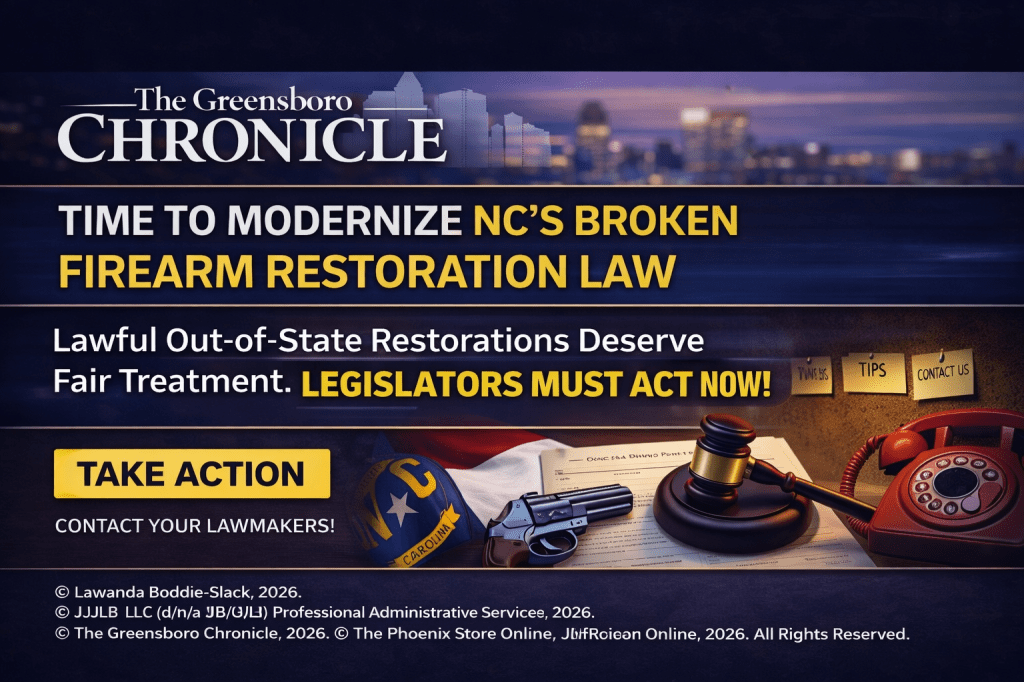
  • How North Carolina’s Firearm Restoration Framework Has Fallen Out of Step With Modern Justice, Mobility, and Public Policy

    By The Greensboro Chronicle

    Public Policy & Legal Affairs Desk

    For decades, North Carolina has occupied a complicated—and increasingly precarious—position in the national debate over firearm rights, criminal rehabilitation, and public safety. Nowhere is that tension more evident than in the state’s firearm restoration laws as they apply to residents with out-of-state felony convictions.

    At issue is not simply whether individuals who have completed their sentences should regain firearm rights, but whether North Carolina’s current legal framework—rooted in assumptions from another era—can withstand modern realities of interstate mobility, constitutional scrutiny, and evolving public policy priorities.

    This investigation examines the foundation of North Carolina’s firearm restoration law, how the process and procedures function in practice, where the law currently stands, and why its application to residents with out-of-state convictions has produced confusion, inequity, and serious constitutional concerns.

    I. The Foundation: How North Carolina’s Firearm Restoration Law Was Built

    North Carolina’s firearm restoration framework grew out of a traditional model of criminal justice that emphasized state sovereignty, territorial jurisdiction, and permanent collateral consequences.

    Historically, the state operated under a simple premise:

    A felony conviction—regardless of where it occurred—triggered a firearm disability under North Carolina law. Restoration of firearm rights was available only if the conviction originated in North Carolina and the individual completed a defined waiting period, met statutory criteria, and obtained relief through state courts.

    This approach reflected mid-to-late 20th-century attitudes that viewed felony convictions as enduring markers of risk rather than temporary legal statuses subject to rehabilitation.

    What the law did not anticipate was a highly mobile society, widespread interstate migration, or the modern understanding that civil rights restoration is not punishment avoidance, but reintegration.

    II. The Process: Restoration in Theory vs. Restoration in Practice

    For individuals with North Carolina convictions, the statutory process—while strict—is at least identifiable:

    Completion of sentence, including probation or parole A defined waiting period Demonstrated law-abiding conduct Petition to the appropriate North Carolina court

    For North Carolina residents with out-of-state convictions, however, the process breaks down.

    The Practical Reality:

    North Carolina courts often lack jurisdiction to “restore” rights tied to convictions from other states. Other states may have already restored the individual’s firearm rights under their own laws. North Carolina does not consistently recognize those restorations. Law enforcement agencies, clerks, attorneys, and even judges frequently interpret the law differently.

    The result is a legal paradox:

    A person may be fully restored and lawful in one state, federally compliant, and permanently barred—or uncertainly exposed—in North Carolina.

    III. Where the Law Currently Stands

    At present, North Carolina law:

    Continues to impose firearm prohibitions based on out-of-state convictions Provides no clear statutory pathway for restoration when the originating state has already granted relief Leaves interpretation largely to enforcement discretion and post-hoc judicial review

    This creates a system where:

    Compliance is unclear Risk of unintentional felony prosecution is high Constitutional rights hinge on geography rather than conduct

    Legal scholars increasingly note that such frameworks invite arbitrary enforcement, a hallmark of laws vulnerable to constitutional challenge.

    IV. Public Policy Has Changed—But the Law Has Not

    Modern public policy increasingly recognizes:

    Rehabilitation over perpetual punishment Evidence-based assessments of risk Uniformity and predictability in civil rights restoration Interstate recognition of legal status (as seen in licensing, family law, and criminal records relief)

    Yet North Carolina’s firearm restoration regime remains anchored in assumptions that:

    Mobility is rare Convictions permanently define character Interstate legal recognition is optional

    These assumptions no longer align with:

    National criminal justice reform trends Expungement and restoration statutes nationwide Second Amendment jurisprudence emphasizing individualized assessments Due process and equal protection principles

    V. Constitutional Tensions and Legal Vulnerabilities

    The disparate treatment of North Carolina residents based solely on where their conviction occurred raises serious questions under:

    Equal Protection – similarly situated individuals are treated differently Due Process – lack of clear notice and predictable standards Full Faith and Credit principles – inconsistent recognition of lawful restorations Second Amendment jurisprudence – categorical bans untethered from current risk

    Courts across the country are increasingly skeptical of blanket prohibitions that fail to account for rehabilitation, time elapsed, or restored status elsewhere.

    North Carolina’s framework, as currently structured, may not survive sustained constitutional scrutiny.

    VI. The Human Cost of Legal Ambiguity

    Beyond doctrine and policy, the real impact is felt by:

    Veterans Long-term residents Business owners Parents and caregivers

    Individuals who have complied with every requirement of the law—often for decades—are left navigating a system where certainty is impossible and compliance is unclear.

    This is not public safety.

    This is legal limbo.

    VII. A Call to Action: Modernizing the Law to Reflect Modern Values

    North Carolina lawmakers now face a critical choice.

    They can:

    Continue enforcing a fragmented, outdated framework that fosters confusion and inequity

    Or they can:

    Craft, draft, and pass legislation that: Clearly recognizes lawful out-of-state restorations Establishes a uniform in-state pathway for residents with foreign convictions Aligns firearm restoration with modern public policy, constitutional principles, and evidence-based risk assessment Provides clarity for courts, law enforcement, and the public alike

    Public policy should reflect who we are today, not who we feared decades ago.

    The time for legislative clarity is no longer optional—it is overdue.

    Legal Disclaimer

    This article is provided for informational and educational purposes only and does not constitute legal advice. Laws and interpretations vary and are subject to change. Readers should consult qualified legal counsel for advice specific to their circumstances.

    Copyright Notice

    © Lawanda Boddie-Slack, 2026. All Rights Reserved.

    © JJLBS LLC d/b/a JJLBS Professional Administrative Services, 2026. All Rights Reserved.

    © The Greensboro Chronicle, 2026. All Rights Reserved.

    © The Phoenix Store Online, 2026. All Rights Reserved

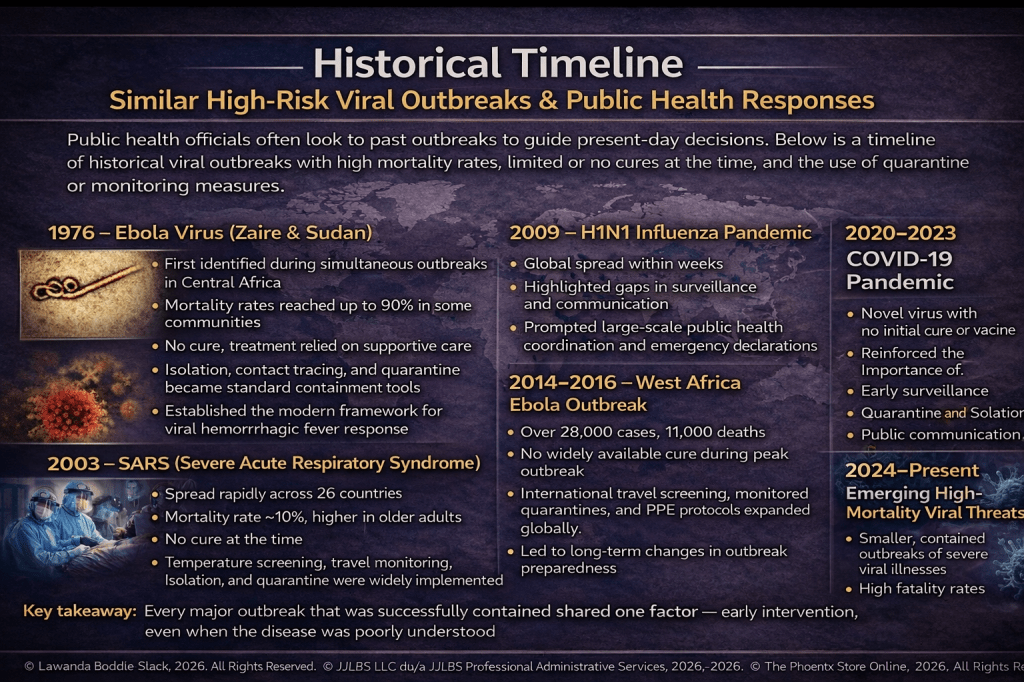
  • Historical Timeline: Similar High-Risk Viral Outbreaks & Public Health Responses

    January 26, 2026

    Jasmine Dantzler Health & Public Safety

    Historical Timeline

    Public health officials often look to past outbreaks to guide present-day decisions. Below is a timeline of historical viral outbreaks with high mortality rates, limited or no cures at the time, and the use of quarantine or monitoring measures.

    1976 – Ebola Virus (Zaire & Sudan)

    First identified during simultaneous outbreaks in Central Africa Mortality rates reached up to 90% in some communities No cure; treatment relied on supportive care Isolation, contact tracing, and quarantine became standard containment tools Established the modern framework for viral hemorrhagic fever response

    2003 – SARS (Severe Acute Respiratory Syndrome)

    Spread rapidly across 26 countries Mortality rate ~10%, higher in older adults No cure at the time Temperature screening, travel monitoring, isolation, and quarantine were widely implemented Demonstrated the effectiveness of early containment

    2009 – H1N1 Influenza Pandemic

    Global spread within weeks Highlighted gaps in surveillance and communication Prompted large-scale public health coordination and emergency declarations

    The Mortal Kombat Tapes

    2014–2016 – West Africa Ebola Outbreak

    Over 28,000 cases, 11,000 deaths No widely available cure during peak outbreak International travel screening, monitored quarantines, and PPE protocols expanded globally Led to long-term changes in outbreak preparedness

    2020–2023 – COVID-19 Pandemic

    Novel virus with no initial cure or vaccine Reinforced the importance of: Early surveillance Quarantine and isolation Public communication Healthcare system preparedness

    2024–Present – Emerging High-Mortality Viral Threats

    Smaller, contained outbreaks of severe viral illnesses High fatality rates in untreated cases Targeted, precautionary reinstatement of COVID-era protocols Emphasis on containment before widespread transmission

    Key takeaway:

    Every major outbreak that was successfully contained shared one factor — early intervention, even when the disease was poorly understood.

    We want to hear from you!

    Legal & Medical Disclaimer

    The Greensboro Chronicle provides this content for informational and educational purposes only. This article is not intended as medical advice, diagnosis, or treatment. Readers should consult qualified healthcare professionals or public health authorities for guidance specific to their individual circumstances. The Greensboro Chronicle makes no guarantees regarding outcomes related to the use or interpretation of this information.

    Copyright Statement

    © Lawanda Boddie-Slack, 2026. All Rights Reserved.

    © JJLBS LLC d/b/a JJLBS Professional Administrative Services, 2026. All Rights Reserved.

    © The Greensboro Chronicle, 2026. All Rights Reserved.

    © The Phoenix Store Online, 2026. All Rights Reserved.
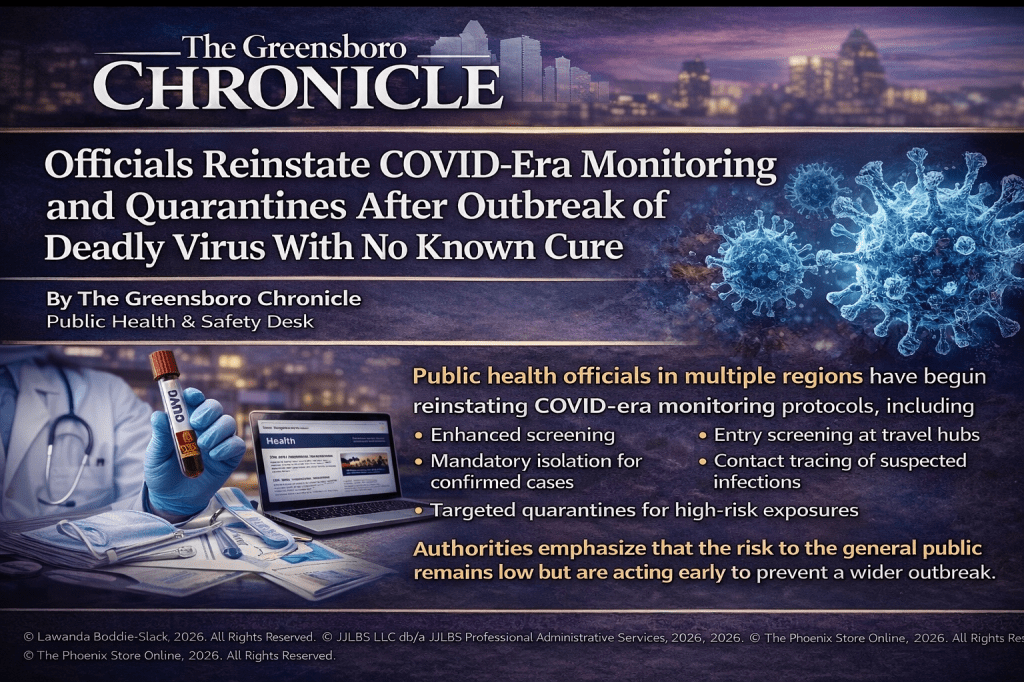
  • Officials Reinstate COVID-Era Monitoring and Quarantines After Outbreak of Deadly Virus With No Known Cure

    January 26, 2026

    By The Greensboro Chronicle

    Public Health & Safety Desk

    Public health officials in multiple regions have begun reinstating COVID-era monitoring protocols, including enhanced screening, isolation measures, and targeted quarantines, following the detection of a high-mortality viral outbreak for which no definitive cure currently exists. While authorities emphasize that the risk to the general public remains low at this time, the response reflects lessons learned during the COVID-19 pandemic: early containment, rapid communication, and public cooperation save lives.

    The virus—classified by health agencies as a severe viral hemorrhagic or systemic infection depending on strain—has drawn international concern due to its high fatality rate, person-to-person transmission through bodily fluids, and the absence of an approved curative treatment. Management relies primarily on early detection, supportive medical care, and strict infection-control practices.

    Health agencies stress that these measures are precautionary, not panic-driven, and are designed to prevent the kind of uncontrolled spread seen during past global outbreaks.

    Available at: http://www.jjlbsllc.square.site

    Why COVID-Era Measures Are Being Reinstated

    Public health officials are applying strategies refined during the COVID-19 pandemic, including:

    Entry screening at ports of travel Contact tracing and exposure monitoring Mandatory isolation for confirmed cases Quarantine for high-risk exposures Enhanced reporting requirements for healthcare facilities

    These protocols are being reintroduced not because the viruses are the same, but because the public-health principles of containment remain effective when facing fast-moving infectious diseases.

    Unlike COVID-19, however, this virus is not airborne in most documented cases. Transmission typically requires direct contact with infected bodily fluids, contaminated surfaces, or unsafe medical handling. Still, healthcare systems are operating under the assumption that early missteps can have fatal consequences.

    Signs and Symptoms to Watch For

    Symptoms may appear 2 to 21 days after exposure, depending on the virus and individual immune response. Early symptoms often resemble common viral illnesses, which can delay diagnosis.

    Early Symptoms

    Sudden high fever Severe headache Muscle and joint pain Profound fatigue or weakness Sore throat

    Progressive or Severe Symptoms

    Vomiting or persistent nausea Diarrhea (sometimes severe) Abdominal pain Unexplained bruising or bleeding Rash or skin discoloration Organ dysfunction in advanced cases

    Health officials warn that symptoms can escalate rapidly, particularly in individuals with underlying health conditions or compromised immune systems.

    When to Seek Medical Care Immediately

    You should seek urgent medical evaluation if you experience symptoms and have:

    Traveled to an affected region Had contact with a confirmed or suspected case Worked in healthcare, laboratory, or emergency response roles Been exposed to bodily fluids of an ill person

    ⚠️ Do not show up unannounced to an emergency room if exposure is suspected.

    Instead, call ahead so medical staff can prepare appropriate infection-control measures.

    Early medical intervention significantly improves outcomes and protects healthcare workers and other patients.

    What to Communicate to Medical Professionals

    Clear, accurate communication can save critical time. Be prepared to provide:

    Recent travel history (countries, cities, dates) Known or possible exposures to ill individuals Timeline of symptoms (when they began and how they progressed) Underlying medical conditions Current medications or immune-suppressing treatments Occupational risks (healthcare, caregiving, lab work)

    Do not minimize symptoms or exposures out of fear or embarrassment. Transparency is essential for effective care and public safety.

    How These Viruses Are Treated

    At present, there is no universally approved curative treatment for several of the viruses prompting these responses. Medical care focuses on:

    Aggressive supportive treatment (fluids, oxygen, blood products) Management of complications Experimental or emergency-authorized therapies when available Strict isolation to prevent spread

    Vaccine research and antiviral development are ongoing, but public health officials caution that prevention remains the most effective defense.

    Public Health Guidance for the Community

    Officials urge the public to:

    Stay informed through verified public-health sources Avoid spreading unverified claims or panic-driven misinformation Practice good hygiene and infection-control habits Respect quarantine and monitoring directives if issued Support healthcare workers and public health responders

    History has shown that early vigilance and community cooperation can mean the difference between containment and crisis.

    A Caution, Not a Cause for Panic

    Health authorities stress that the reinstatement of monitoring and quarantine protocols is a sign of preparedness, not impending catastrophe. These systems exist precisely to prevent worst-case scenarios.

    Public cooperation, responsible media coverage, and informed awareness remain the strongest tools in confronting emerging health threats—especially those with no immediate cure.

    Legal & Medical Disclaimer

    The Greensboro Chronicle provides this content for informational and educational purposes only. This article is not intended as medical advice, diagnosis, or treatment. Readers should consult qualified healthcare professionals or public health authorities for guidance specific to their individual circumstances. The Greensboro Chronicle makes no guarantees regarding outcomes related to the use or interpretation of this information.

    Copyright Statement

    © Lawanda Boddie-Slack, 2026. All Rights Reserved.

    © JJLBS LLC d/b/a JJLBS Professional Administrative Services, 2026. All Rights Reserved.

    © The Greensboro Chronicle, 2026. All Rights Reserved.

    © The Phoenix Store Online, 2026. All Rights Reserved.
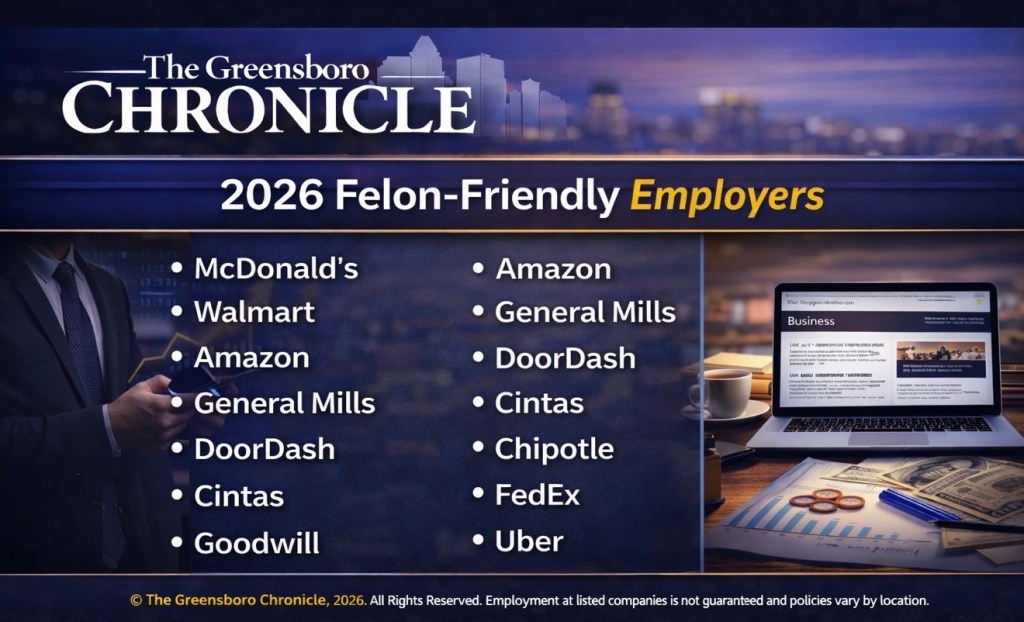
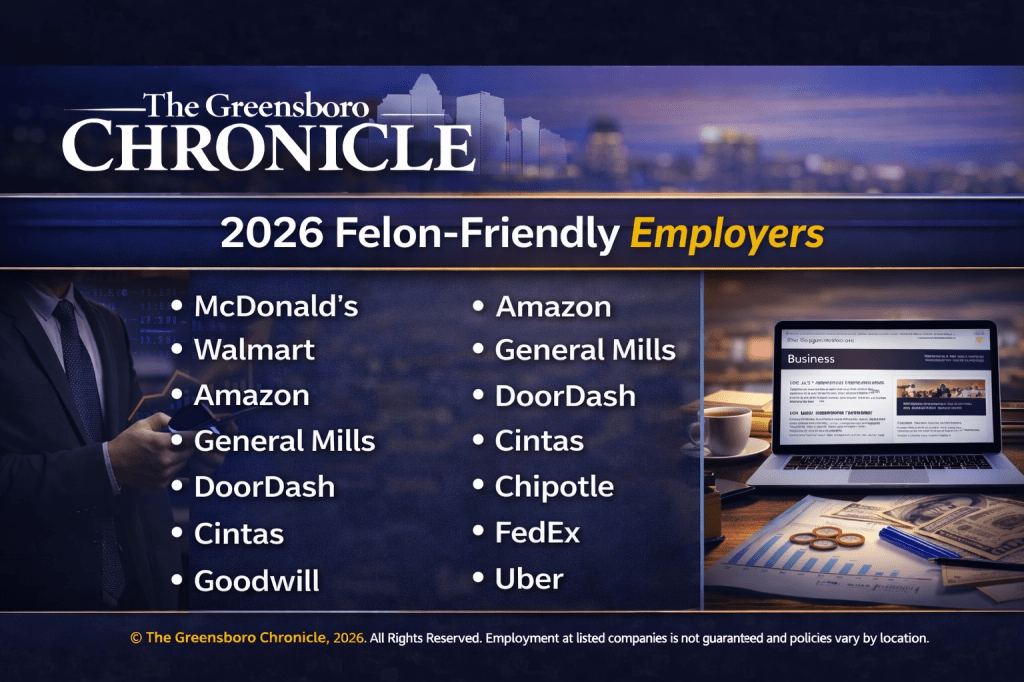
  • 📋 2026 Felon-Friendly Employers (Publicly Reported)

    January 26, 2026

    🔧 Retail & Food Service

    McDonald’s (fast food)  Starbucks (coffee / retail)  Walmart (retail)  Dollar Tree / Family Dollar (discount retail)  Marshalls / TJ Maxx (department retail)  CVS Health (pharmacy & retail)  Chipotle & other fast-casual restaurants (varies by location)  DoorDash / DashMart (gig / team roles) 

    🚚 Logistics, Delivery & Warehouse

    Amazon (warehousing & logistics)  UPS & FedEx (package handling / delivery)  Pennsylvania Logistics LLC (regional delivery)  Various employers posting “felon-friendly” warehouse jobs on major job boards (Indeed/Glassdoor) 

    🛠️ Manufacturing, Industrial & Services

    General Mills (food manufacturing)  Coca-Cola (manufacturing / distribution)  Cintas (uniforms / industrial services)  Waste Management & related contractors  Uber (driver / service partner roles, varies by locale) 

    🧰 Second Chance Programs & Agencies

    Goodwill Industries (retail & job support)  Temp agencies (PeopleReady, Labor Finders, TrueBlue, etc.)  Fair Chance job networks (1500+ companies listing opportunities) 

    ⚠️ Important Notes & Legal Disclaimer

    This list does not guarantee employment at any company or location; actual hiring policies vary by state, franchise owner, and role. “Felon-friendly” status generally comes from public reports, job board labeling, or anecdotal worker experiences — employers may still conduct background checks. Always verify individual company policies and check job descriptions directly when applying.

    © 2026 The Greensboro Chronicle — All rights reserved. This document is provided for informational purposes only and may contain aggregated public data from multiple online sources (e.g., job boards, public employer reports). No endorsement of specific employers is implied. Terminology like “felon-friendly” and “ex-offender friendly” reflects common usage in public job resources and does not constitute a legal classification or employment guarantee. Mentioned names and data are used under fair use for informational reporting

  • Public Trust and Pandemic Funds: How COVID-19 Fraud Cases Continue Long After the Money Is Gone

    January 26, 2026

    By The Greensboro Chronicle Investigative Desk

    When Congress rushed trillions of dollars into the economy during the COVID-19 pandemic, speed was prioritized over scrutiny. The result was predictable: unprecedented relief paired with unprecedented fraud. What has proven less predictable is how long some of these cases continue to surface—years after the checks were issued and spent.

    Recent allegations involving Sharon Henderson, alongside nationally publicized cases tied to Brett Favre, George Santos, and Mississippi welfare officials such as John Davis, raise a central question:

    How do fraud cases survive when the statute of limitations appears to have expired?

    This report examines the similarities and differences among these cases—and the legal mechanisms that allow prosecutors to keep them alive.

    The Allegations at a Glance

    Sharon Henderson: Unemployment Benefits Under Scrutiny

    State Rep. Sharon Henderson has been accused of theft and making false statements to fraudulently obtain more than $17,000 in COVID-19 unemployment benefits. According to publicly available court filings and reporting, investigators allege that representations made to obtain benefits conflicted with eligibility requirements under pandemic relief programs.

    Henderson has denied wrongdoing. As with all defendants, she is presumed innocent unless and until proven guilty in a court of law.

    Brett Favre: Welfare Funds and Celebrity Influence

    In Mississippi, Brett Favre became entangled in one of the largest public-assistance scandals in state history. Prosecutors allege that Temporary Assistance for Needy Families (TANF) funds were improperly diverted to projects that benefited Favre or his associates, including a volleyball facility at a public university.

    Unlike traditional unemployment fraud, this case centers on misuse of welfare funds through nonprofit intermediaries, rather than direct benefit applications.

    George Santos: Pandemic Unemployment Fraud

    Former U.S. Representative George Santos has admitted in federal court to multiple fraud schemes, including illegally collecting COVID-19 unemployment benefits while simultaneously earning income. His case stands out for its clarity: financial records, benefit filings, and admissions all align.

    Santos’s prosecution demonstrates how federal jurisdiction and documentary evidence can simplify pandemic fraud cases.

    John Davis and Mississippi Welfare Officials

    Former Mississippi Department of Human Services Director John Davis and others were accused of conspiring to misuse federal welfare funds intended for low-income families. These allegations involve long-running schemes, layered nonprofits, and ongoing concealment, extending the legal lifespan of the case.

    Similarities Across the Cases

    Despite differences in scale and visibility, these cases share notable traits:

    Federal money (either directly or indirectly) COVID-era emergency programs with relaxed oversight Alleged misrepresentations or omissions Delayed discovery of the alleged misconduct Public trust implications, particularly for elected or influential figures.

    Why These Cases Still Exist: The Statute of Limitations Explained

    At first glance, many COVID-related claims appear time-barred. Most fraud statutes carry 3–6 year limitation periods. However, several legal doctrines allow cases to survive well beyond the apparent deadline.

    1. Delayed Discovery Rule

    The statute of limitations may not begin until the fraud was discovered or reasonably could have been discovered—particularly when defendants allegedly concealed the misconduct.

    2. Continuing Offense Doctrine

    If fraudulent benefits were received over time, each payment can restart or extend the limitations period.

    3. Conspiracy Charges

    When prosecutors allege conspiracy, the clock often runs from the last overt act, not the initial fraud.

    4. False Statements to the Government

    Lying to obtain benefits can trigger separate charges under state or federal false-statement statutes, each with its own limitations period.

    5. Federal Tolling During Emergencies

    Certain federal statutes allow tolling when investigations were delayed due to extraordinary circumstances—including pandemic-related disruptions.

    Why Prosecutors Pursue These Cases

    Beyond recovering funds, these prosecutions serve broader purposes:

    Deterrence for future emergency-fund abuse Restoring public confidence in relief programs Signaling accountability, regardless of status or office

    As one former federal prosecutor noted publicly, “Pandemic fraud didn’t disappear—it simply aged.”

    A Final Legal Reality Check

    It is critical to underscore that allegations are not convictions. Each individual discussed in this article retains the full presumption of innocence and the right to due process. Outcomes will depend on evidence, procedural rulings, and judicial interpretation of complex statutes.

    Legal Disclaimer

    This article is published by The Greensboro Chronicle for informational and journalistic purposes only. It does not constitute legal advice, nor should it be relied upon as such. All individuals referenced are presumed innocent unless and until proven guilty in a court of law. Allegations, charges, and investigations are subject to change as legal proceedings continue.

    Copyright Notice

    © 2026 The Greensboro Chronicle. All rights reserved.

    No portion of this article may be reproduced, distributed, or transmitted in any form or by any means without prior written permission, except for brief quotations used for news reporting, commentary, or scholarly purposes.

  • Dancing Dolls TV Star Shot D3ad Moments After Her Dedicated DD4L Party

    January 26, 2026

    John Lee Staff Writer

    Two weeks after her nineteenth birthday, Shakira Gatlin was still wrapped in a happiness she had earned the long way—through practice, discipline, and belief. The Dancing Dolls had thrown her a dedicated DD4L celebration, and for a few precious hours the room felt lighter than the world outside it. Teammates chanted her name. Phones glowed. Posts poured in—small, shining receipts that effort still mattered.

    She wore her DD4L bow like a crown. Not the kind that demands attention, but the kind that quietly says, I belong here. Shakira smiled the way leaders do when they are thinking about everyone else first—when they are trying to make space for hope.

    Hours later, that bow would be mentioned again, not in a dance recap or highlight reel, but in the stunned, careful language people use when there are no words strong enough to explain the unexplainable.

    Sometimes the distance between a celebration and a tragedy is only one door, one moment, and one careless hand.

    In Jackson, a place known for its music, resilience, and civil rights legacy, poverty and violence press hard against young lives—especially Black teenagers. Opportunity can feel narrow. The pull of the streets is loud. Shakira Gatlin was born January 19, 2003, one of six siblings in a close-knit family that loved her fiercely.

    Those who knew her remember a shy child who didn’t always command the room. But when she danced, something changed. Her posture straightened. Her focus sharpened. Around age twelve, Shakira joined Dancing Dolls for Life—DD4L—a program built on discipline, academics, self-esteem, and performance. It wasn’t just choreography. It was structure. Standards. A promise that if you showed up and worked, you could build a future.

    Shakira did exactly that.

    She grew from a quiet student into a young woman others looked to for cues—how to carry yourself, how to keep going when practice was hard, how to represent something bigger than yourself. She earned her place. She earned her celebration.

    Available at: http://www.jjlbsllc.square.site

    And then, senselessly, her life was taken.

    There is no meaning in this loss. No lesson that makes it easier to bear. Only the hollow quiet that follows when a light is extinguished too soon. A family shattered. A team missing a heartbeat. A community once again forced to mourn a young Black life that had so much left to give.

    Shakira Gatlin should have been planning her next season, her next goal, her next chapter. She should have had time—time to grow, to lead, to live. Instead, the city woke to another name added to a list that grows far too long, far too fast.

    We remember her not for how she died, but for how she lived: with commitment, with grace, and with a belief that showing up mattered. Her bow was never just an accessory. It was a symbol of belonging, of effort, of dreams in motion.

    And the tragedy is not only that she is gone—but that she never got the chance to see how far she could have gone.

    Legal Disclaimer

    Transparency matters. Integrity matters. Accountability matters.

    At The Greensboro Chronicle, our investigative reporting is grounded in publicly available records, documented sources, and firsthand accounts submitted by our readers. References to individuals or organizations are made strictly in the public interest and do not constitute findings of liability or wrongdoing.

    All allegations are presented as such and remain subject to verification, response, and adjudication by appropriate legal or regulatory authorities. We welcome factual corrections and the opportunity for response from all parties mentioned.

    Copyright Notice – 2026

    © 2026 The Greensboro Chronicle. All rights reserved. All content is protected under applicable copyright laws. Unauthorized reproduction, redistribution, or republication of this material, in whole or in part, without express written permission is strictly prohibited.

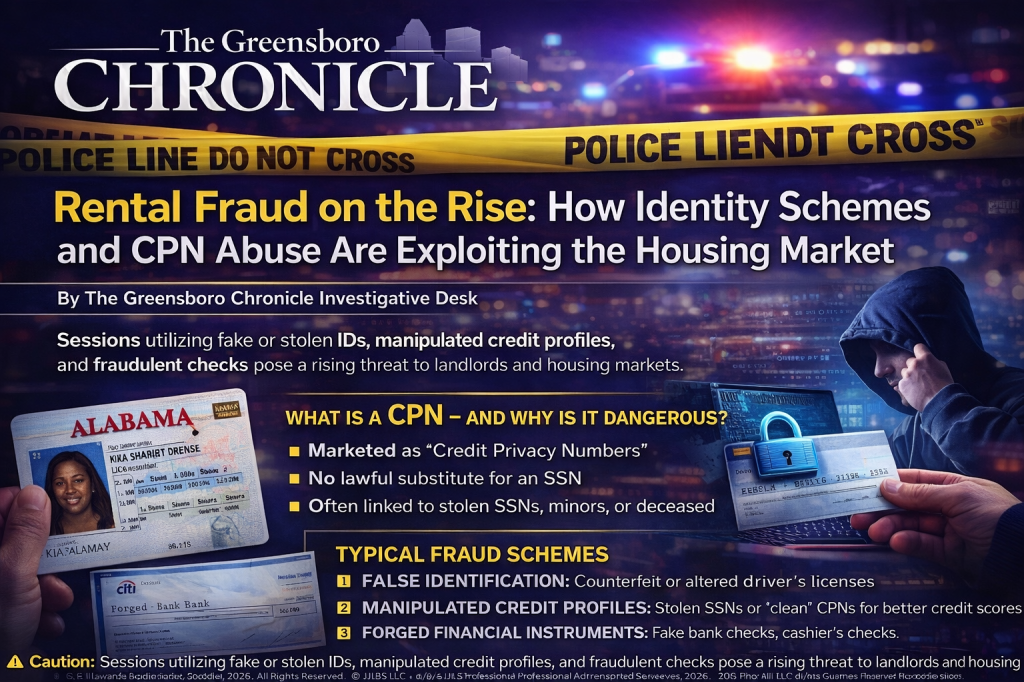
  • Rental Fraud on the Rise: How Identity Schemes and CPN Abuse Are Exploiting the Housing Market

    By The Greensboro Chronicle Investigative Desk

    Across North Carolina and beyond, law enforcement agencies are reporting a sharp increase in rental fraud schemes targeting apartment complexes, private landlords, and property management companies. At the center of many of these cases is a familiar pattern: false identities, forged financial documents, and the illegal misuse of credit-related technology.

    One method drawing increasing scrutiny is the fraudulent use of CPNs, often marketed online as “Credit Privacy Numbers” or “credit profile numbers.”

    What Is a CPN — and Why Is It Dangerous?

    A CPN is often falsely advertised as a legal alternative to a Social Security number. In reality:

    There is no legitimate consumer use for a CPN in place of an SSN Many CPNs are stolen, fabricated, or linked to minors, elderly individuals, or deceased persons Using a CPN to apply for housing, credit, or utilities may constitute identity theft, wire fraud, and false pretenses

    Despite online claims, federal and state authorities consistently warn that using a CPN to rent or lease property is illegal when done to conceal identity or credit history.

    How Rental Fraud Schemes Typically Work

    Investigators note a recurring pattern in cases involving fraudulent rentals:

    False Identification Fraudsters present altered or counterfeit driver’s licenses to establish a new identity. Manipulated Credit Profiles CPNs or stolen SSNs are used to generate “clean” credit reports, bypassing poor credit or prior evictions. Forged Financial Instruments Fake cashier’s checks or bank drafts are used to secure move-in approval before fraud is detected. Rapid Occupancy Once approved, suspects may quickly occupy the unit, complicating eviction and recovery efforts.

    Who Pays the Price?

    Rental fraud doesn’t just impact property owners. The fallout includes:

    Financial losses for landlords Higher rents and stricter screening for legitimate tenants Identity theft victims facing long-term credit damage Court systems burdened with complex fraud cases

    A Cautionary Reminder

    Law enforcement officials stress that technology-based fraud is evolving faster than ever, and housing markets remain a prime target. What may be marketed online as a “credit fix” or “privacy solution” can quickly become a felony criminal case with lasting consequences.

    Legal Reminder

    This explainer is for public awareness and educational purposes. References to alleged criminal activity are based on publicly available information.

    All individuals accused of crimes are presumed innocent unless and until proven guilty in a court of law.

  • Woman Charged in Alleged Apartment Rental Fraud Scheme

    Wake County Case Highlights Rising Concerns Over Identity & Financial Fraud

    By Lorene Hardy, Investigative Journalist

    Date: January 26, 2026

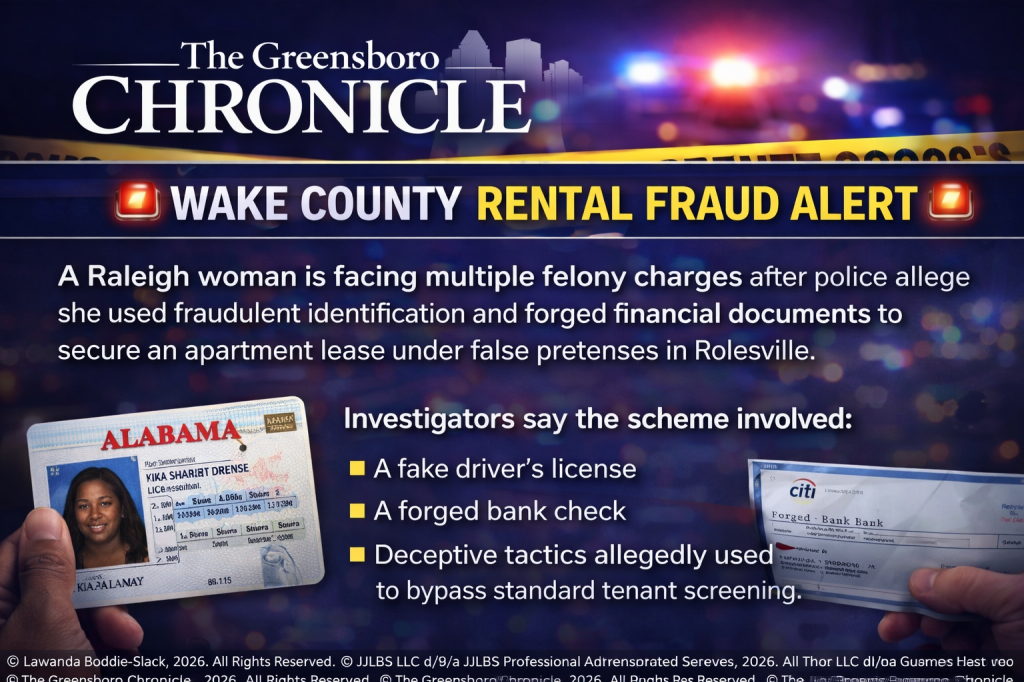
    A Wake County woman is facing multiple felony charges after law enforcement authorities allege she orchestrated a calculated scheme involving fraudulent identification and forged financial instruments to secure an apartment lease under false pretenses.

    According to arrest warrants filed by the Rolesville Police Department, Kia Shante Burt, 32, of Raleigh, has been charged with three felony offenses:

    Felony Obtaining Property by False Pretenses Felony Common Law Uttering Felony Possession/Manufacture of Fraudulent Identification

    Court documents allege that Burt knowingly and willfully used a fraudulent Alabama driver’s license to misrepresent her identity while applying for housing at Cobblestone Village Apartments in Rolesville. Investigators contend the false identification was presented to apartment management to secure approval for a lease she allegedly would not have qualified for under her true identity.

    Authorities further allege that the deception extended beyond identity fraud. In a separate charge, Burt is accused of presenting a forged Citi Bank official check as payment for the apartment. Investigators state the check appeared legitimate on its face and was capable of defrauding the property owner, but was later determined to be fraudulent upon verification.

    A third felony charge stems from Burt’s alleged possession of the fake Alabama driver’s license, which law enforcement asserts was manufactured or obtained specifically to facilitate fraud and deception.

    Available at: http://www.jjlbsllc.square.site

    The arrest warrant was issued on January 22, 2025, and the case is currently being handled in Wake County District Court. Burt was issued a $3,000 secured bond.

    A Broader Warning

    Law enforcement officials note that cases involving false identification and financial instruments pose significant risks not only to property owners and financial institutions, but also to communities at large. Such schemes can undermine trust in rental markets, strain judicial resources, and expose landlords and residents to financial loss.

    While this case remains in its early stages, it underscores the importance of due diligence, identity verification, and vigilance in rental and financial transactions.

    Show Your Support

    Legal Presumption

    All charges referenced in this report are allegations. Kia Shante Burt is presumed innocent unless and until proven guilty in a court of law.

    Legal Disclaimer – The Greensboro Chronicle

    Transparency matters. Integrity matters. Accountability matters.

    At The Greensboro Chronicle, our investigative reporting is grounded in publicly available records, documented sources, and firsthand accounts submitted by our readers. References to individuals or businesses are made strictly in the public interest and do not constitute findings of liability or wrongdoing.

    All allegations are presented as such and remain subject to verification, response, and adjudication by appropriate legal or regulatory authorities. We welcome factual corrections and the opportunity for response from all parties mentioned.

    Copyright Statement

    © Lawanda Boddie-Slack, 2026. All Rights Reserved.

    © JJLBS LLC d/b/a JJLBS Professional Administrative Services, 2026. All Rights Reserved.

    © The Greensboro Chronicle, 2026. All Rights Reserved.

    © The Phoenix Store Online, 2026. All Rights Reserved.