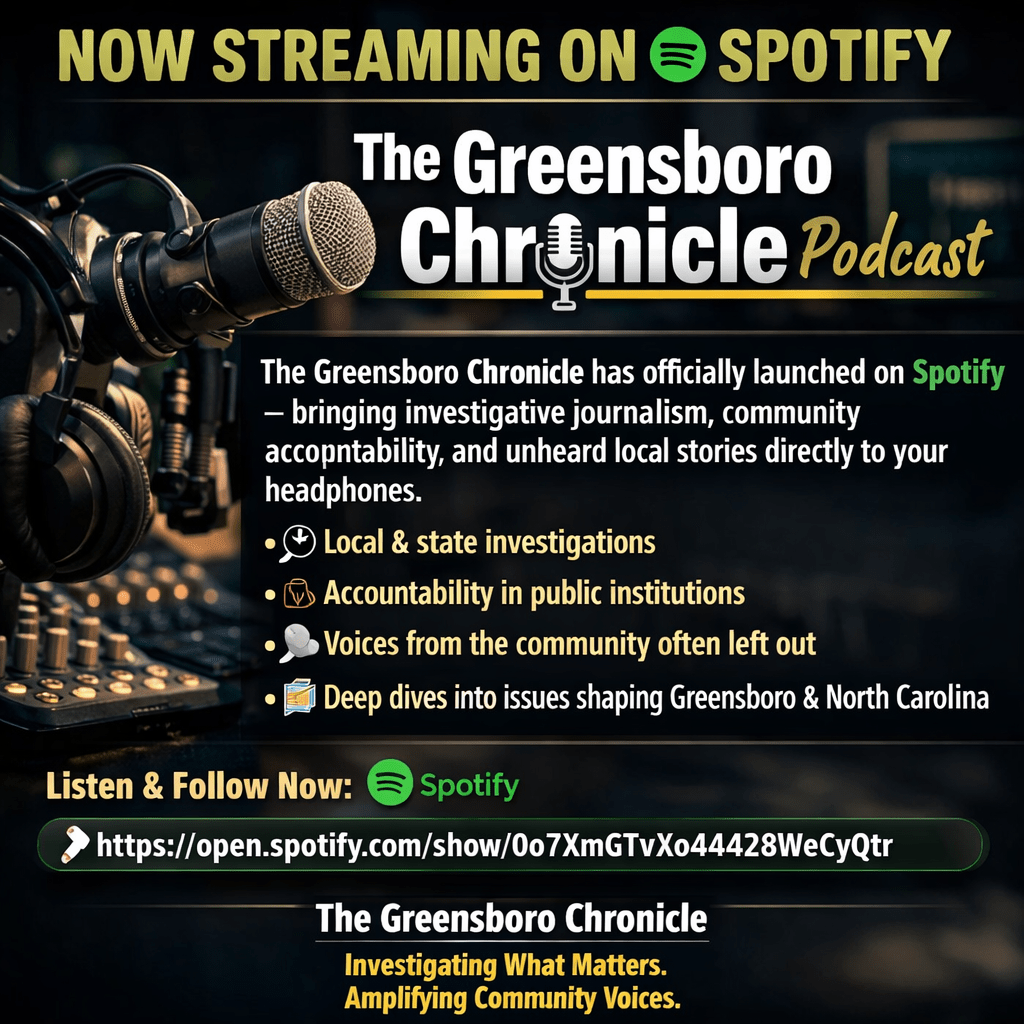
The Greensboro Chronicle is now on Spotify
Copyright 2026 The Greensboro Chronicle. All Rights Reserved.
Greensboro Chronicle, we believe journalism is more than reporting the news—it’s about uncovering the truth, amplifying community voices, and working toward real solutions.
We are an independent investigative news platform dedicated to shining a light on issues that matter most to the people of Greensboro. From housing and local governance to public safety, business, and neighborhood life, our mission is to hold power accountable while fostering meaningful dialogue among residents.
The Chronicle isn’t just a newsroom—it’s a community hub. We invite readers to not only stay informed, but also to participate in the conversation, share perspectives, and collaborate on solutions that strengthen our city.
Together, we can confront challenges, celebrate resilience, and shape a more transparent, just, and thriving Greensboro.
Greensboro Chronicle Investigative Staff and Volunteers
January 15, 2025
Lorene Hardy-staff writer
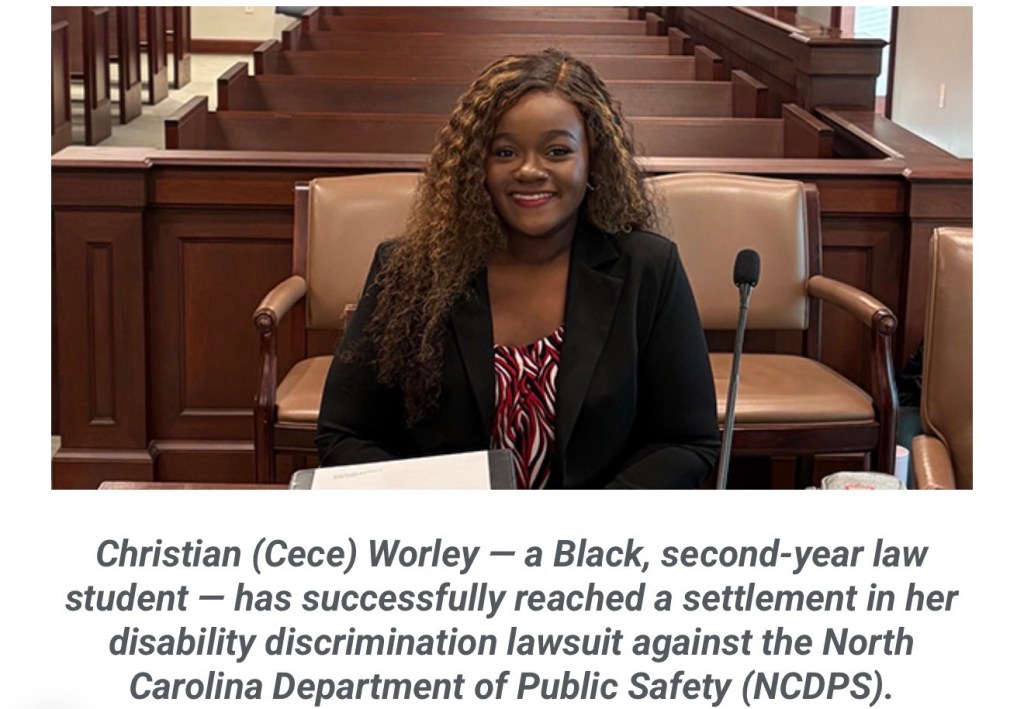
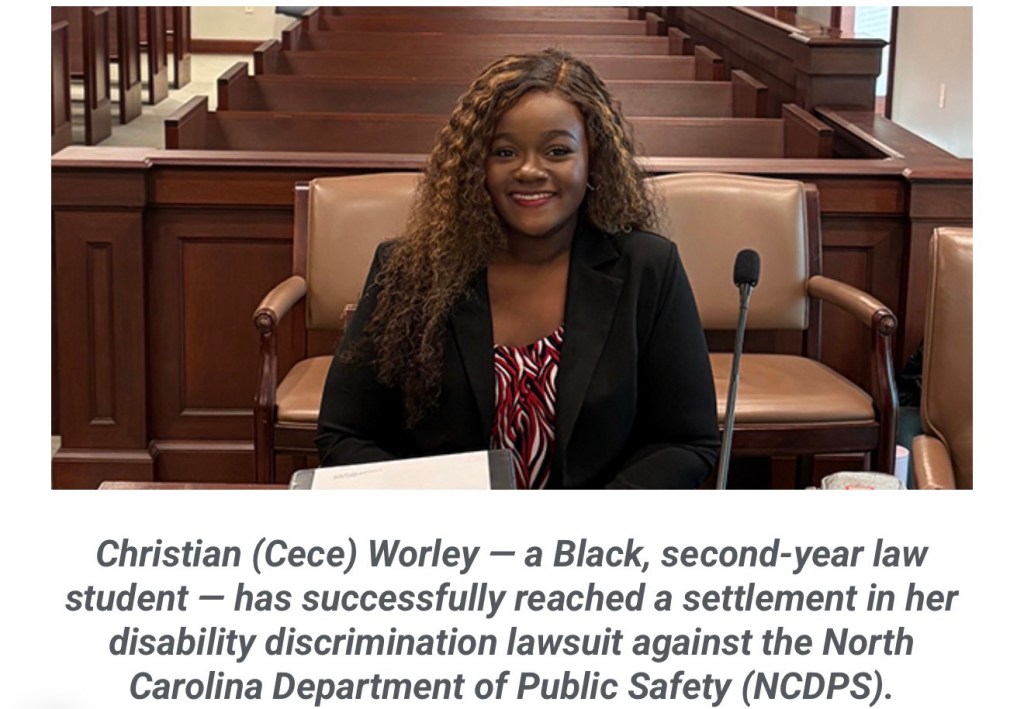
Below is an in-depth, plain-language explanation and analysis of the case, written to be accessible to non-lawyers while still conveying why this litigation matters legally, procedurally, and historically—especially because every major victory was achieved pro se.
1. What This Case Is Really About (In Plain Language)
At its core, this case is about whether a woman with a serious, chronic reproductive condition has the right to ask for a modest workplace adjustment—and whether an employer can legally dismiss that request by treating women’s pain as inconvenient or interchangeable.
Christian “Cece” Worley was not asking for a permanent change, special privileges, or reduced job standards. She asked for telework on one single day per month—the first day of her menstrual cycle—because her endometriosis caused severe symptoms that interfered with basic functioning. Endometriosis is a medically recognized, chronic condition that can cause debilitating pain, fatigue, gastrointestinal distress, and neurological symptoms.
What followed was not a neutral employment decision. According to the record, it was a categorical refusal, paired with gender-based assumptions (“I’d have to do this for every woman”), threats of termination, discouragement from using accrued leave, and an ultimatum that effectively forced her resignation.
This case asks a simple but powerful question:
If an employer refuses even to consider an accommodation for a serious medical condition—and instead pressures an employee to quit—does that violate the ADA?
For the first time in North Carolina, and likely the first time nationally at this stage of litigation, the federal courts answered: a jury could reasonably say yes.
2. Why This Case Is Extraordinary: She Did It Pro Se
One of the most important facts cannot be overstated:
Cece Worley did this without a lawyer.
She filed her case pro se—meaning she represented herself—after multiple attorneys declined representation, telling her that the law around endometriosis and the ADA was “too underdeveloped” or “too uncertain.”
That matters because:
Less than 3% of pro se civil cases survive summary judgment Government defendants, especially state agencies, are among the hardest defendants to defeat ADA cases are legally complex, fact-intensive, and procedurally unforgiving
Despite all of that, Worley not only survived—she won repeatedly at every procedural stage that normally ends pro se cases early.
3. Procedural Victories That Most Plaintiffs Never Reach
A. Surviving a Motion to Dismiss
Early in the case, NCDPS tried to end the lawsuit before evidence was even exchanged. Worley defeated that effort, meaning the court found her allegations legally sufficient on their face.
Why this matters:
Many civil rights cases die here. Courts often dismiss ADA claims before discovery if they think the disability or accommodation theory is weak. This court did not.
B. Winning Discovery Battles Against a State Agency
Discovery is where pro se litigants are most often overwhelmed. Worley:
Preserved her claims through contested discovery disputes Navigated procedural rules without counsel Took and defended depositions Elicited admissions from agency witnesses
Why this matters:
Discovery is not about storytelling—it is about rules, deadlines, objections, and strategy. The fact that a self-represented plaintiff not only survived but used discovery effectively is rare.

C. Defeating a Late-Stage Attempt to Depose Her
Perhaps one of the most telling moments in the case was procedural rather than substantive.
NCDPS waited nearly eight months into the discovery period before attempting to depose Worley, then asked the court to extend discovery after it had already closed.
Worley opposed the motion—arguing that the delay was unjustified and strategic. The court agreed.
The judge:
Found the request dilatory Refused to reward NCDPS for its own delay Denied the extension
Why this matters:
Courts rarely side with pro se plaintiffs on procedural timing disputes against government defendants. This ruling signaled that the court was scrutinizing the agency’s litigation conduct—and taking Worley seriously as a litigant.
D. Surviving Summary Judgment — The Rarest Victory of All
Summary judgment is where most cases die, especially ADA cases and especially pro se cases.
On July 18, 2025, Magistrate Judge Robert T. Numbers II ruled that:
Endometriosis can qualify as a disability under the ADA Worley’s symptoms were severe enough to meet that standard Her request to telework one day per month could be found reasonable A jury could conclude NCDPS unlawfully denied accommodation
District Judge Terrence Boyle later adopted the ruling in full.
Why this matters:
This ruling did not merely allow the case to continue—it created a legal foothold where none clearly existed before in North Carolina, and possibly anywhere in the country at this procedural stage.
4. Why the Endometriosis Ruling Is So Important
Before this case, employers often dismissed endometriosis-based accommodation requests by arguing:
The condition is “temporary” or “cyclical” Symptoms are “subjective” Menstrual-related impairments are not serious enough Accommodations would open the floodgates for all women
The court rejected that logic.
It recognized that:
A condition does not have to be constant to be disabling Chronic, recurring impairments can substantially limit major life activities Gendered disabilities are not exempt from ADA protection
This shifts the legal landscape. Employers can no longer safely assume that reproductive or menstrual disorders fall outside ADA coverage.
5. Constructive Discharge: When “You Can Quit” Means “You Must”
The facts also support a constructive discharge theory—meaning Worley did not leave voluntarily in any meaningful sense.
According to the record, she was told:
There would “absolutely not” be accommodations She would not be retained at the end of training Mentioning accommodations again could lead to immediate termination
Her resignation date coincided precisely with the onset of her next menstrual cycle—the very condition she had sought to manage.
In plain terms:
She was forced to choose between her health and her job. The law does not allow employers to manufacture that choice.
6. Why This Case Matters Beyond One Person
A. For Women and Reproductive Health
Hundreds of women have come forward with similar stories—termination, threats, retaliation, or dismissal after disclosing menstrual or reproductive health conditions.
This case validates what many have experienced privately:
Workplaces have systematically minimized, mocked, or punished women for gendered disabilities.
B. For Black Women in Particular
Black women face:
Lower diagnosis rates for endometriosis Longer delays in treatment Greater dismissal of pain Compounded race- and gender-based bias
That Worley—a Black woman—forced legal recognition of this condition makes the case especially significant.
C. For Access to Justice
This case exposes a structural problem:
Lawyers declined representation The law was deemed “too risky” Yet the claims were legally sound
If Worley had accepted that advice, this precedent would not exist.
Her success demonstrates that access to justice is often limited not by merit, but by gatekeeping—and that pro se litigants, when given fair consideration, can change the law.
7. The Settlement and Its Systemic Impact
The December 19, 2025 settlement included:
Favorable monetary terms A commitment by NCDPS to implement department-wide ADA training
That training obligation is critical. It means this case did not just compensate harm—it reduced the likelihood of future harm to others.
8. Why This Case Will Be Remembered
This case stands at the intersection of:
Disability rights Gender justice Racial equity Access to courts
It shows how legal change often begins:
With one person Acting without institutional backing Refusing to accept that the law is “not ready” for their reality
Cece Worley did not just survive the system.
She forced it to listen.
And by doing so—pro se—she turned an individual act of resistance into a blueprint for systemic change.

There are two sounds that define the cultural heartbeat of many Historically Black College and University (HBCU) campuses:
The stomp of synchronized boots.
The buck of a dance line breaking down on the fifty-yard line.
Fraternity and sorority stepping.
Majorette and bucking-style dance.
Different origins. Different formations. Same cultural core.
Both art forms emerged from African diasporic memory, Southern Black resilience, and the ritualized performance culture of HBCUs. Together, they have shaped public perception of Black excellence, youth identity, gender expression, and collective pride for more than a century.
This is not halftime.
This is heritage.
I. African Rhythms, American Reinvention
The roots of both stepping and bucking-style majorette dance begin in West African traditions where:
The body was an instrument Call-and-response signaled community Percussion communicated belonging Collective movement affirmed identity
When enslaved Africans were stripped of drums in the American South, rhythm survived through hands, feet, and voice.
Clapping.
Stomping.
Chanting.
These elements later resurfaced in African American churches, work songs, military drill, and campus traditions. What evolved in the 20th century was not imitation—but adaptation.
II. The Rise of Fraternity & Sorority Stepping
Stepping became formalized within historically Black Greek-letter organizations—often referred to as the Divine Nine—under the umbrella of the National Pan-Hellenic Council (NPHC).
Among these organizations:
Alpha Phi Alpha Fraternity, Inc. Omega Psi Phi Fraternity, Inc. Kappa Alpha Psi Fraternity, Inc. Delta Sigma Theta Sorority, Inc. Zeta Phi Beta Sorority, Inc.
Stepping blended:
African rhythmic memory Military cadence Campus rivalry Organizational pride
By the mid-20th century, probate shows and step competitions had become central to HBCU culture at institutions such as:
Howard University Florida A&M University North Carolina A&T State University
Stepping was precision with purpose. It publicly declared unity, discipline, and identity in a society that often denied Black collective power.

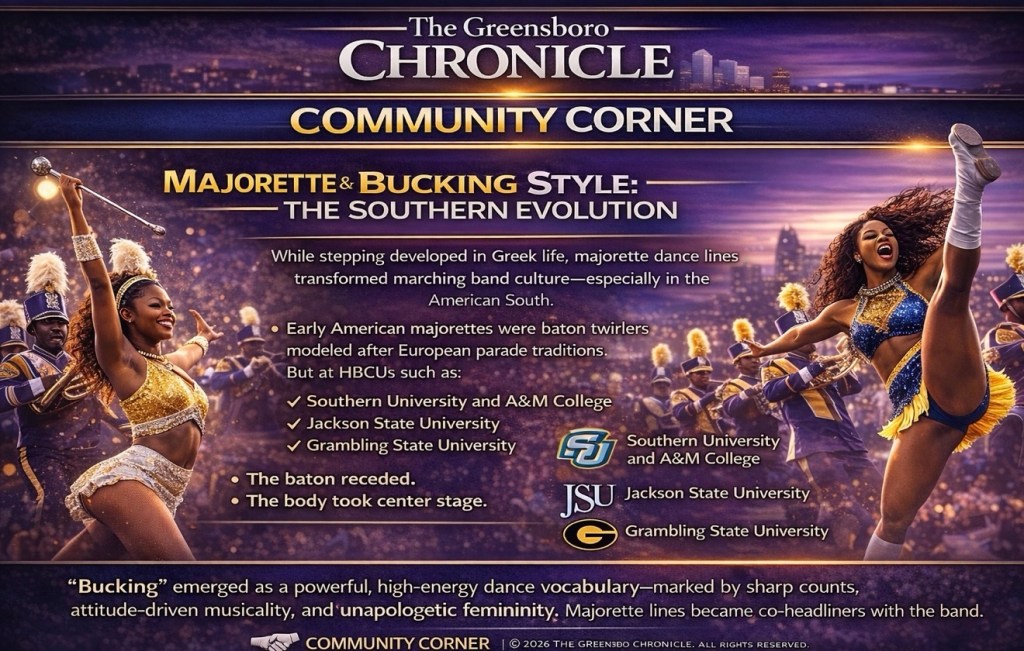
III. Majorette & Bucking Style: The Southern Evolution
While stepping developed in Greek life, majorette dance lines transformed marching band culture—especially in the American South.
Early American majorettes were baton twirlers modeled after European parade traditions. But at HBCUs such as:
Southern University and A&M College Jackson State University Grambling State University
something radical happened.
The baton receded.
The body took center stage.
Hip isolations.
Explosive turns.
Deep squat pulses.
High kicks with Southern swagger.
“Bucking” emerged as a powerful, high-energy dance vocabulary—marked by sharp counts, attitude-driven musicality, and unapologetic femininity.
Majorette lines became co-headliners with the band. When the horns hit a breakdown, the dance line answered with power.
IV. Shared DNA: Formation, Identity, Call & Response
Though stepping and bucking differ in aesthetics, they share critical cultural DNA:
Stepping
Majorette/Bucking
Boot stomp percussion
Hip-driven musical accents
Organizational chants
Musical breakdown choreography
Fraternity/Sorority pride
Band and institutional pride
Tight military formation
Formation-based breakdowns
Call-and-response vocals
Call-and-response movement
Both rely on:
Collective synchronization Rhythmic precision Visual dominance Community affirmation
Both say the same thing in different languages:
We belong here.
V. Impact on African American Culture & Community
1. Cultural Preservation
These art forms preserve African diasporic movement traditions in modern form. They are living archives.
2. Youth Development & Pipeline
Today:
Elementary and high school step teams exist nationwide. Youth majorette teams train year-round.
Television shows like Bring It! expanded majorette visibility to younger audiences, while films such as Stomp the Yard introduced stepping to mainstream America.
For many young Black students, participation builds:
Discipline Confidence Leadership Public performance skill Cultural literacy
These are not extracurricular hobbies. They are identity incubators.
VI. Public Perception: Celebration & Controversy
As visibility increased, so did scrutiny.
Stepping has sometimes been misunderstood or conflated with hazing, despite being a sanctioned performance tradition when practiced appropriately within organizational rules.
Majorette dance, particularly bucking style, has faced criticism rooted in:
Respectability politics Gendered scrutiny Misinterpretation of expressive femininity
Yet within Black communities—especially HBCU culture—these performances are not objectified. They are celebrated.
The line is elite.
The yard is sacred.
VII. Gender, Power & Expression
Stepping historically foregrounded male fraternal performance (though sorority stepping is equally powerful), while bucking-style majorette dance placed Black women front and center.
Majorette lines redefined:
Public Black femininity Athleticism Glamour Command presence
Stepping emphasized:
Brotherhood Vocal authority Structured solidarity
Together, they represent a spectrum of Black gender expression—disciplined yet expressive, fierce yet communal.
VIII. The New Generation: TikTok, Viral Culture & Legacy Tension
In the social media era, snippets of bucking choreography and step sequences circulate globally.
With that visibility comes tension:
Who owns the style? Is context being lost? Is commercialization diluting heritage?
Younger generations remix tradition with hip-hop, pop choreography, and digital aesthetics. Yet the foundational vocabulary remains tied to HBCU culture.
The stomp still echoes West Africa.
The buck still pulses Southern band culture.
What changes is the stage.
IX. The Greensboro & North Carolina Connection
In North Carolina, North Carolina A&T State University continues to serve as a cultural anchor where stepping and band traditions remain central to campus life.
In cities like Greensboro—historically significant in civil rights history—these art forms carry additional weight. They are reminders that Black public presence has always required discipline, courage, and collective pride.
Performance becomes legacy.
Conclusion: Rhythm as Resistance, Movement as Memory
Stepping and majorette/bucking-style dance are not parallel trends—they are intertwined expressions of African American cultural survival and brilliance.
One stomps in formation.
One bucks in breakdown.
Both carry history.
Both build community.
Both teach the next generation how to stand tall in rhythm.
In a society that once criminalized Black gathering and sound, these art forms transformed the body into declaration.
Every stomp is memory.
Every buck is power.
And the culture continues—count by count.
Legal Disclaimer
This article is provided for educational and informational purposes only. It reflects historical research and publicly available information. It does not represent official positions of any fraternity, sorority, university, or dance organization referenced. Readers are encouraged to consult primary institutional and organizational sources for official histories and policies.
© 2026 The Greensboro Chronicle. All Rights Reserved.
ENGLISH-ONLY CDL TESTING IN MARYLAND: SAFETY STANDARD OR POLICY SIGNAL?
A red semi-truck dominates the frame. Across the top: “ENGLISH ONLY.” Beneath it, bold lettering declares that all truckers and bus drivers are required to take commercial driver’s license tests in English.
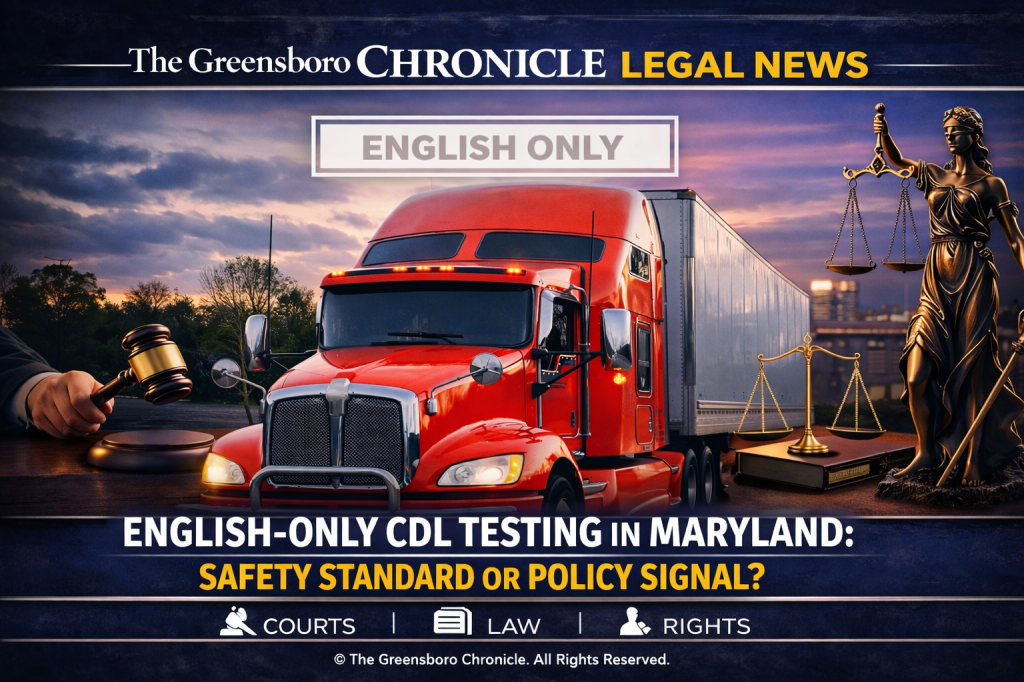
The message is blunt. The policy shift it represents is even more so.
Maryland is aligning enforcement of Commercial Driver’s License (CDL) testing with long-standing federal requirements that commercial motor vehicle operators be able to read and speak English sufficiently to understand traffic signs, respond to official inquiries, and complete reports. But the renewed focus on “English-only” testing is more than bureaucratic housekeeping. It is a flashpoint in a national debate over safety, labor, immigration, and economic stability.
This is not just about language. It is about who gets to drive America’s economy—and under what conditions.
The Legal Foundation: What Federal Law Already Says
Under federal regulations administered by the Federal Motor Carrier Safety Administration (FMCSA), commercial drivers operating in interstate commerce must:
Read and speak English sufficiently to converse with the general public Understand highway traffic signs and signals in English Respond to official inquiries Complete reports and records
These standards have existed for decades. The CDL program itself was established under the Commercial Motor Vehicle Safety Act of 1986 to reduce crashes involving large trucks and buses by creating uniform national licensing standards.
In short: English competency has long been part of the federal safety framework.
What Maryland’s enforcement posture signals is not the creation of a new requirement—but a more rigid interpretation and application of one.
The Safety Argument
Proponents argue the matter is simple: commercial vehicles are 80,000-pound machines operating on crowded highways. Road signs are in English. Emergency instructions are in English. Federal compliance documentation is in English.
A driver who cannot interpret a hazardous materials placard, a weight restriction sign, or an emergency detour notice could pose a real safety risk. According to National Highway Traffic Safety Administration (NHTSA) data, large trucks are involved in thousands of fatal crashes each year nationwide. While language proficiency is not typically listed as a primary crash factor, communication failures during roadside inspections and post-crash investigations have been cited by regulators as complicating enforcement and safety compliance.
From a purely regulatory standpoint, uniform comprehension ensures consistent enforcement.
Safety advocates ask: if aviation requires standardized English proficiency for pilots worldwide, why should commercial trucking—another high-risk transportation sector—be different?
The Labor and Economic Reality
Yet policy does not exist in a vacuum.
The American Trucking Associations (ATA) has repeatedly reported a persistent driver shortage, estimating tens of thousands of open positions nationwide. The industry has increasingly relied on immigrant labor to fill those gaps. Many of these drivers complete English proficiency requirements successfully. Others rely on translated study materials and bilingual training programs to bridge comprehension gaps.
An “English-only” testing posture, depending on how it is implemented, may:
Reduce the immediate pool of eligible drivers Increase training costs Disproportionately affect immigrant communities Exacerbate freight delays
Maryland’s economy is deeply intertwined with logistics. The Port of Baltimore, interstate corridors, and regional freight routes depend on a steady supply of licensed drivers.
If enforcement tightens abruptly without transitional support—such as accessible ESL programs tailored to commercial driving terminology—the ripple effects could be economic.

The Civil Rights Dimension
Language itself is not a protected class under federal civil rights law. However, national origin is. Courts have recognized that English-only workplace policies may, under certain circumstances, intersect with national origin discrimination if applied unevenly or without business necessity.
In the CDL context, the business necessity argument—public safety—is strong.
But how the policy is implemented matters.
Is the state offering reasonable access to English language learning resources?
Is testing administered fairly?
Are standards clear and consistent?
A safety rule applied neutrally is one thing. A safety rule applied selectively is another.
Transparency is the dividing line.
What This Is — And What It Isn’t
It is important to distinguish between rhetoric and regulation.
Maryland is not banning non-English speakers from employment.
It is not criminalizing multilingual drivers.
It is not imposing a novel statutory requirement.
It is enforcing an existing federal English proficiency mandate tied to interstate commercial operation.
However, the symbolism of “English Only” messaging carries cultural weight. In an era where immigration policy is intensely politicized, enforcement optics matter. When language standards are framed as crackdowns rather than compliance measures, public trust erodes.
Policy communication must be precise.
A Smarter Path Forward
If the goal is safety—and it should be—then the solution is not exclusion. It is elevation.
Maryland could:
Expand state-supported ESL programs tailored specifically to CDL vocabulary Provide standardized study guides in multiple languages while maintaining English testing Offer transitional compliance timelines Increase transparency around pass/fail data to ensure fairness
Safety and inclusion are not mutually exclusive. Competency is the standard—not cultural conformity.
The Larger Question
America’s highways are arteries of commerce. The men and women behind the wheel—regardless of accent—keep food on shelves, medicine in hospitals, and supply chains moving.
Requiring drivers to understand the language of the road is reasonable.
Weaponizing language as a political signal is not.
If Maryland’s enforcement of English-only CDL testing strengthens safety without undermining workforce stability or fairness, it will stand as responsible governance.
If it becomes a blunt instrument in a broader cultural battle, the consequences will extend far beyond the testing center.
The red truck in the image is more than a vehicle.
It is a reminder that policy drives people—and people drive policy.
Legal Disclaimer:
This op-ed is for informational and commentary purposes only and does not constitute legal advice. Readers should consult qualified counsel for specific legal guidance regarding commercial driver licensing requirements or civil rights implications.
© 2026 Greensboro Chronicle. All Rights Reserved

There’s a rumor that refuses to die. It lives in message boards scraped clean, in archived convention interviews, in the margins of court filings about character rights and “independent creation.” It’s the kind of rumor that survives because no one ever officially confirms it.
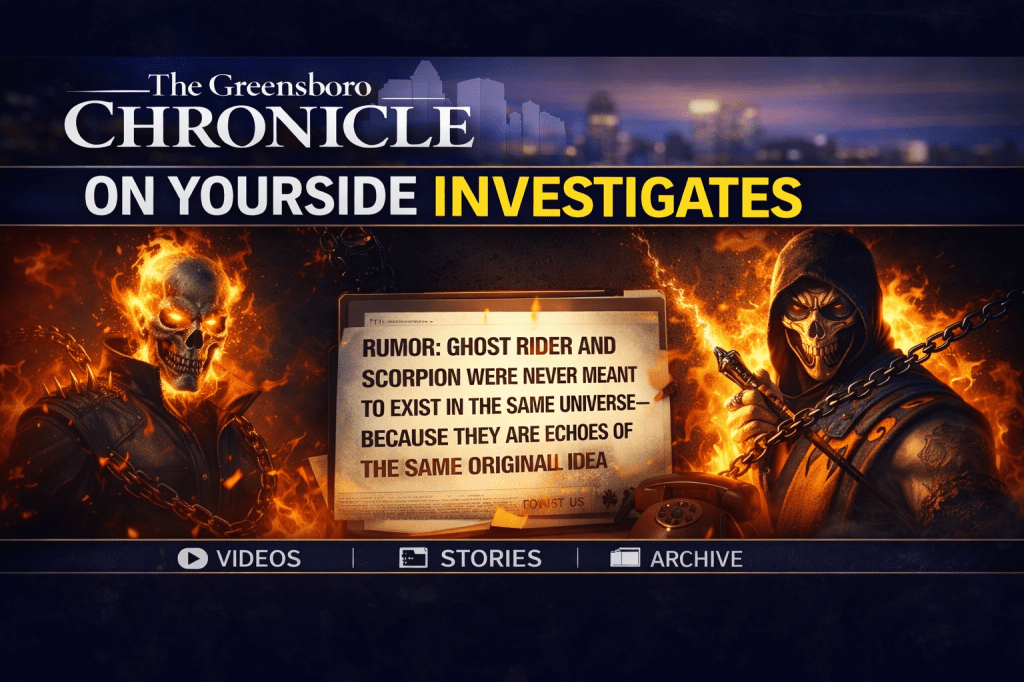
The rumor says Ghost Rider and Scorpion were never meant to exist in the same universe—because they are echoes of the same original idea.
According to the legend, sometime in the late 1970s, a concept circulated quietly through entertainment circles: a supernatural enforcer bound by fire, chained to vengeance, condemned to punish the guilty after death. The idea was pitched, reshaped, rejected, repurposed. Studios passed. Notes were buried. The concept fractured.
One fragment allegedly found its way into comic mythology: a flaming skull, hellfire wheels, chains that bind the wicked, a curse masquerading as justice.
Another fragment, the legend claims, went darker.
By the early 1990s, arcade cabinets began whispering the other half of the story. A specter in yellow. Burned flesh. A chain spear fired from the abyss. A dead man dragged back by rage alone. His warning wasn’t subtle:
Get over here.
Urban lore insists that early Mortal Kombat development notes referenced a “vengeful revenant archetype” inspired by non-licensed mythic materials. Fans later noticed the overlap:
Fire as punishment, not power Chains as judgment, not tools Resurrection through rage Justice without mercy
The similarities were dismissed as coincidence—until they weren’t.
At conventions, creators deflected. Interviews were edited. Early design sketches disappeared from public archives. A few fans swear they saw legal correspondence redacted and refiled under unrelated case numbers during the 1990s IP boom, when studios quietly tightened ownership lines around anything that smelled like hellfire.
The cautionary version of the legend goes further.
It says the characters were deliberately separated—not legally, but mythologically. That allowing them to cross would expose the shared origin: a single idea about vengeance so violent it had to be split in two to be sold.
In this telling, Ghost Rider became the warning: justice burns everyone, including the judge.
Scorpion became the consequence: vengeance doesn’t ask permission.
And the reason they never officially meet—never crossover, never acknowledge each other—isn’t copyright at all.
It’s containment.
Because if the two halves ever rejoin, the legend says, the story stops being entertainment and becomes indictment. Fire without restraint. Punishment without end. A mirror held too close to the human appetite for retribution.
Urban legends survive because they answer a question no one wants to ask out loud:
Why do we keep reinventing the same monster?
And why does it always wear chains?
⚠️ LEGAL & EDITORIAL DISCLAIMER
This article is a work of commentary, folklore analysis, and creative storytelling based on publicly observable themes, fan theories, and longstanding urban legends.
It does not assert factual claims regarding intellectual property ownership, creator intent, or legal disputes. Any resemblance to real persons, companies, or legal actions is interpretive and speculative, used solely for cultural and journalistic discussion.
All fictional characters referenced are the property of their respective rights holders.
© COPYRIGHT NOTICE
© 2026 The Greensboro Chronicle. All rights reserved.
No part of this publication may be reproduced, redistributed, or transmitted in any form without prior written permission, except for brief quotations used for commentary, criticism, or educational purposes consistent with fair use

By The Greensboro Chronicle | Opinion
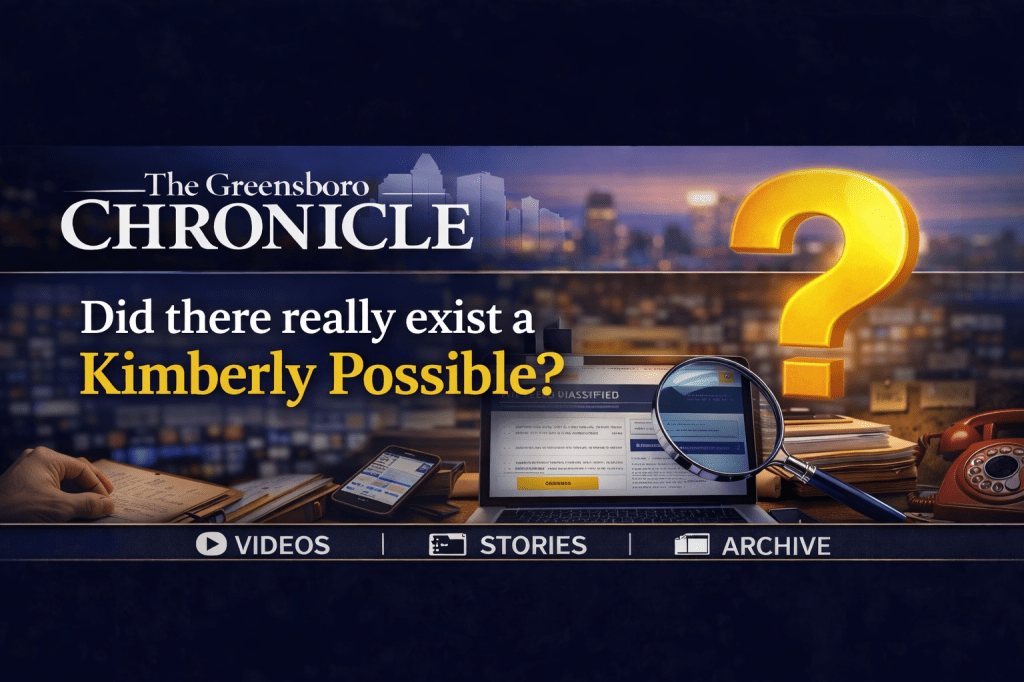
Every generation inherits a handful of stories that feel too specific to be pure fiction. They come wrapped in bright colors, hummable theme songs, and the promise that good always wins—but underneath, something colder hums. Kim Possible was sold as a Disney Channel fantasy: a cheerleader who moonlights as a globe-trotting hero, saving the world between algebra tests. Yet for years, whispers have persisted about a “real” Kim Possible—less animated, more classified.
The whispers are the point.
There is no verified, singular woman named Kim Possible who leapt from locker halls into lairs of doom. What exists instead is older, darker, and far more unsettling: a composite born of intelligence history, wartime necessity, and a long tradition of laundering brutal realities into palatable myths.
To understand why the legend sticks, you have to step away from animation and into archives.
The Skeleton Key: How Myths Get Made
During the Cold War—and well before it—Western intelligence agencies leaned heavily on young operatives, particularly women, whose perceived “normalcy” was their camouflage. Students, athletes, couriers, translators. Their work was not glamorous. It was transactional, coercive, and often disposable. Files declassified decades later reveal patterns: youth recruited early, identities fragmented, missions compartmentalized so no one could see the whole truth. Survival depended on silence.
Popular culture has always cleaned this up. Spy fiction replaced trauma with wit. Moral ambiguity became a punchline. By the late 20th century, the idea of a teenage operative was no longer shocking—it was marketable.
That is the soil from which Kim Possible grew.

Sanitization as Survival
When Disney premiered Kim Possible, it did something deceptively clever. It folded espionage into after-school TV, drained the blood from the floor, and left behind a role model. The villains were absurd. The danger reset every episode. No one disappeared forever.
This wasn’t accidental. Entertainment has long served as a pressure valve, allowing societies to acknowledge uncomfortable truths without confronting them. By turning intelligence work into a cartoon, the genre reassured parents and advertisers alike: this is safe. Whatever the real world demanded of real people could be reimagined as harmless adventure.
And yet, the bones still showed.
The show’s core premise—constant travel, rotating aliases, adult handlers, high-risk missions with no public accountability—mirrored real operational structures more closely than many viewers realized. That resonance is what fuels the myth of a “real” Kim Possible. People sense that the fantasy is built atop something true, even if the details are wrong.
The Darkness We Prefer Not to See
The eeriest part of the legend isn’t the idea that a teenage spy once existed. It’s the historical record that says many did—and that their stories were never theirs to tell.
Intelligence history is crowded with unnamed women whose contributions were minimized, classified, or erased. Some were celebrated only after death. Others were disavowed entirely. Their lives did not end with a theme song; they ended with NDAs, broken health, or quiet obscurity. When pop culture borrows their outline and paints it neon, it creates a comforting lie: that the system was kind, that the work was noble, that the cost was manageable.
The myth of the “real Kim Possible” persists because it asks a safer question than the truth. It asks who instead of how many. It searches for a single heroine rather than confronting a machinery that consumed thousands.
Why the Legend Still Matters
This isn’t about debunking a rumor for sport. It’s about recognizing a pattern. When societies are unwilling to face the damage done in the name of security, they package it as nostalgia. They turn classified suffering into content. They let children hum along.
And then they wonder why the story won’t stay fictional.
The “real” Kim Possible isn’t a person you can look up. She’s an echo—of programs that prized utility over humanity, of cultures that preferred a cartoon to an accounting, and of histories that remain partially sealed not because they’re thrilling, but because they’re damning.
Call that eerie. Call it cautionary. Just don’t call it impossible.
Legal Disclaimer
This op-ed reflects historical analysis, publicly available records, cultural criticism, and commentary. It does not assert the existence of any specific real individual as the basis for fictional characters, nor does it allege wrongdoing by any identifiable person. References to intelligence practices are general, historical, and non-classified in nature.
Copyright Notice
© 2026 The Greensboro Chronicle. All rights reserved.
This article is an original work of commentary and analysis. No portion may be reproduced, distributed, or republished without prior written permission from The Greensboro Chronicle, except for brief quotations used for purposes of criticism, commentary, or news reporting consistent with fair use

By The Greensboro Chronicle | Consumer & Legal Affairs
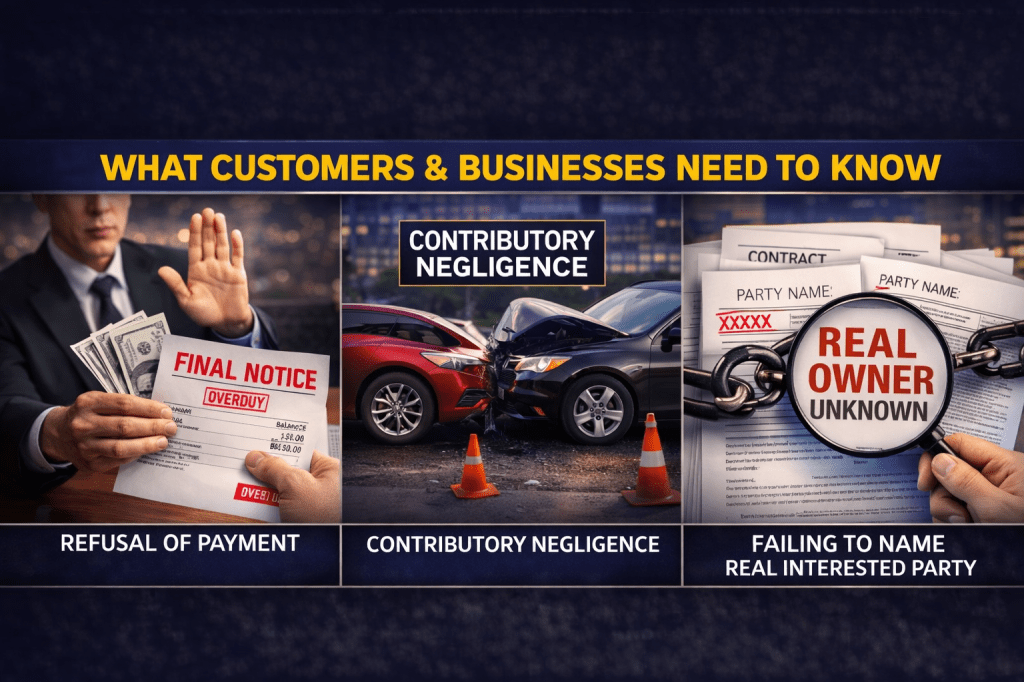
In North Carolina, many companies lose lawsuits—and public trust—not because of dramatic fraud or intentional wrongdoing, but because of something far simpler: they get the basics wrong at the beginning.
Under long-standing North Carolina legal doctrines, refusing payment, blocking compliance, misidentifying parties, or mishandling responsibility can transform an otherwise routine transaction into a legal and reputational disaster. These doctrines are not obscure loopholes. They are settled law, repeatedly enforced by courts, regulators, and insurers.
This article explains—in plain language—how the doctrines of Compliance Prevention, Refusal of Payment, Contributory Negligence, Vicarious Liability, and Respondeat Superior operate, and why businesses that ignore them often end up paying twice: once in court, and again in public credibility.
1. Compliance Prevention: When a Company Causes Its Own Violation
What it means:
A party cannot profit from preventing another party from complying with the law or a contract.
In North Carolina, if a business blocks, refuses, interferes with, or makes compliance impossible—and then claims breach, default, or violation—it has created what courts call compliance prevention.
Common examples include:
Refusing to accept timely payment, then declaring default Providing incomplete or misleading payment instructions Failing to identify the proper party to pay Ignoring written attempts to resolve or cure an issue
Why this backfires:
Courts view this as self-inflicted harm. Once compliance prevention is shown, the company’s claims often collapse entirely. Worse, evidence of prevention frequently supports consumer protection violations, fee-shifting, and punitive exposure.
Bottom line:
If a business slams the door on compliance, it cannot later complain that someone didn’t walk through it.

2. Refusal of Payment: The Quiet Trigger for Liability
What it means:
A business that refuses lawful, timely payment may forfeit its ability to claim nonpayment.
Under North Carolina law, a creditor or merchant generally cannot:
Reject payment, and Still claim the payer is in default
Why this matters:
Refusal of payment often becomes the linchpin fact that:
Defeats breach claims Undermines collection efforts Exposes the company to unfair or deceptive trade practice allegations
Even worse for businesses, written refusals, call logs, or recorded communications frequently become exhibits—not defenses.
In practice:
Many companies believe refusing payment strengthens leverage. In reality, it often destroys it.
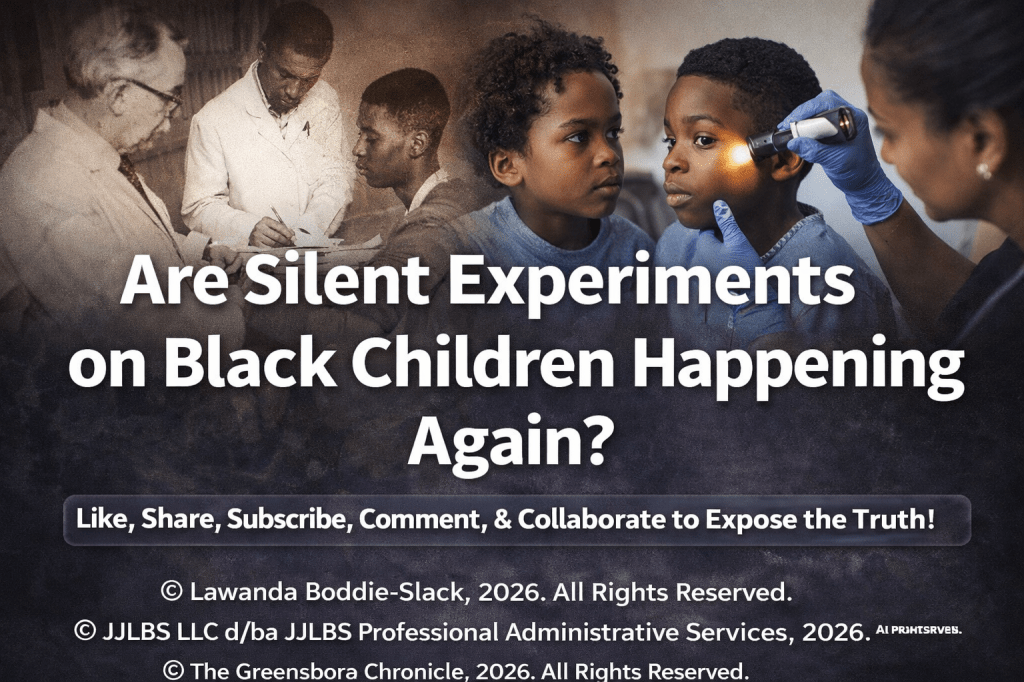
3. Contributory Negligence: When One Mistake Bars Recovery
North Carolina remains one of the few states that still applies pure contributory negligence.
What it means:
If a party contributes even slightly to the harm it complains about, it may be barred from recovery entirely.
How businesses trip over this rule:
Giving incorrect instructions Failing to verify identities or ownership Sending contradictory communications Allowing internal confusion between departments or agents
If a company’s own conduct helps cause the dispute, courts may rule that the company caused its own loss.
Why insurers care:
Contributory negligence findings frequently trigger coverage disputes and reservation-of-rights letters—because preventable conduct is not the same as unavoidable risk.
4. Vicarious Liability: You Own What Your Agents Do
What it means:
Businesses are legally responsible for the acts of their agents when those acts occur within the scope of their work.
That includes:
Employees Contractors Collection agencies Servicers Property managers Vendors acting on the company’s behalf
A company cannot escape liability by saying:
“That wasn’t us—that was our vendor.”
If the vendor was acting for the business, the liability follows the business.
Real-world consequence:
Companies routinely discover too late that outsourcing misconduct does not outsource responsibility.
5. Respondent Superior: The Doctrine That Protects the Public
Closely related to vicarious liability, respondeat superior holds employers accountable for employee actions performed during employment.
Why courts enforce it strictly:
This doctrine exists to protect the public—not companies. The law assumes businesses are in the best position to:
Train workers Supervise conduct Prevent systemic abuse
When companies fail to do so, courts do not excuse the harm—they assign it.
How Companies End Up “Handing Over Money”
When these doctrines combine, the result is predictable:
A business refuses payment or blocks compliance An agent or employee escalates improperly The wrong party is named or identified The company’s own conduct contributes to the dispute Liability attaches automatically under agency law Defense costs rise Insurers push for settlement Reputational harm follows
At that point, many cases are resolved not because the company was “wrong,” but because it can no longer prove it was right.
What Customers Should Verify from the Start
Consumers and businesses alike should document and verify the following early—before disputes arise:
Who is the real, legally interested party? Who is authorized to accept payment? What methods of payment are permitted? Are payment refusals documented? Are communications consistent and traceable? Are agents properly identified and supervised?
Paper trails protect both sides—but only if they exist before conflict begins.
Why This Matters Now
As regulators, courts, and consumers become more sophisticated, sloppy compliance is no longer invisible. Routine business shortcuts increasingly appear in court filings, investigative reports, and public records.
The companies most at risk are not always the biggest offenders—but often the ones who assume:
“This is how it’s always been done.”
In North Carolina, that assumption can be very expensive.
Legal Disclaimer
This article is provided for informational and educational purposes only and does not constitute legal advice. Reading this article does not create an attorney-client relationship. Laws and interpretations may change, and readers should consult a licensed North Carolina attorney regarding specific legal questions or situations.
Copyright & Publication Notice
© 2026 The Greensboro Chronicle. All rights reserved.
No portion of this article may be reproduced, distributed, or republished without express written permission, except for brief quotations used for commentary, criticism, or news reporting consistent with fair-use principles.
By The Greensboro Chronicle | Consumer & Legal Affairs
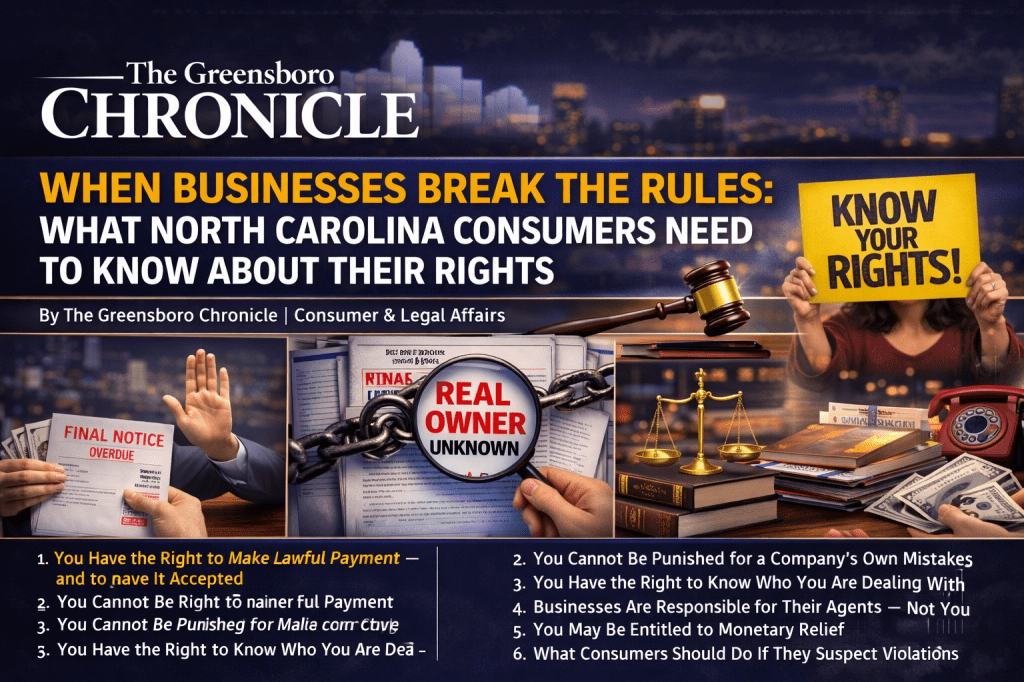
When a company refuses payment, blocks compliance, misidentifies who actually owns a debt or account, or allows its agents to act improperly, consumers often assume they are powerless.
That assumption is wrong.
North Carolina law provides meaningful protections and remedies when businesses engage in prohibited conduct such as compliance prevention, wrongful payment refusal, contributory negligence, or agency misconduct. These protections exist not to punish commerce—but to ensure fairness, accountability, and transparency.
This article explains, in plain language, what your rights are, what relief may be available, and what steps matter most when a business crosses legal lines.
1. You Have the Right to Make Lawful Payment — and to Have It Accepted
If you tender timely, lawful payment using an authorized method, a business generally cannot refuse it and then penalize you.
If a company:
Rejects payment without legal justification Fails to provide clear payment instructions Creates barriers that make payment impossible
you may have defenses against:
Default claims Collection efforts Late fees and penalties Adverse credit reporting
In some circumstances, wrongful refusal of payment becomes evidence of unfair or deceptive conduct.
What you may be entitled to:
Reversal of claimed default Removal of penalties Correction of account status Compensation if harm resulted

2. You Cannot Be Punished for a Company’s Own Mistakes
Under North Carolina law, a business cannot cause a problem and then blame you for it.
If a company’s actions contributed to the situation—by:
Giving conflicting instructions Naming the wrong party Failing to respond to cure attempts Interfering with compliance
that conduct may bar the company from recovery and shift responsibility back to the business.
Consumer protection laws recognize this as unfair conduct, particularly when the consumer acted in good faith.
3. You Have the Right to Know Who You Are Dealing With
One of the most common—and most serious—violations involves failing to identify the real interested party.
Consumers have the right to know:
Who actually owns the account or debt Who has legal authority to collect or enforce Whether an agent is acting on behalf of someone else
If a business or collector cannot clearly identify the real party in interest, its claims may be legally defective.
Potential consumer remedies include:
Dismissal of improper claims Challenges to enforcement actions Recovery of damages for misrepresentation
4. Businesses Are Responsible for Their Agents — Not You
Consumers are not required to untangle corporate relationships.
If a company’s:
Employee Contractor Servicer Property manager Collection agency
acts improperly while performing company business, the company remains responsible.
This means consumers may pursue remedies against the business itself, even if the misconduct was carried out by a third party.
5. You May Be Entitled to Monetary Relief
Depending on the facts, consumers may be entitled to:
Actual damages Statutory damages Recovery of improperly collected amounts Compensation for emotional distress (where supported) Attorney’s fees and costs (in qualifying cases)
In North Carolina, unfair or deceptive trade practices may also allow enhanced damages in certain circumstances.
Importantly, entitlement depends on evidence, timing, and how the conduct is documented.
6. Documentation Is Your Strongest Protection
Consumers who succeed in enforcing their rights usually do one thing well: they document everything.
Helpful records include:
Payment attempts and receipts Written refusals Emails, letters, and notices Call logs and recordings (where lawful) Screenshots and account statements
Documentation often determines whether a dispute becomes a quick correction—or a costly legal fight.
7. What Consumers Should Do If They Suspect Violations
If you believe a business has engaged in prohibited conduct:
Do not ignore the issue Preserve all communications Request written clarification Avoid verbal-only resolutions Seek qualified legal guidance early
Silence or delay often benefits the party that created the problem.
Why These Rights Matter
These protections exist because compliance failures harm more than individual consumers. They undermine trust, distort markets, and reward careless or abusive practices.
North Carolina law places responsibility where it belongs—on the party with power, information, and control.
When consumers understand their rights, unlawful conduct becomes harder to hide.
Legal Disclaimer
This article is provided for general informational purposes only and does not constitute legal advice. Reading this article does not create an attorney-client relationship. Laws vary by circumstance, and readers should consult a licensed North Carolina attorney regarding specific legal questions or disputes.
Copyright & Publication Notice
© 2026 The Greensboro Chronicle. All rights reserved.
This publication may not be reproduced, distributed, or republished in whole or in part without prior written permission, except for brief quotations used in news reporting, commentary, or criticism consistent with fair-use principles
By The Greensboro Chronicle Investigative Desk
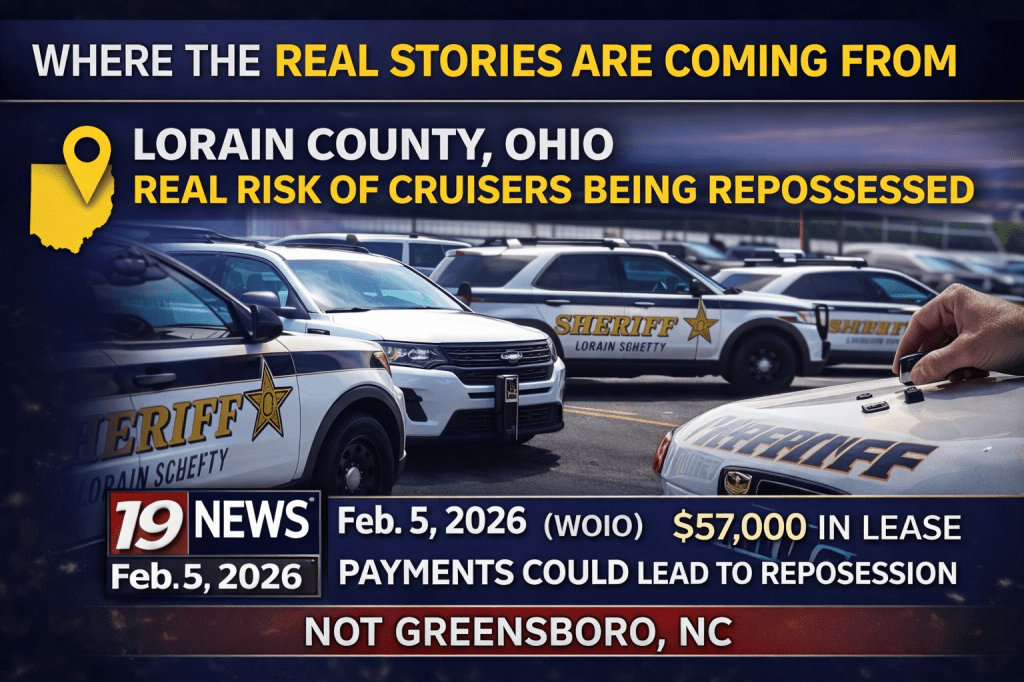
Recently, claims have circulated online suggesting that the Greensboro Police Department is at risk of having its patrol vehicles repossessed or taken back by a leasing company due to non-payment. To be clear: there is no verifiable reporting that such a repossession threat is happening in Greensboro.
So where does this idea come from — what’s real, what’s rumor, and how did it get mixed up with local conversations? We dug into available facts and context to give readers a clear picture.
📌 Where the Real Stories Are Coming From
🔹 Lorain County, Ohio — Real Risk of Cruisers Being Repossessed
A story published on Feb. 5, 2026 by 19 News (WOIO) reports that more than 40 cruisers used by the Lorain County Sheriff’s Office could be repossessed if lease payments of over $57,000 are not made to the leasing company. Deputies reportedly began removing equipment from cruisers amid the dispute between the county commission and the sheriff’s union.
This credible, recent news from Ohio appears to be one of the primary factual events that’s being shared and sometimes misinterpreted online as “Greensboro PD vehicles at risk of repossession.”
However, that Lorain County situation is in Ohio — not Greensboro, North Carolina — and there is no authoritative local reporting linking the same circumstances to Greensboro’s police fleet.
📍 What’s Going on Locally With Greensboro Police Vehicles?
Here’s what we can confirm from official local budget and council records:
🔹 In 2023, the Greensboro City Council approved spending $1 million to buy 24 replacement police vehicles — because the department’s available backup fleet was extremely low (one spare vehicle at the time).
🔹 Earlier, the city had authorized a 20-vehicle fleet expansion to support recruitment and retention (the “take-home car program”). An 18-month delay due to supply-chain issues pushed back deployment of those vehicles.
There is no indication that those vehicles are leased and in danger of being taken back — the purchases were approved and funded through city budgets and council actions. No reporting suggests vendors have threatened to repossess Greensboro PD vehicles.
🧠 So Why the Confusion?
Here are some common drivers of this kind of misinformation:
🟡 1. Social posts confusing one department’s problems with another’s
The real Lorain County cruiser issue has factual footing and is spreading across social feeds. Some posts, however, mistakenly attach Greensboro’s name to the trend.
🟡 2. Local budget debates and dissatisfaction
There have been ongoing local discussions and some opinion pieces about police funding and staffing in Greensboro — including debates about vehicle availability, officer recruitment, and compensation. These debates don’t reflect a liquidation risk, but they do feed frustration that can make dramatic claims more believable.
🟡 3. Police fleet challenges aren’t unusual
Municipal police fleets across the U.S. frequently contend with aging vehicles, maintenance backlogs, and supply delays. Some cruiser leases require regular payments and maintenance — but the danger of repossession is not a normal part of general city fleet finances absent specific default on contracts.
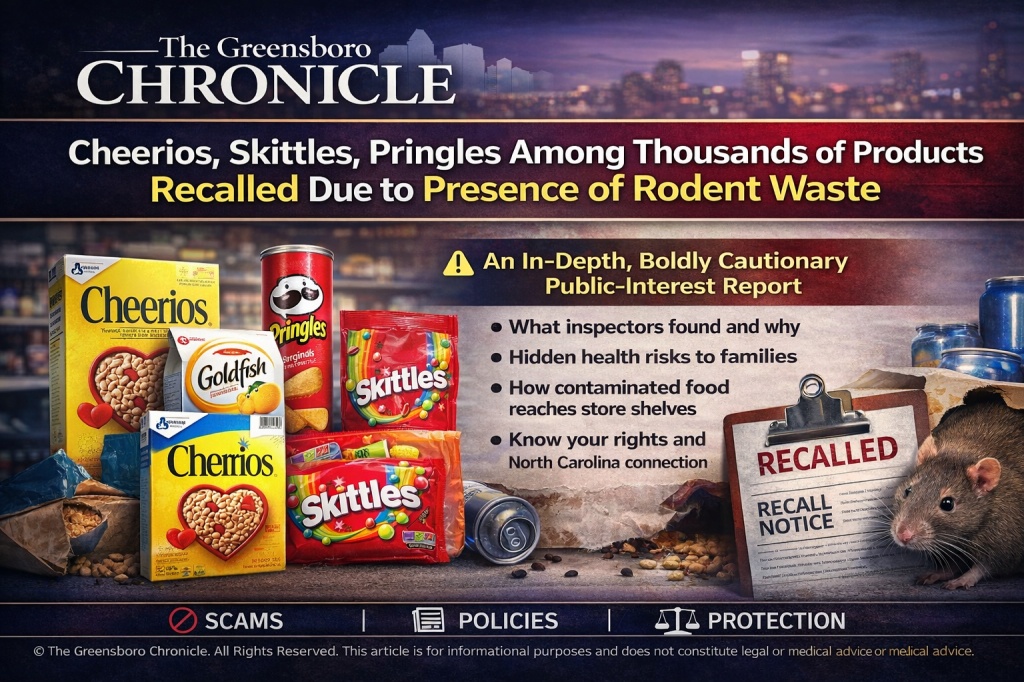
🧾 What’s on the Horizon?
🚘 Local Budget Conversations Continue: City council and department staff regularly present budgets and capital plans for Greensboro’s police fleet — including replacement vehicles and equipment acquisitions for future fiscal years.
📊 Public Safety Remains Priority: Greensboro’s FY25-26 budget process includes public safety, with community budget sessions and council review scheduled each year. Citizens can engage and watch council meetings where fleet issues are discussed.
📍 No Verified Repossession Threat for Greensboro: As of this writing, again — there is no factual, vetted reporting that the Greensboro Police Department is facing vehicle repossession due to unpaid lease or finance contracts.
🛡️ Disclaimer
This article is based on all currently available public data and established reporting as of February 2026. It reflects facts sourced from credible news organizations and official city records. Rumors, social posts, or unverified claims are not treated as factual without corroboration.
📣 The Greensboro Chronicle Is Following This
The Greensboro Chronicle is actively monitoring developments related to police funding, fleet management, and public safety budgeting — especially as conversations about municipal services continue in City Council and community forums.
If new reliable information emerges suggesting any change in police department fleet status or financial risk to city operations, we will update our coverage accordingly.
© 2026 The Greensboro Chronicle — All Rights Reserved. The Greensboro Chronicle organization claims copyright and editorial rights to this investigative reporting and its unique narrative structure. Unauthorized commercial redistribution is prohibited

An inquisitive, boldly cautionary examination of a children’s icon that unsettled a generation
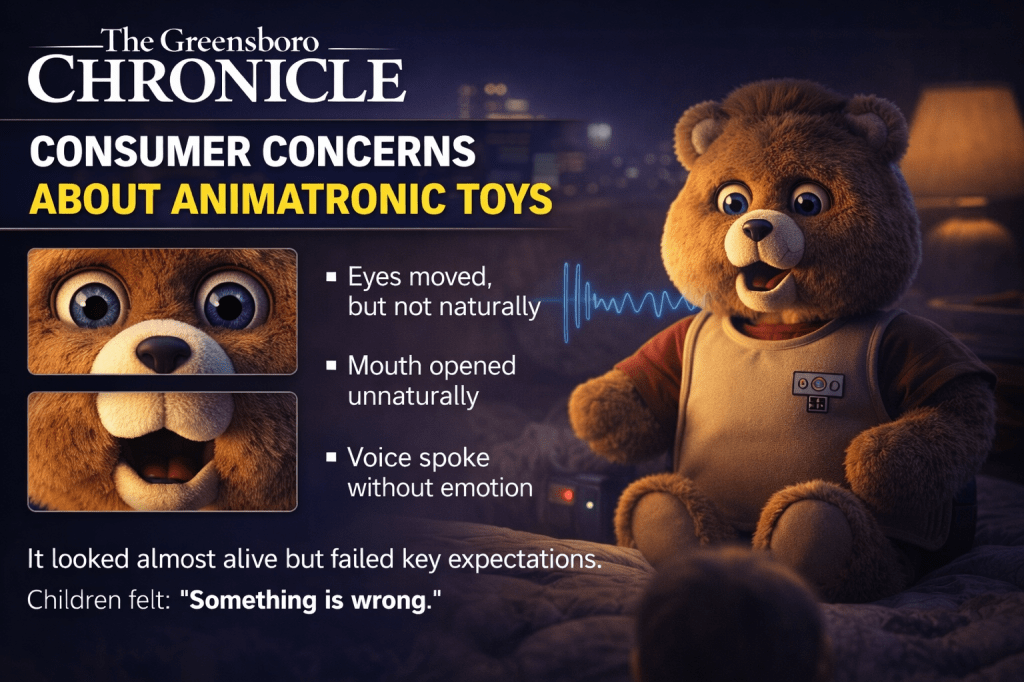
In the mid-1980s, living rooms across America welcomed a plush storyteller designed to read bedtime tales and teach gentle lessons. Parents saw innovation. Marketers saw magic. Children, however, often saw something else entirely.
For many, Teddy Ruxpin wasn’t comforting. He was unsettling—sometimes terrifying. Decades later, adults still swap stories about racing out of dark rooms, unplugging cassette players mid-sentence, or waking to the sound of a mechanical voice continuing a story long after it should have stopped.
This article explores why Teddy Ruxpin became feared—not as folklore, but as a convergence of technology limits, psychological triggers, and a cultural moment that underestimated how children actually perceive “friendly” machines.

The Promise vs. the Reality
Teddy Ruxpin debuted as a breakthrough: an animatronic toy that synchronized mouth and eye movements to cassette tapes. The goal was intimacy—stories told to the child, not at them.
But intimacy requires trust. And trust is fragile when a toy doesn’t quite behave like a toy—or a living thing.
Children expected warmth and predictability. What they often got instead was something that hovered in an uncomfortable in-between state: not alive, not inert.
The Uncanny Valley Effect (Before We Had the Name)
Long before “uncanny valley” became common language, Teddy Ruxpin lived there.
His eyes moved, but not smoothly His mouth opened, but not naturally His voice spoke, but without emotional cadence
Human brains—especially developing ones—are extremely sensitive to faces and voices. When something looks almost alive but fails key expectations, the brain interprets it as a threat.
Children didn’t think, “This toy is malfunctioning.”
They felt, “Something is wrong.”
That feeling sticks.
Mechanical Failures That Felt Supernatural
Publicly documented user experiences and product reviews from the era repeatedly describe:
Tape desynchronization, causing delayed or mismatched speech Motor wear, producing grinding or clicking sounds Eyes opening without sound when tapes jammed Stories continuing after power switches failed
To an adult, these are mechanical issues.
To a child in a dark room, they’re proof the bear is alive—and not obeying rules.
Fear thrives when cause and effect break down.
Nighttime + Voice = Vulnerability
Teddy Ruxpin wasn’t a daytime toy. He was marketed for bedtime.
That matters.
Bedtime is when:
Lights are low Imagination is high Cognitive defenses are tired
A disembodied voice emerging from a plush figure, especially one that doesn’t blink or emote correctly, can easily override a child’s sense of safety.
Many parents later admitted they didn’t witness the fear—because it happened after the door closed.
Loss of Control: The Hidden Trigger
Traditional toys stop when you stop playing.
Teddy Ruxpin did not.
Once the cassette rolled, the child was no longer in control. They couldn’t interrupt easily. They couldn’t predict pauses. They couldn’t make it stop without adult help.
Psychologists note that loss of agency is one of the fastest ways to induce fear in children. Teddy Ruxpin unintentionally embodied that loss.
Cultural Timing Made It Worse
The 1980s were filled with public anxiety about:
Automation entering homes Talking machines replacing human interaction Technology behaving unpredictably
Against that backdrop, a talking bear with moving eyes wasn’t neutral. It symbolized something adults were excited about—but children weren’t ready for.
In hindsight, Teddy Ruxpin arrived too early for the emotional maturity of both the technology and its audience.
Why the Fear Lasted
What makes Teddy Ruxpin different from other “creepy toy” stories is longevity.
People remember:
Where they were How old they were What the voice sounded like The exact moment fear set in
That’s because early childhood fear, especially when mixed with confusion rather than danger, imprints deeply. The brain doesn’t file it as “memory.” It files it as warning.
A Cautionary Lesson, Not a Villain
Teddy Ruxpin was not malicious. He was ambitious.
He represents what happens when:
Technology moves faster than emotional design Adults project comfort onto children without listening “Innovative” replaces “developmentally appropriate”
Modern designers study these failures carefully now. User-centered design exists because of toys like Teddy Ruxpin—not in spite of them.
Final Thought
Fear doesn’t require harm.
It only requires uncertainty, vulnerability, and silence when something feels wrong.
Teddy Ruxpin didn’t mean to scare a generation.
But he taught one a lasting lesson:
If something talks to children, it must first understand them.
Legal Disclaimer — The Greensboro Chronicle
This article is published for informational, historical, and educational purposes only. The Greensboro Chronicle does not allege criminal conduct, intent, or wrongdoing by any manufacturer, distributor, or individual referenced herein. All observations reflect publicly reported information, documented consumer experiences, cultural analysis, and commentary protected under the First Amendment. Interpretations are presented in good faith and do not constitute product safety claims, psychological diagnoses, or legal conclusions.
Copyright Notice
© 2026 The Greensboro Chronicle.
All rights reserved. No portion of this publication may be reproduced, distributed, transmitted, or republished in any form without prior written permission, except for brief quotations used with proper attribution for news reporting, commentary, or educational purposes.

By The Greensboro Chronicle |
Legal Disclaimer: This article is informational in nature and does not constitute legal, financial, or immigration advice. Readers should consult qualified attorneys or financial professionals before making business or immigration decisions. |
© 2026 The Greensboro Chronicle. All rights reserved.
🔥 What Just Happened:
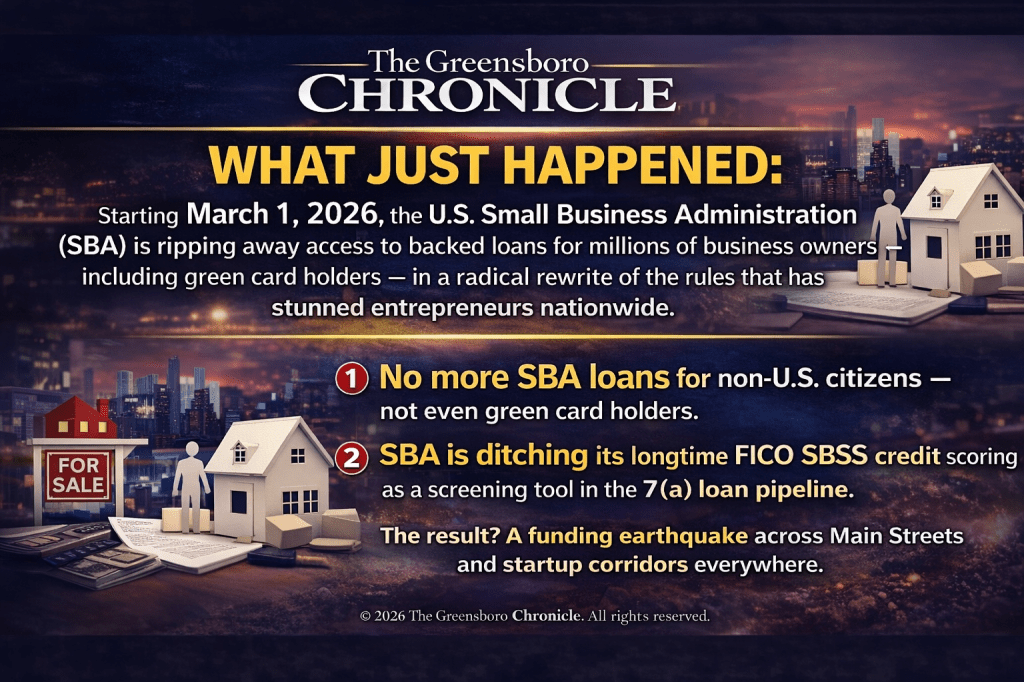
Starting March 1, 2026, the U.S. Small Business Administration (SBA) is ripping away access to backed loans for millions of business owners — including green card holders — in a radical rewrite of the rules that has stunned entrepreneurs nationwide.
These changes include:
1. No more SBA loans for non-U.S. citizens — not even green card holders.
2. SBA is ditching its longtime FICO SBSS credit scoring as a screening tool in the 7(a) loan pipeline.
The result? A funding earthquake across Main Streets and startup corridors everywhere.
🧠 What Used to Be — The Old SBA Rules
For decades, SBA loans were America’s secret sauce for small business financing: affordable terms, partial federal guarantees, and lifelines for startups that couldn’t get conventional bank capital.
Before March 2026, the basic eligibility landscape looked like this:
✔️ Businesses could receive SBA 7(a) and 504 loans if they were located in the U.S. and met size and credit standards.
✔️ Owners had to be U.S. citizens or lawful permanent residents (green card holders) — but minority non-citizen ownership was often allowed up to specific thresholds.
✔️ SBA used the FICO Small Business Scoring System (SBSS) to pre-screen many 7(a) applications through a credit score range (0–300).
Non-citizens, including conditional residents or certain visa holders, could sometimes qualify or apply through nuanced lender discretion and specific documentation — though this was always complex.
⚠️ WHAT TRIGGERED THIS EARTHQUAKE CHANGE
🎯 Policy Overhaul and Executive Pressure
The SBA’s drastic rewrite is tied to broader federal policy shifts aimed at tightening citizenship verification in federal benefits — including loan programs — under recent executive directives and internal SBA policy notices. These directives expanded the definition of ineligible persons to include many non-citizens in managerial or ownership roles.
📉 Stricter Risk Controls and Political Blame Games
Officials pitched these changes as “protecting taxpayers” and aligning eligibility with stringent immigration enforcement priorities. Critics — including bipartisan lawmakers — argue that these rules have unintentionally strangled small business lending, contributing to sharp drops in approvals and blocking financing for vibrant immigrant entrepreneur communities.
🚨 NEW DEADLY RULES FOR SBA LOANS, EFFECTIVE MARCH 1, 2026
❌ No Non-Citizens — Even Green Card Holders
Effective March 1, 2026:
👉 If any direct or indirect owner of a business is not a U.S. citizen or U.S. national with permanent residency, the business cannot borrow SBA loans — period. Green card holders are explicitly stripped of eligibility.
Previous exceptions allowing up to 5% ownership by non-citizens have been rescinded.
🚫 FICO SBSS Credit Screening Dropped
In a parallel move, SBA will no longer use the FICO SBSS score to screen 7(a) applications — meaning:
📉 The standardized, semi-predictive scoring that helped lenders assess business credit risk is gone.
📉 Lenders must now rely more heavily on manual underwriting, cash-flow analyses, and other subjective factors.
This adds new friction — and uncertainty — to lending decisions.

🧍♂️ WHO THIS HITS THE HARDEST
Non-Citizens
🌎 Immigrant entrepreneurs, startup founders, and family businesses that depend on SBA backing are suddenly locked out — even if they’ve lived, worked, and paid taxes for years.
Small Businesses With Non-U.S. Managers
Changes in ownership and key employee definitions could even disqualify companies where *owners are citizens but key employees are not — a controversial interpretation that critics say goes beyond citizenship intent.
Lenders and Local Economies
Banks and credit unions must now rewrite underwriting procedures — at a time of stagnating small business credit — potentially worsening the lending drought.
💡 ARE THERE STILL PATHS FOR NON-CITIZENS?
It’s not all shutdowns — but options are limited, complex, and often higher-cost:
✔️ Alternative Lenders
Private small business lenders, community development financial institutions (CDFIs), or microloan programs that do not depend on SBA guarantees might still work with lawful non-citizens.
✔️ State & Local Grants
Some states and municipalities offer grant programs irrespective of federal citizenship eligibility.
✔️ Immigrant-Focused Funds
Certain nonprofit and angel investment funds focus on immigrant business owners — but these are not SBA guarantees and often require pitch quality & collateral.
✔️ Visa-Linked Funding
EB-5 and certain investor visa categories can open doors to capital inflows, but are costly and require complex immigration/legal planning.
📢 CALL TO ACTION — URGENT AND BOLD
Small business owners across the U.S., regardless of citizenship status, cannot afford delay.
If you are a business owner or investor who:
✔️ Has an SBA loan pending
✔️ Wants capital for growth
✔️ Has immigrant co-owners or managers
✔️ Relies on SBA 7(a) or 504 financing
You MUST ACT NOW.
🔎 Talk to a qualified SBA lender immediately to assess your current application before March 1, 2026.
📞 Consult an immigration attorney to explore whether your status or ownership structure can be preserved under the new rules.
📈 Seek alternative financing channels — sooner, not later.
The American Dream has never been this precarious. Act before your future is legislated away.
Copyrights © 2026 The Greensboro Chronicle. All rights reserved. Reproduction in whole or part without permission is prohibited.
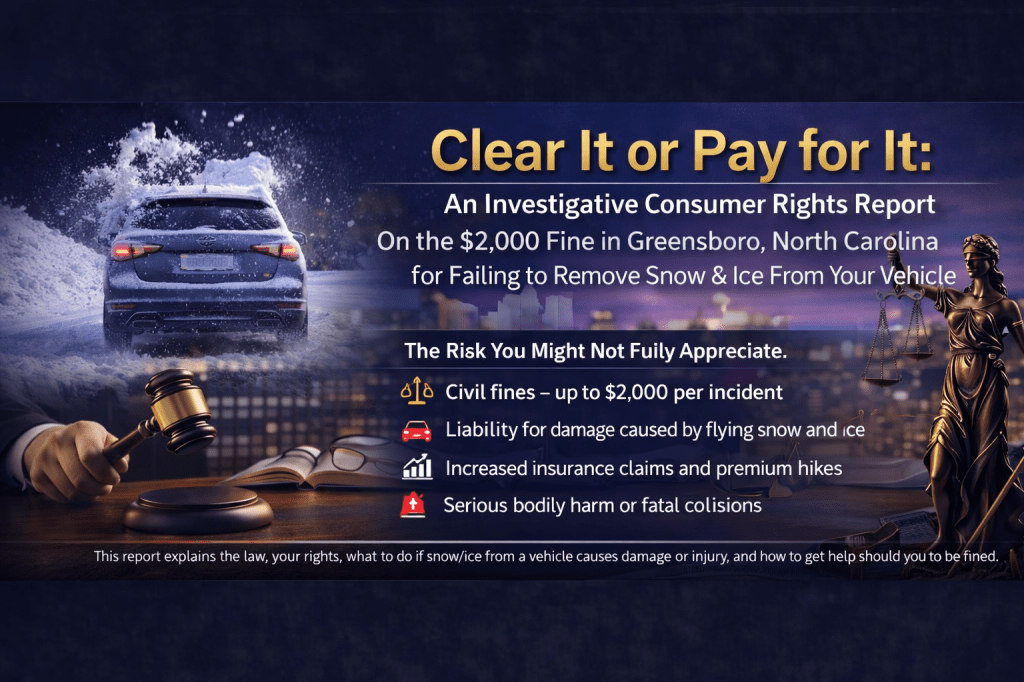
An Investigative Consumer Rights Report
On the $2,000 Fine in Greensboro, North Carolina for Failing to Remove Snow & Ice From Your Vehicle
Published by The Greensboro Chronicle
© 2026 The Greensboro Chronicle™ — All Rights Reserved.
❄️ The Risk You Might Not Fully Appreciate
Winter weather brings slippery roads, frosted windshields and — often overlooked — serious legal and safety obligations for vehicle owners to clear snow and ice from their cars and trucks.
In Greensboro, North Carolina, failing to properly remove snow and ice from your vehicle before driving can expose you to:
⚖️ Civil fines — up to $2,000 per incident 🚗 Liability for damage caused by flying snow and ice 📉 Increased insurance claims and premium hikes 🚨 Serious bodily harm or fatal collisions
This report explains the law, your rights, what to do if snow/ice from a vehicle causes damage or injury, and how to get help should you be fined.
📜 What the Law Means — In Plain Language
North Carolina’s vehicle code includes requirements related to keeping vehicles safe and visible. While the state does not have a specific statute that says “you must remove all snow and ice,” prosecutors and law enforcement increasingly use broader vehicle safety and negligence laws to issue citations.
In Greensboro and throughout North Carolina:
Drivers are required to operate vehicles in a safe condition. Snow or ice that becomes dislodged and strikes another vehicle or person can be treated as negligence. Law enforcement can charge drivers when snow or ice creates a traffic hazard.
👉 In practice, officers frequently cite negligent operation or careless driving when snow or ice from a vehicle leads to an accident or hazard.
The maximum fine for certain moving violations in North Carolina — including impaired operations or reckless conduct — can reach $2,000.
🔎 Why This Matters to You
Even if a fine isn’t issued at the scene, you can still be:
💥 Held financially responsible if snow/ice from your vehicle injures a person 🚗 Sued if your vehicle causes property damage due to flying ice or snow 🧾 Required to defend against insurance claims 🪪 Facing higher insurance premiums 📉 Exposed to civil liability beyond the fine
🧳 BEFORE You Drive
✔️ Step-by-Step Snow & Ice Removal
Before starting your vehicle:
Clear all windows and mirrors — no partial scraping. Remove snow from the roof, hood, and trunk — not just the glass. Brush off headlights, taillights, and signals. Clear snow from wheel wells and top edges of tires. Double-check the entire vehicle for ice chunks that could fall off.
Even small ice chunks can fly at high speed and become deadly projectiles.
🚗 If Snow/Ice FROM YOUR Vehicle Hits Another Vehicle
If a piece of ice or snow becomes airborne from your vehicle and:
📍 It damages another vehicle:
Stop immediately. Exchange names, contact info, and insurance details. Photograph the scene — including vehicle positions, debris, and damage. File a police report if required by law or if damage is significant. Notify your insurance company as soon as possible.
📍 It injures another person:
Call 911 immediately. Provide first responders with accurate information. Do not admit fault at the scene — but cooperate with investigators. Contact your insurance agent and consider legal counsel.
Police will determine whether charges or fines are appropriate.
🚗 If Snow/Ice FROM ANOTHER VEHICLE Hits YOU
Ensure safety first — move to a safe location. Document everything: License plate number Photos of damage Weather and road conditions Exchange information with the other driver. Call police if required or if injuries are present. File an insurance claim promptly.
Insurance may cover damage under comprehensive or collision coverage, depending on your policy.
📌 Consumer Rights & How to Fight an Unjust Fine
If you are issued a citation — including a potential $2,000 fine — you have the following rights:
Right to Due Process: You may contest the fine in court. Right to Evidence: You can request police reports, photos, and incident records. Right to Representation: You may hire an attorney to represent you. Right to Appeal: If you lose your case, you generally have appeal rights.
🆘 Where to Find Assistance
Legal Help
Greensboro Bar Association Lawyer Referral Service North Carolina Bar Association Consumer Assistance Programs Local civil rights or legal aid services
Insurance Guidance
Contact your agent or insurer’s claims department immediately. Ask about coverage for snow/ice damage. Keep all documentation — estimates, photos, correspondence.
Consumer Protection
North Carolina Attorney General’s Consumer Protection Division State and local traffic safety offices
❗ Why This Is More Than Just an Inconvenience
Driving with snow and ice on your vehicle isn’t merely a bad habit — when those chunks fly off at highway speeds, they can:
Shatter windshields Cause loss of control Result in road closures Lead to catastrophic injuries or deaths
And if a court finds that your failure to clear snow/ice contributed to an accident, damages awarded against you may far exceed any fine.
🧠 Final Takeaway
Clearing snow and ice from your vehicle isn’t optional — it’s a matter of safety and legal responsibility.
The potential consequences — financial, legal, and human — are serious.
Before you drive in wintry weather, clear your vehicle thoroughly and be prepared to act appropriately if an accident occurs — whether you’re at fault or injured by someone else.
⚖️ LEGAL DISCLAIMER
This article is provided for educational and informational purposes only and does not constitute legal advice. Laws vary by jurisdiction and change over time. Consult a licensed attorney for legal advice regarding your specific circumstances. The Greensboro Chronicle and its authors are not responsible for actions taken based on this report.
© 2026 The Greensboro Chronicle™, All Rights Reserved. Reproduction prohibited without express written permission
 Greensboro Chronicle