
There are two sounds that define the cultural heartbeat of many Historically Black College and University (HBCU) campuses:
The stomp of synchronized boots.
The buck of a dance line breaking down on the fifty-yard line.
Fraternity and sorority stepping.
Majorette and bucking-style dance.
Different origins. Different formations. Same cultural core.
Both art forms emerged from African diasporic memory, Southern Black resilience, and the ritualized performance culture of HBCUs. Together, they have shaped public perception of Black excellence, youth identity, gender expression, and collective pride for more than a century.
This is not halftime.
This is heritage.

I. African Rhythms, American Reinvention
The roots of both stepping and bucking-style majorette dance begin in West African traditions where:
The body was an instrument Call-and-response signaled community Percussion communicated belonging Collective movement affirmed identity
When enslaved Africans were stripped of drums in the American South, rhythm survived through hands, feet, and voice.
Clapping.
Stomping.
Chanting.
These elements later resurfaced in African American churches, work songs, military drill, and campus traditions. What evolved in the 20th century was not imitation—but adaptation.
II. The Rise of Fraternity & Sorority Stepping
Stepping became formalized within historically Black Greek-letter organizations—often referred to as the Divine Nine—under the umbrella of the National Pan-Hellenic Council (NPHC).
Among these organizations:
Alpha Phi Alpha Fraternity, Inc. Omega Psi Phi Fraternity, Inc. Kappa Alpha Psi Fraternity, Inc. Delta Sigma Theta Sorority, Inc. Zeta Phi Beta Sorority, Inc.
Stepping blended:
African rhythmic memory Military cadence Campus rivalry Organizational pride
By the mid-20th century, probate shows and step competitions had become central to HBCU culture at institutions such as:
Howard University Florida A&M University North Carolina A&T State University
Stepping was precision with purpose. It publicly declared unity, discipline, and identity in a society that often denied Black collective power.

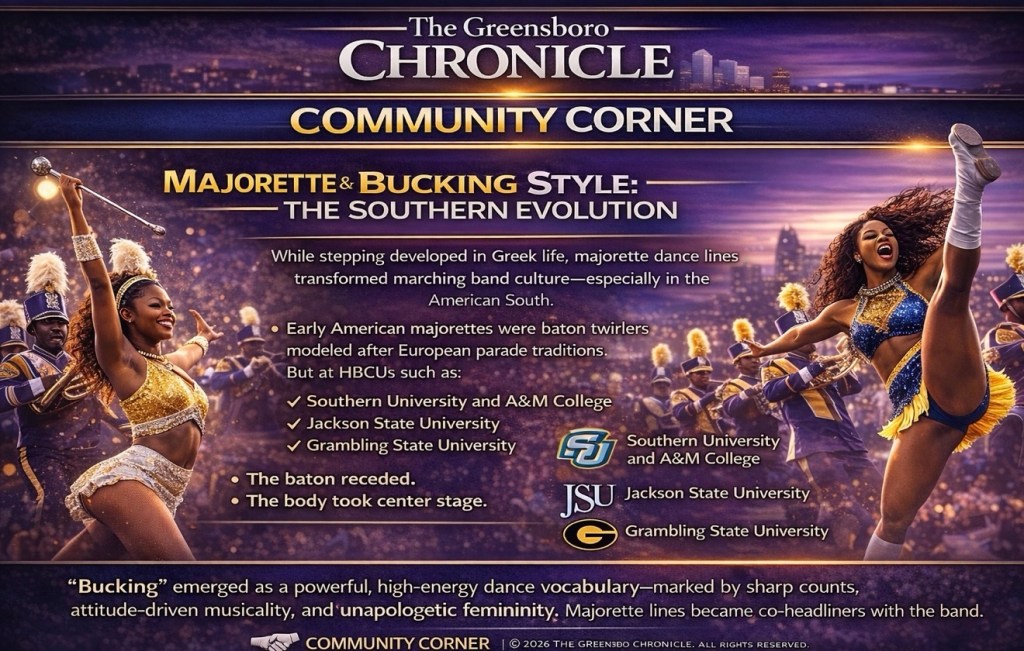
III. Majorette & Bucking Style: The Southern Evolution
While stepping developed in Greek life, majorette dance lines transformed marching band culture—especially in the American South.
Early American majorettes were baton twirlers modeled after European parade traditions. But at HBCUs such as:
Southern University and A&M College Jackson State University Grambling State University
something radical happened.
The baton receded.
The body took center stage.
Hip isolations.
Explosive turns.
Deep squat pulses.
High kicks with Southern swagger.
“Bucking” emerged as a powerful, high-energy dance vocabulary—marked by sharp counts, attitude-driven musicality, and unapologetic femininity.
Majorette lines became co-headliners with the band. When the horns hit a breakdown, the dance line answered with power.
IV. Shared DNA: Formation, Identity, Call & Response
Though stepping and bucking differ in aesthetics, they share critical cultural DNA:
Stepping
Majorette/Bucking
Boot stomp percussion
Hip-driven musical accents
Organizational chants
Musical breakdown choreography
Fraternity/Sorority pride
Band and institutional pride
Tight military formation
Formation-based breakdowns
Call-and-response vocals
Call-and-response movement
Both rely on:
Collective synchronization Rhythmic precision Visual dominance Community affirmation
Both say the same thing in different languages:
We belong here.

V. Impact on African American Culture & Community
1. Cultural Preservation
These art forms preserve African diasporic movement traditions in modern form. They are living archives.
2. Youth Development & Pipeline
Today:
Elementary and high school step teams exist nationwide. Youth majorette teams train year-round.
Television shows like Bring It! expanded majorette visibility to younger audiences, while films such as Stomp the Yard introduced stepping to mainstream America.
For many young Black students, participation builds:
Discipline Confidence Leadership Public performance skill Cultural literacy
These are not extracurricular hobbies. They are identity incubators.
VI. Public Perception: Celebration & Controversy
As visibility increased, so did scrutiny.
Stepping has sometimes been misunderstood or conflated with hazing, despite being a sanctioned performance tradition when practiced appropriately within organizational rules.
Majorette dance, particularly bucking style, has faced criticism rooted in:
Respectability politics Gendered scrutiny Misinterpretation of expressive femininity
Yet within Black communities—especially HBCU culture—these performances are not objectified. They are celebrated.
The line is elite.
The yard is sacred.
VII. Gender, Power & Expression
Stepping historically foregrounded male fraternal performance (though sorority stepping is equally powerful), while bucking-style majorette dance placed Black women front and center.
Majorette lines redefined:
Public Black femininity Athleticism Glamour Command presence
Stepping emphasized:
Brotherhood Vocal authority Structured solidarity
Together, they represent a spectrum of Black gender expression—disciplined yet expressive, fierce yet communal.

VIII. The New Generation: TikTok, Viral Culture & Legacy Tension
In the social media era, snippets of bucking choreography and step sequences circulate globally.
With that visibility comes tension:
Who owns the style? Is context being lost? Is commercialization diluting heritage?
Younger generations remix tradition with hip-hop, pop choreography, and digital aesthetics. Yet the foundational vocabulary remains tied to HBCU culture.
The stomp still echoes West Africa.
The buck still pulses Southern band culture.
What changes is the stage.
IX. The Greensboro & North Carolina Connection
In North Carolina, North Carolina A&T State University continues to serve as a cultural anchor where stepping and band traditions remain central to campus life.
In cities like Greensboro—historically significant in civil rights history—these art forms carry additional weight. They are reminders that Black public presence has always required discipline, courage, and collective pride.
Performance becomes legacy.
Conclusion: Rhythm as Resistance, Movement as Memory
Stepping and majorette/bucking-style dance are not parallel trends—they are intertwined expressions of African American cultural survival and brilliance.
One stomps in formation.
One bucks in breakdown.
Both carry history.
Both build community.
Both teach the next generation how to stand tall in rhythm.
In a society that once criminalized Black gathering and sound, these art forms transformed the body into declaration.
Every stomp is memory.
Every buck is power.
And the culture continues—count by count.

Legal Disclaimer
This article is provided for educational and informational purposes only. It reflects historical research and publicly available information. It does not represent official positions of any fraternity, sorority, university, or dance organization referenced. Readers are encouraged to consult primary institutional and organizational sources for official histories and policies.
© 2026 The Greensboro Chronicle. All Rights Reserved.
 Greensboro Chronicle
Leave a comment