ENGLISH-ONLY CDL TESTING IN MARYLAND: SAFETY STANDARD OR POLICY SIGNAL?
A red semi-truck dominates the frame. Across the top: “ENGLISH ONLY.” Beneath it, bold lettering declares that all truckers and bus drivers are required to take commercial driver’s license tests in English.
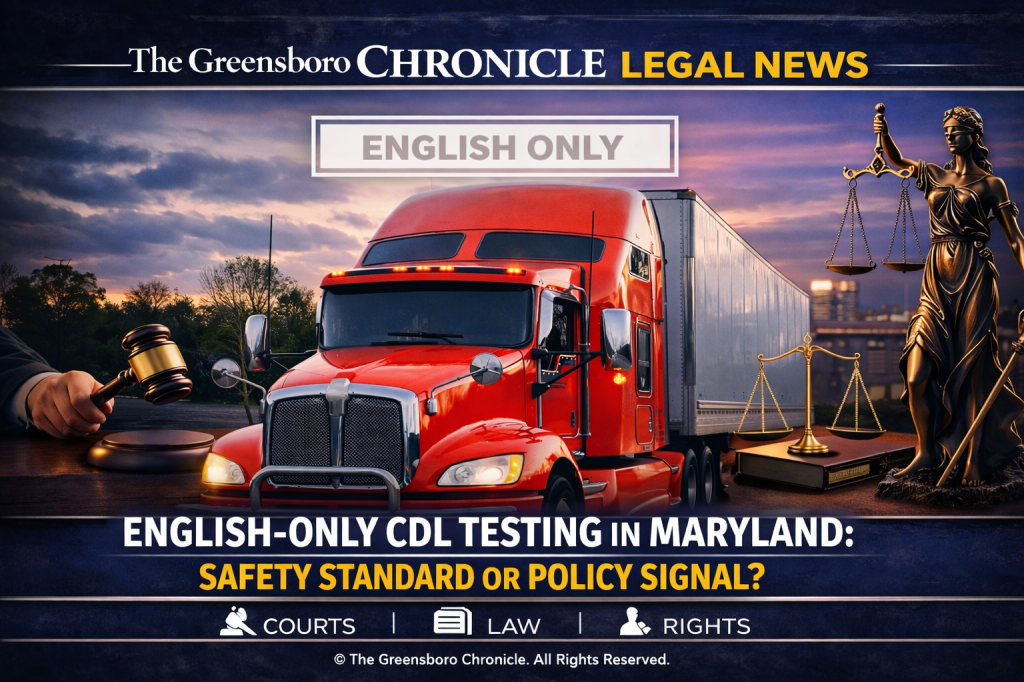
The message is blunt. The policy shift it represents is even more so.
Maryland is aligning enforcement of Commercial Driver’s License (CDL) testing with long-standing federal requirements that commercial motor vehicle operators be able to read and speak English sufficiently to understand traffic signs, respond to official inquiries, and complete reports. But the renewed focus on “English-only” testing is more than bureaucratic housekeeping. It is a flashpoint in a national debate over safety, labor, immigration, and economic stability.
This is not just about language. It is about who gets to drive America’s economy—and under what conditions.
The Legal Foundation: What Federal Law Already Says
Under federal regulations administered by the Federal Motor Carrier Safety Administration (FMCSA), commercial drivers operating in interstate commerce must:
Read and speak English sufficiently to converse with the general public Understand highway traffic signs and signals in English Respond to official inquiries Complete reports and records
These standards have existed for decades. The CDL program itself was established under the Commercial Motor Vehicle Safety Act of 1986 to reduce crashes involving large trucks and buses by creating uniform national licensing standards.
In short: English competency has long been part of the federal safety framework.
What Maryland’s enforcement posture signals is not the creation of a new requirement—but a more rigid interpretation and application of one.
The Safety Argument
Proponents argue the matter is simple: commercial vehicles are 80,000-pound machines operating on crowded highways. Road signs are in English. Emergency instructions are in English. Federal compliance documentation is in English.
A driver who cannot interpret a hazardous materials placard, a weight restriction sign, or an emergency detour notice could pose a real safety risk. According to National Highway Traffic Safety Administration (NHTSA) data, large trucks are involved in thousands of fatal crashes each year nationwide. While language proficiency is not typically listed as a primary crash factor, communication failures during roadside inspections and post-crash investigations have been cited by regulators as complicating enforcement and safety compliance.
From a purely regulatory standpoint, uniform comprehension ensures consistent enforcement.
Safety advocates ask: if aviation requires standardized English proficiency for pilots worldwide, why should commercial trucking—another high-risk transportation sector—be different?
The Labor and Economic Reality
Yet policy does not exist in a vacuum.
The American Trucking Associations (ATA) has repeatedly reported a persistent driver shortage, estimating tens of thousands of open positions nationwide. The industry has increasingly relied on immigrant labor to fill those gaps. Many of these drivers complete English proficiency requirements successfully. Others rely on translated study materials and bilingual training programs to bridge comprehension gaps.
An “English-only” testing posture, depending on how it is implemented, may:
Reduce the immediate pool of eligible drivers Increase training costs Disproportionately affect immigrant communities Exacerbate freight delays
Maryland’s economy is deeply intertwined with logistics. The Port of Baltimore, interstate corridors, and regional freight routes depend on a steady supply of licensed drivers.
If enforcement tightens abruptly without transitional support—such as accessible ESL programs tailored to commercial driving terminology—the ripple effects could be economic.
The Civil Rights Dimension
Language itself is not a protected class under federal civil rights law. However, national origin is. Courts have recognized that English-only workplace policies may, under certain circumstances, intersect with national origin discrimination if applied unevenly or without business necessity.
In the CDL context, the business necessity argument—public safety—is strong.
But how the policy is implemented matters.
Is the state offering reasonable access to English language learning resources?
Is testing administered fairly?
Are standards clear and consistent?
A safety rule applied neutrally is one thing. A safety rule applied selectively is another.
Transparency is the dividing line.
What This Is — And What It Isn’t
It is important to distinguish between rhetoric and regulation.
Maryland is not banning non-English speakers from employment.
It is not criminalizing multilingual drivers.
It is not imposing a novel statutory requirement.
It is enforcing an existing federal English proficiency mandate tied to interstate commercial operation.
However, the symbolism of “English Only” messaging carries cultural weight. In an era where immigration policy is intensely politicized, enforcement optics matter. When language standards are framed as crackdowns rather than compliance measures, public trust erodes.
Policy communication must be precise.

A Smarter Path Forward
If the goal is safety—and it should be—then the solution is not exclusion. It is elevation.
Maryland could:
Expand state-supported ESL programs tailored specifically to CDL vocabulary Provide standardized study guides in multiple languages while maintaining English testing Offer transitional compliance timelines Increase transparency around pass/fail data to ensure fairness
Safety and inclusion are not mutually exclusive. Competency is the standard—not cultural conformity.
The Larger Question
America’s highways are arteries of commerce. The men and women behind the wheel—regardless of accent—keep food on shelves, medicine in hospitals, and supply chains moving.
Requiring drivers to understand the language of the road is reasonable.
Weaponizing language as a political signal is not.
If Maryland’s enforcement of English-only CDL testing strengthens safety without undermining workforce stability or fairness, it will stand as responsible governance.
If it becomes a blunt instrument in a broader cultural battle, the consequences will extend far beyond the testing center.
The red truck in the image is more than a vehicle.
It is a reminder that policy drives people—and people drive policy.

Legal Disclaimer:
This op-ed is for informational and commentary purposes only and does not constitute legal advice. Readers should consult qualified counsel for specific legal guidance regarding commercial driver licensing requirements or civil rights implications.
© 2026 Greensboro Chronicle. All Rights Reserved
 Greensboro Chronicle
Leave a comment