
There’s a rumor that refuses to die. It lives in message boards scraped clean, in archived convention interviews, in the margins of court filings about character rights and “independent creation.” It’s the kind of rumor that survives because no one ever officially confirms it.
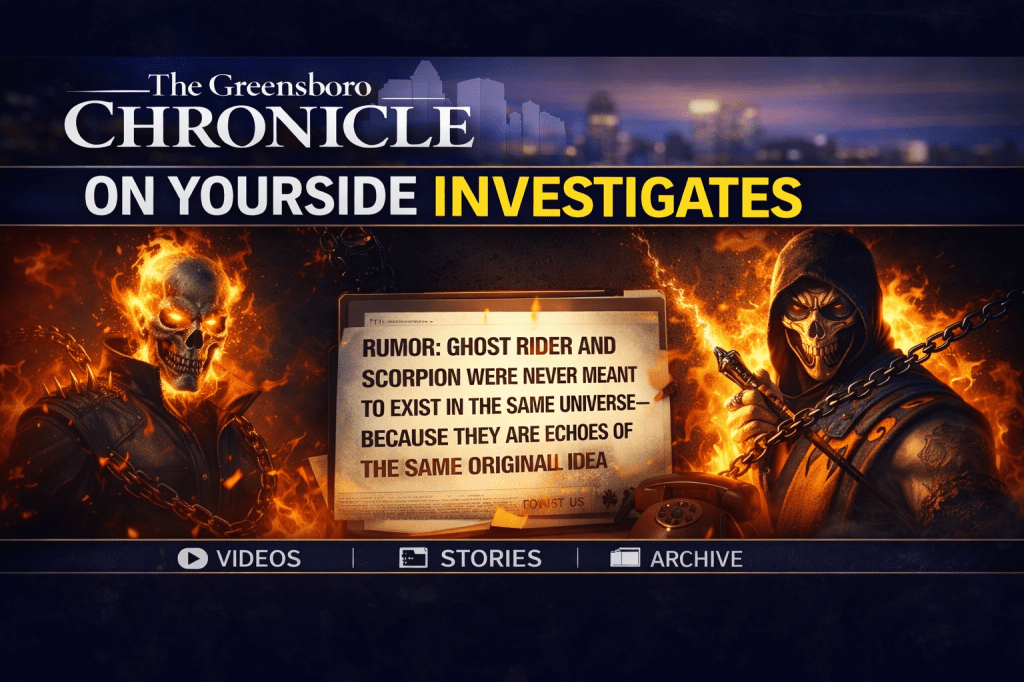
The rumor says Ghost Rider and Scorpion were never meant to exist in the same universe—because they are echoes of the same original idea.
According to the legend, sometime in the late 1970s, a concept circulated quietly through entertainment circles: a supernatural enforcer bound by fire, chained to vengeance, condemned to punish the guilty after death. The idea was pitched, reshaped, rejected, repurposed. Studios passed. Notes were buried. The concept fractured.
One fragment allegedly found its way into comic mythology: a flaming skull, hellfire wheels, chains that bind the wicked, a curse masquerading as justice.
Another fragment, the legend claims, went darker.
By the early 1990s, arcade cabinets began whispering the other half of the story. A specter in yellow. Burned flesh. A chain spear fired from the abyss. A dead man dragged back by rage alone. His warning wasn’t subtle:
Get over here.
Urban lore insists that early Mortal Kombat development notes referenced a “vengeful revenant archetype” inspired by non-licensed mythic materials. Fans later noticed the overlap:
Fire as punishment, not power Chains as judgment, not tools Resurrection through rage Justice without mercy
The similarities were dismissed as coincidence—until they weren’t.
At conventions, creators deflected. Interviews were edited. Early design sketches disappeared from public archives. A few fans swear they saw legal correspondence redacted and refiled under unrelated case numbers during the 1990s IP boom, when studios quietly tightened ownership lines around anything that smelled like hellfire.
The cautionary version of the legend goes further.
It says the characters were deliberately separated—not legally, but mythologically. That allowing them to cross would expose the shared origin: a single idea about vengeance so violent it had to be split in two to be sold.

In this telling, Ghost Rider became the warning: justice burns everyone, including the judge.
Scorpion became the consequence: vengeance doesn’t ask permission.
And the reason they never officially meet—never crossover, never acknowledge each other—isn’t copyright at all.
It’s containment.
Because if the two halves ever rejoin, the legend says, the story stops being entertainment and becomes indictment. Fire without restraint. Punishment without end. A mirror held too close to the human appetite for retribution.
Urban legends survive because they answer a question no one wants to ask out loud:
Why do we keep reinventing the same monster?
And why does it always wear chains?

⚠️ LEGAL & EDITORIAL DISCLAIMER
This article is a work of commentary, folklore analysis, and creative storytelling based on publicly observable themes, fan theories, and longstanding urban legends.
It does not assert factual claims regarding intellectual property ownership, creator intent, or legal disputes. Any resemblance to real persons, companies, or legal actions is interpretive and speculative, used solely for cultural and journalistic discussion.
All fictional characters referenced are the property of their respective rights holders.
© COPYRIGHT NOTICE
© 2026 The Greensboro Chronicle. All rights reserved.
No part of this publication may be reproduced, redistributed, or transmitted in any form without prior written permission, except for brief quotations used for commentary, criticism, or educational purposes consistent with fair use
 Greensboro Chronicle
Leave a comment