January 30, 1956
On this day in 1956, while Martin Luther King Jr. stood before a packed church urging discipline, dignity, and nonviolence, hatred struck from the shadows.
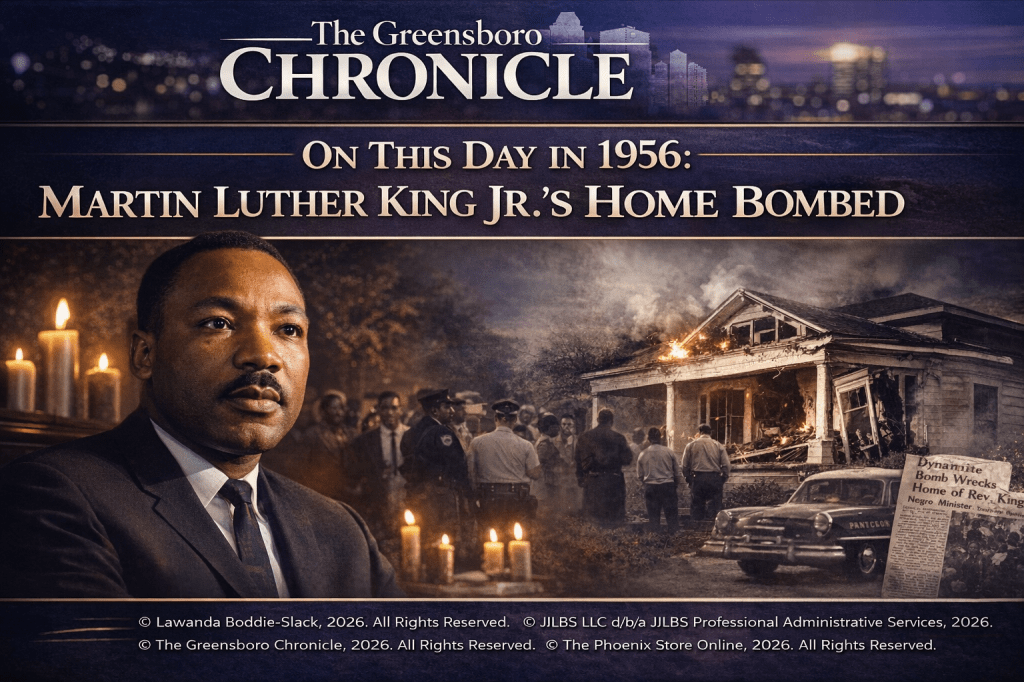
A bomb exploded on the front porch of Dr. King’s home in Montgomery, Alabama.
Inside were his wife, Coretta Scott King, and their infant daughter, Yolanda. By sheer fortune—and perhaps history’s quiet insistence—neither was injured. The blast shattered windows, splintered wood, and sent shockwaves through a city already trembling under the weight of moral reckoning.
Outside, an angry crowd gathered. Some were neighbors. Many were supporters of the Montgomery Bus Boycott—ordinary Black citizens who had walked for weeks rather than submit to segregation. They were furious. Some were armed. All were hurt.
What happened next would help define the American civil rights movement.
A Test of Leadership Under Fire
Dr. King rushed home from the mass meeting he had been addressing. Confronted with the wreckage of his house and the danger facing his family, he did not call for vengeance. He did not raise his voice.
Instead, standing amid broken glass and raw fear, he called for calm.
“We must meet violence with nonviolence,” he told the crowd.
“Remember the teachings of Jesus: Love your enemies.”
In that moment, King was no longer simply a pastor thrust into leadership by circumstance. He became the moral compass of a movement that would change the nation—not through force, but through conscience.
The bombing was meant to intimidate. Instead, it clarified the stakes.
The Broader Context: Montgomery in 1956
The Montgomery Bus Boycott was only weeks old, sparked by the arrest of Rosa Parks and sustained by tens of thousands of Black residents refusing to ride segregated buses. White supremacist groups, local officials, and segregationist leaders were determined to break the movement.
Violence was part of that strategy.
King’s home was not targeted because it was vulnerable—it was targeted because it symbolized something dangerous to the status quo: organized, principled resistance grounded in moral authority.
The bombing failed in its objective. Public sympathy grew. The boycott hardened its resolve. And King’s insistence on nonviolence—tested under the most personal of circumstances—cemented his national standing.
Why This Day Still Matters
It is easy, decades later, to romanticize the civil rights movement as inevitable. It was not.
Progress came inch by inch, under constant threat. Leaders faced surveillance, arrests, bombings, and assassination. Families bore the cost alongside them.
January 30, 1956, reminds us that courage is not the absence of fear—it is the refusal to let fear dictate the future.
It also reminds us that moral clarity often emerges not in moments of comfort, but in moments of crisis.
Dr. King could have justified rage that night. History might have understood it. But he chose restraint—and in doing so, helped steer a nation closer to its unfinished promise.
A Living Legacy
The porch was rebuilt. The movement marched on. And the idea that justice could be pursued without surrendering one’s humanity survived an attempt to destroy it.
Today, we remember not just the bomb—but the restraint that followed it.
Not just the hatred—but the discipline that outlasted it.
Because on this day, violence tried—and failed—to silence justice.
Legal Disclaimer
This article is published for educational, historical, and journalistic purposes. It reflects historical records, contemporaneous reporting, and widely accepted scholarly accounts of events surrounding the Montgomery Bus Boycott and the life of Dr. Martin Luther King Jr. It does not constitute legal advice and should not be interpreted as an endorsement or condemnation of any modern individual, organization, or policy beyond historical context.
Copyright Notice
© 2026 The Greensboro Chronicle. All rights reserved.
This article may not be reproduced, redistributed, or republished in whole or in part without prior written permission, except for brief quotations used for commentary, criticism, or educational purposes consistent with fair use.
 Greensboro Chronicle
Leave a comment