Food recall notices can look intimidating—but most are intentionally technical. Here’s how to decode them quickly and protect your household.
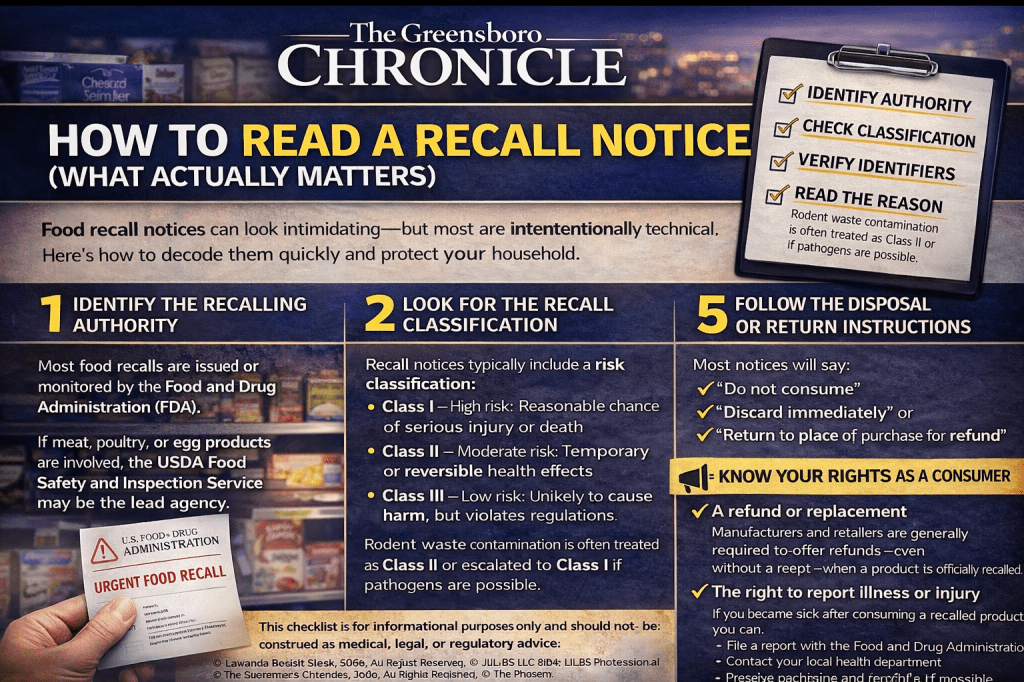
1. Identify the Recalling Authority
Most food recalls are issued or monitored by the Food and Drug Administration (FDA).
If meat, poultry, or egg products are involved, the USDA Food Safety and Inspection Service may be the lead agency.
If it’s not coming from a government regulator or the manufacturer directly, verify the source before acting.
2. Look for the Recall Classification
Recall notices typically include a risk classification:
Class I – High risk: Reasonable chance of serious injury or death Class II – Moderate risk: Temporary or reversible health effects Class III – Low risk: Unlikely to cause harm, but violates regulations
Rodent waste contamination is often treated as Class II or escalated to Class I if pathogens are possible.
3. Check the Product Identifiers (This Is Crucial)
Ignore the brand name headlines—focus on:
UPC or barcode number Lot or batch code Production or “best by” date Facility or plant code (often stamped on packaging)
Only products matching all listed identifiers are officially recalled—but if packaging is damaged or unclear, err on the side of caution.
4. Read the “Reason for Recall” Carefully
Phrases like:
“Potential contamination” “Cannot rule out exposure” “Unsanitary conditions”
…often mean testing was incomplete or conditions were severe enough that safety could not be guaranteed.
That’s especially important in rodent-related recalls, where contamination may not be visible.
5. Follow the Disposal or Return Instructions
Most notices will say:
“Do not consume” “Discard immediately” or “Return to place of purchase for refund”

Do not attempt to wash, cook, or inspect recalled food.
📣 KNOW YOUR RIGHTS AS A CONSUMER
If you purchased recalled food, you are not powerless.
Your rights include:
✔ A refund or replacement
Manufacturers and retailers are generally required to offer refunds—even without a receipt—when a product is officially recalled.
✔ The right to report illness or injury
If you became sick after consuming a recalled product, you can:
File a report with the Food and Drug Administration Contact your local health department Preserve packaging and receipts if possible
✔ The right to transparency
You are entitled to know:
Why the product was recalled Which facility was involved Whether the issue was previously cited by inspectors
✔ The right to pursue legal remedies
If contamination caused medical harm, lost wages, or hospitalization, affected consumers may have grounds for product liability or negligence claims, depending on circumstances.
Important: Reporting issues helps regulators identify patterns and prevent repeat violations.
Legal Disclaimer
This article is provided for informational and educational purposes only and does not constitute medical, legal, or regulatory advice. The Greensboro Chronicle relies on publicly available inspection records, recall notices, and regulatory disclosures available at the time of publication. Recall classifications, findings, and enforcement actions may change. Readers should consult official recall announcements, healthcare providers, and qualified professionals for guidance specific to their individual circumstances.
Copyright Notice
© The Greensboro Chronicle, 2026. All rights reserved.
This article may not be reproduced, distributed, republished, or transmitted in whole or in part without the prior written permission of The Greensboro Chronicle, except for brief quotations used for news reporting, commentary, or educational purposes with proper attribution.
 Greensboro Chronicle
Leave a comment