A legal victory couldn’t stop the financial freefall—and now the warning signs are flashing red across Black higher education
By The Greensboro Chronicle
Investigations & Accountability Desk
Just weeks ago, there was cautious celebration.
After a bruising three-year property tax battle, Barber-Scotia College finally secured a ruling preserving its long-standing tax-exempt educational status—a legal win that administrators hoped would stabilize the school’s finances and buy critical time.
Instead, the victory marked the calm before the collapse.
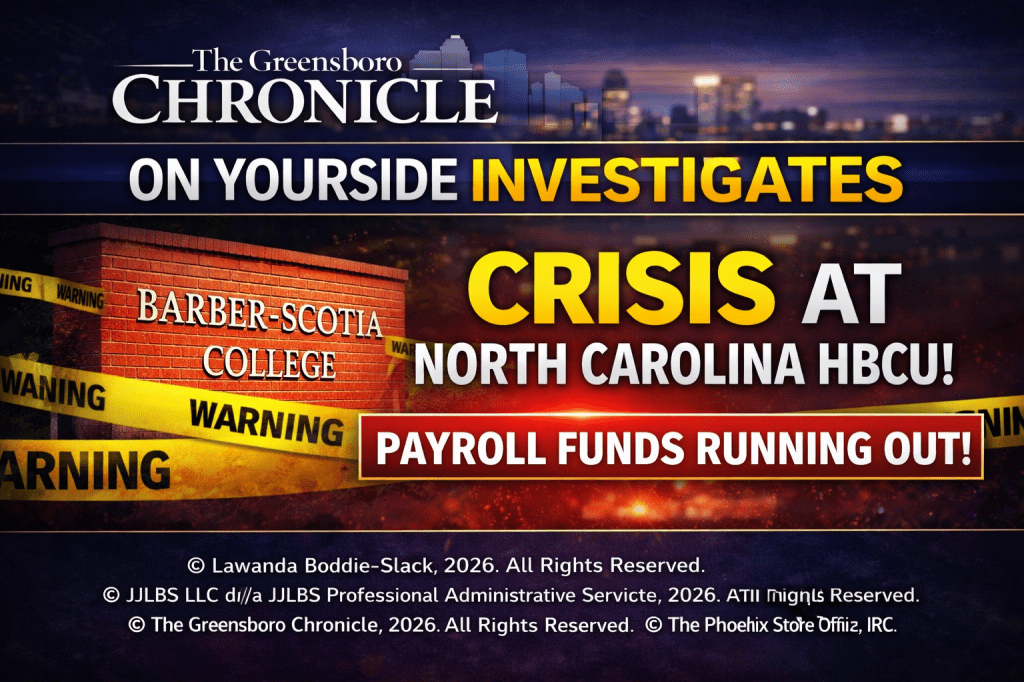
This week, the college’s president confirmed what faculty, staff, and students had already begun to fear: Barber-Scotia College has completely run out of money and is unable to pay employees this month.
The revelation has sent shockwaves through North Carolina’s higher-education community and reignited urgent questions about the fragility of America’s historically Black colleges and universities (HBCUs)—especially smaller, private institutions already operating on razor-thin margins.
A WIN IN COURT—AND A LOSS IN REAL LIFE
The tax ruling was expected to ease one of Barber-Scotia’s most persistent financial burdens. For years, the school fought local authorities over property taxes that administrators argued threatened the institution’s survival. The final decision preserved the college’s nonprofit, educational exemption—on paper, a decisive win.
But court victories do not generate cash flow.
According to public statements and financial disclosures, Barber-Scotia entered the ruling already deeply cash-strapped, burdened by deferred maintenance, declining enrollment, limited donor pipelines, and restricted access to large-scale endowments that cushion many larger universities.
The legal relief removed one expense—but it did not replenish empty accounts.
PAYCHECKS MISSED, TRUST SHAKEN
The most alarming development is not theoretical.
Faculty and staff were informed that payroll obligations cannot be met, a moment that often signals an institution has crossed from crisis into existential danger. Missed paychecks ripple outward—triggering housing insecurity, insurance lapses, and resignations that further destabilize operations.
Higher-education finance experts note that when payroll interruptions occur, accreditation risks often follow, as accrediting bodies closely monitor an institution’s ability to meet basic operational standards.
A FAMILIAR STORY ACROSS HBCUs
While Barber-Scotia’s situation is acute, it is not isolated.
Across the country, many small HBCUs face a dangerous convergence of pressures:
Declining enrollment tied to demographic shifts Heavy reliance on tuition as primary revenue Aging infrastructure with limited capital investment Donor fatigue and uneven philanthropic attention Rising operational and compliance costs
Legal wins, emergency fundraising, and short-term loans often provide temporary oxygen, but without sustained structural reform, they rarely change long-term outcomes.
WHY THIS MATTERS BEYOND ONE CAMPUS
HBCUs educate a disproportionate share of Black professionals, educators, engineers, and civic leaders. When one falters, the consequences extend far beyond payroll spreadsheets.
Each closure, suspension, or financial emergency narrows access, erodes trust, and compounds historic inequities in higher education funding.
And yet, public intervention frequently arrives late—or not at all.

THE QUIET QUESTION NO ONE WANTS TO ASK
If a court victory preserving tax-exempt status wasn’t enough to stabilize Barber-Scotia College, the uncomfortable question remains:
How many other HBCUs are one missed payroll away from the same announcement?
Financial disclosures, enrollment data, and public audits suggest Barber-Scotia may not be the last to confront this reckoning.
The warning signs are visible.
The timelines are tightening.
And unless systemic funding gaps are addressed, additional HBCUs may soon face the same or strikingly similar crises—with little more than legal victories to show for their fight.

Legal Disclaimer
The Greensboro Chronicle publishes investigative and analytical content for informational and public-interest purposes only. All information contained in this article is derived from publicly available records, official statements, and reputable secondary sources believed to be accurate at the time of publication. This report does not constitute legal, financial, or professional advice. Individuals and institutions referenced are presumed to be acting in good faith unless otherwise established by verified evidence. Readers are encouraged to conduct their own independent research.
Copyright Statement
© Lawanda Boddie-Slack, 2026. All Rights Reserved.
© JJLBS LLC d/b/a JJLBS Professional Administrative Services, 2026. All Rights Reserved.
© The Greensboro Chronicle, 2026. All Rights Reserved.
© The Phoenix Store Online, 2026. All Rights Reserved.
 Greensboro Chronicle
Leave a comment