
January 25, 2026
Lorene Hardy Investigative Journalist
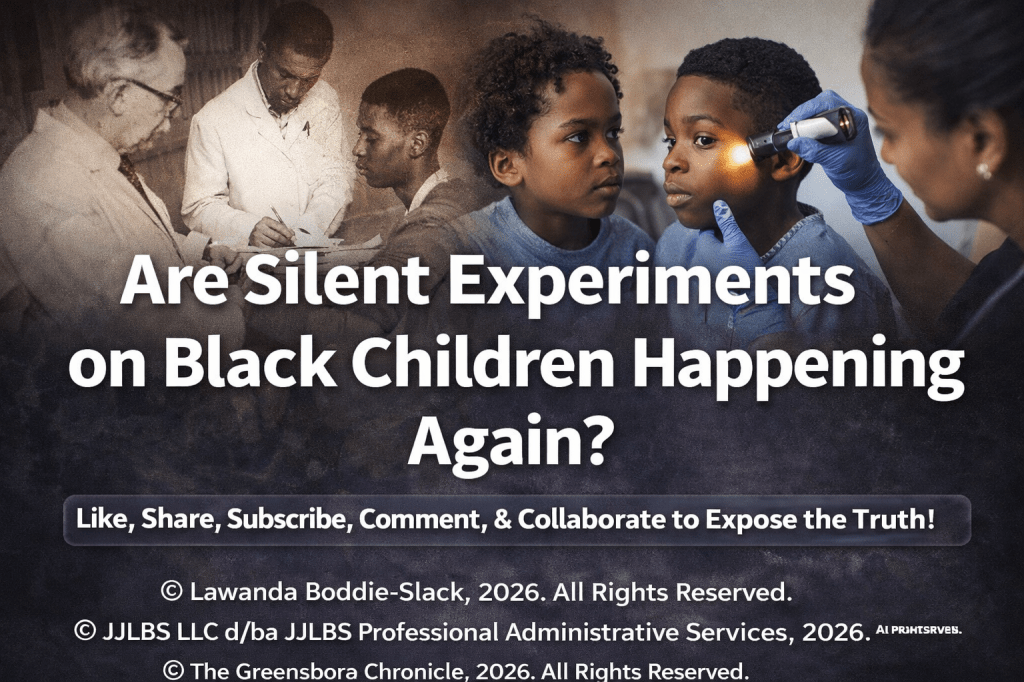
Executive Summary
For Black Americans, fear of government medical or behavioral “experimentation” is not rooted in conspiracy—it is rooted in history. The Tuskegee Syphilis Study proved that unethical practices can exist for decades under official authority while remaining hidden from public scrutiny.
Today, no publicly acknowledged federal study mirrors Tuskegee in name or stated purpose. However, an alleged and currently unfolding pattern of policies, pilot programs, and data-driven interventions involving Black children has triggered alarm among civil rights attorneys, parents, ethicists, and public health advocates.
This report examines:
What is documented What is alleged Why the comparison to Tuskegee is being raised again And why transparency is urgently needed before harm is normalized
I. What the Tuskegee Study Was — and Why It Still Matters
The Tuskegee Study was not a rogue operation. It was:
Designed and funded by the U.S. government Justified as “public health research” Conducted on a racially isolated population Hidden behind bureaucracy and medical authority
Participants were never told the truth, never gave informed consent, and were denied treatment even after a cure existed.
Key lesson:
Tuskegee was not discovered because the government came clean—it ended because outsiders exposed it.
II. What Is Alleged to Be Happening Now
⚠️ Important Distinction
There is no confirmed public record of a declared medical experiment targeting Black children.
What is alleged is something more subtle—and historically familiar.

III. The Alleged “New Study” — What Advocates Are Pointing To
Civil rights groups and parents describe a multi-layered system that they argue functions like an experiment, even if it is not labeled as one.
1. Target Population
Disproportionately Black children Concentrated in low-income or state-dependent settings Often involved with: Public schools Foster care systems Juvenile justice pipelines Public health or behavioral programs
This mirrors Tuskegee’s reliance on a population with limited power to refuse.
2. Interventions Without Clear, Plain-Language Consent
Allegations include:
Behavioral or psychological screening embedded in schools Data collection tied to “wellness,” “risk,” or “early intervention” programs Medication practices in foster care with minimal parental oversight Digital tracking, predictive analytics, and “risk scoring”
Parents report learning after the fact—or not at all.
3. Data as the New Needle
Unlike Tuskegee’s physical procedures, today’s alleged experiment is said to rely on:
Longitudinal data collection Algorithmic modeling Behavioral modification frameworks Public-private data sharing
The harm, critics argue, may not be immediate—but cumulative and permanent.
4. Opacity by Design
Advocates cite:
Programs launched as “pilots” or “demonstrations” Fragmented oversight across agencies Private contractors shielded from public records laws Consent buried in complex forms or school enrollment paperwork
As with Tuskegee, complexity becomes camouflage.

IV. Why Black Families See the Warning Signs Early
Black communities recognize patterns because they have lived them:
Being told programs are “for their benefit” Being excluded from decision-making Being reassured by experts—until damage is undeniable
As many advocates say:
“We’re not saying this is Tuskegee.
We’re saying this is how Tuskegee started.”
V. What Transparency Would Require — And Why It’s Missing
If nothing unethical is happening, transparency should be easy.
Advocates are calling for:
Full public disclosure of programs involving children Independent audits with community representation Plain-language explanations of risks and data use Opt-out mechanisms without retaliation Strong whistleblower protections
Resistance to these requests is what fuels suspicion.

VI. Why Waiting for Proof Is Dangerous
Tuskegee ended only after damage was already done.
History shows that unethical practices are rarely announced—they are:
Justified Normalized Defended And only later condemned
The question is not whether history repeats exactly, but whether it rhymes quietly enough to escape notice.
Call to Action: Stop History Before It Writes Itself
We do not need another official apology decades from now.
V. Why Black Families See the Warning Signs Early
Black communities recognize patterns because they have lived them:
Being told programs are “for their benefit” Being excluded from decision-making Being reassured by experts—until damage is undeniable
As many advocates say:
“We’re not saying this is Tuskegee.
We’re saying this is how Tuskegee started.”
VI. What Transparency Would Require — And Why It’s Missing
If nothing unethical is happening, transparency should be easy.
Advocates are calling for:
Full public disclosure of programs involving children Independent audits with community representation Plain-language explanations of risks and data use Opt-out mechanisms without retaliation Strong whistleblower protections
Resistance to these requests is what fuels suspicion.
VII. Why Waiting for Proof Is Dangerous
Tuskegee ended only after damage was already done.
History shows that unethical practices are rarely announced—they are:
Justified Normalized Defended And only later condemned
The question is not whether history repeats exactly, but whether it rhymes quietly enough to escape notice.
Call to Action: Stop History Before It Writes Itself
We do not need another official apology decades from now.
Demand action now:
Ask schools and agencies what data they collect on children Support FOIA and public records requests Insist on community oversight Challenge programs that operate without transparency Speak publicly and collectively
Black children are not test cases.
Black families are not collateral.
And silence has never been neutral.
Ask schools and agencies what data they collect on children Support FOIA and public records requests Insist on community oversight Challenge programs that operate without transparency Speak publicly and collectively
Black children are not test cases.
LEGAL DISCLAIMER & COPYRIGHT NOTICE
Black families are not collateral.
And silence has never been neutral.

Transparency matters. Integrity matters. Accountability matters.
At The Greensboro Chronicle, our investigative reporting is grounded in publicly available records, documented sources, and firsthand accounts submitted by our readers. References to individuals or businesses are made strictly in the public interest and do not constitute findings of liability or wrongdoing.
All allegations are presented as such and remain subject to verification, response, and adjudication by appropriate legal or regulatory authorities. We welcome factual corrections and the opportunity for response from all parties mentioned.
Copyright Notice – 2026
All content is protected under applicable copyright laws. Unauthorized reproduction, redistribution, or misuse of our original work is strictly prohibited.
© Lawanda Boddie-Slack
© JJLBS LLC d/b/a JJLBS Professional Administrative Services
© The Greensboro Chronicle
© The Phoenix Store Online
All Rights Reserved.
We stand on truth, due process, and responsible journalism.
👍 Like
🔁 Share
💬 Comment
📰 Follow & Subscribe
#GreensboroChronicle #Transparency #InvestigativeJournalism #PublicInterest #CopyrightProtected #IndependentMedia #Accountability #ResponsibleReporting
 Greensboro Chronicle
Leave a comment