
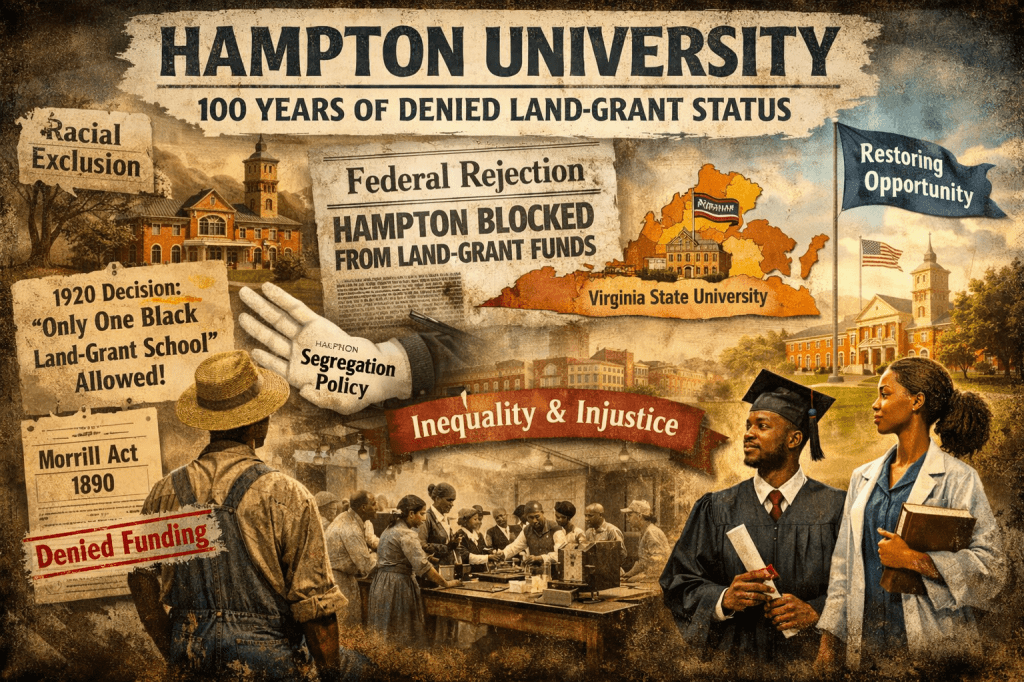
Restoring What Was Denied: Hampton University, Land-Grant Status, and the Long Shadow of Segregation
For more than a century, a decision rooted in segregation-era thinking quietly shaped higher education in Virginia: the federal government refused to recognize Hampton University as a land-grant institution, not because it failed to qualify—but because policymakers believed only one Black institution in the state was allowed to receive land-grant funding.
Now, Virginia lawmakers are attempting to reverse that injustice. Their effort is not simply about money or classification. It is about correcting a historic wrong, modernizing public policy, and confronting how racial exclusion was embedded into federal and state systems for generations.
This article explains what happened, why it mattered, and what restoring Hampton’s land-grant status could mean today—in clear, plain language.

What Is a Land-Grant University—and Why It Matters
Land-grant universities were created under the Morrill Act of 1862, which gave states federal land to fund colleges focused on agriculture, engineering, and practical education. A second law, the Morrill Act of 1890, extended land-grant funding to Black colleges in Southern states that still enforced segregation.
Land-grant status comes with:
Ongoing federal funding Research grants and infrastructure investment Cooperative extension programs serving communities statewide Agricultural, scientific, and technical workforce development
In short: land-grant universities are engines of economic mobility and public service.
The 1920 Decision: “Only One Black Land-Grant School”
Virginia’s response to the 1890 Morrill Act was shaped by segregation. Rather than allow multiple Black institutions to share in land-grant resources, state and federal officials designated Virginia State University (then Virginia Normal and Industrial Institute) as the sole Black land-grant institution.
Hampton University—founded in 1868 and nationally respected for agricultural, industrial, and teacher education—was excluded.
The rationale was not academic. It was political and racial:
Funding Black education was seen as a concession, not an investment White-controlled systems wanted strict limits on Black institutional growth Officials feared that multiple well-funded Black universities would threaten segregation’s economic hierarchy
By 1920, federal authorities formally denied Hampton special land-grant funds on the basis that Virginia had already “fulfilled” its obligation by supporting one Black institution.
This logic would never have been applied to white colleges.

The Long-Term Impact of Exclusion
The denial had consequences that compounded over generations.
1. Lost Investment
While white land-grant universities accumulated hundreds of millions of dollars over decades, Hampton was forced to rely on private philanthropy, tuition, and limited state support.
2. Restricted Research Capacity
Without land-grant status, Hampton lacked access to federal agricultural experiment stations, extension services, and long-term research pipelines.
3. Structural Inequality
The decision reinforced a false hierarchy: that Black institutions had to compete with one another for legitimacy and resources, while white institutions expanded freely.
4. Generational Harm
Students, faculty, farmers, and communities that could have benefited from Hampton-led research and outreach simply never received those services.
This wasn’t accidental. It was policy by design.
Why Lawmakers Are Acting Now
Today’s push to restore Hampton’s land-grant status is part of a broader national reckoning with segregation-era laws that were never formally undone—only ignored.
Lawmakers argue:
The 1920 decision violates modern principles of equal protection and equity There is no legal or moral basis for limiting land-grant status to one Black institution per state Federal law does not cap the number of eligible institutions
Importantly, this effort is not about stripping resources from Virginia State University. It is about acknowledging that Hampton was unjustly excluded and deserves parallel recognition.

What Restoring Land-Grant Status Would Change
If Hampton’s land-grant status is restored, the effects would be concrete and measurable.
New Federal Funding Streams
Hampton would gain access to agricultural research funding, STEM grants, and infrastructure support previously unavailable.
Community-Based Extension Services
Programs supporting farmers, entrepreneurs, and families—especially in underserved communities—could expand statewide.
Workforce Development
More investment in engineering, environmental science, cybersecurity, and applied research aligned with today’s economy.
National Precedent
Restoration would signal that historic discrimination can—and should—be corrected, even decades later.
This is not symbolic reform. It is structural repair.
Why This Moment Matters
Segregation didn’t end simply because laws changed. Many discriminatory policies were never repealed—they were just left standing.
The effort to restore Hampton University’s land-grant status asks a direct question:
If a decision was wrong when it was made, and its harm is still measurable today, do we have a responsibility to fix it?
Virginia lawmakers are saying yes.
And if successful, this reversal would stand as a reminder that equity isn’t about favoritism—it’s about finally honoring commitments that were denied on the basis of race.
Bottom Line
For over 100 years, Hampton University was excluded from land-grant funding not because it failed to qualify, but because policymakers believed Black excellence must be rationed.
Restoring Hampton’s land-grant status is about more than correcting a footnote in history. It is about dismantling a policy built on exclusion and replacing it with one grounded in opportunity, fairness, and truth.
History made the wound. Policy has the power to heal it.
Watch the full video on YouTube

LEGAL DISCLAIMER & COPYRIGHT NOTICE
Transparency matters. Integrity matters. Accountability matters.
At The Greensboro Chronicle, our investigative reporting is grounded in publicly available records, documented sources, and firsthand accounts submitted by our readers. References to individuals or businesses are made strictly in the public interest and do not constitute findings of liability or wrongdoing.
All allegations are presented as such and remain subject to verification, response, and adjudication by appropriate legal or regulatory authorities. We welcome factual corrections and the opportunity for response from all parties mentioned.
Copyright Notice – 2026
All content is protected under applicable copyright laws. Unauthorized reproduction, redistribution, or misuse of our original work is strictly prohibited.
© Lawanda Boddie-Slack
© JJLBS LLC d/b/a JJLBS Professional Administrative Services
© The Greensboro Chronicle
© The Phoenix Store Online
All Rights Reserved.
📢 We stand on truth, due process, and responsible journalism.
👍 Like
🔁 Share
💬 Comment
📰 Follow & Subscribe
#GreensboroChronicle #Transparency #InvestigativeJournalism #PublicInterest #CopyrightProtected #IndependentMedia #Accountability #ResponsibleReporting
 Greensboro Chronicle
Leave a comment