Copyrighting AI-Generated Content
January 23, 2026
Lorene Hardy – Staff Writer
What You Can Protect, What You Can’t, and How to Do It Properly
Artificial intelligence has changed how content is created—but it has not eliminated copyright law. In fact, AI has made copyright issues more complicated, and many creators are unintentionally leaving their work unprotected or legally vulnerable.
If you use AI to help create images, articles, videos, graphics, or designs, how you handle copyright matters more than ever.
This guide explains—in plain language—what can be copyrighted, what cannot, how to do it correctly, and what happens if you don’t.
The Core Rule: AI Alone Cannot Own Copyright
Under U.S. copyright law:
Copyright protects human creativity—not machines.
That means:
Content generated entirely by AI without meaningful human input is not copyrightable AI itself cannot be an author You cannot claim exclusive rights to purely machine-generated output
This is where many creators get tripped up.
What Can Be Copyrighted When AI Is Involved
You can copyright AI-assisted content if a human contributes creative expression.
Examples of protectable human contributions include:
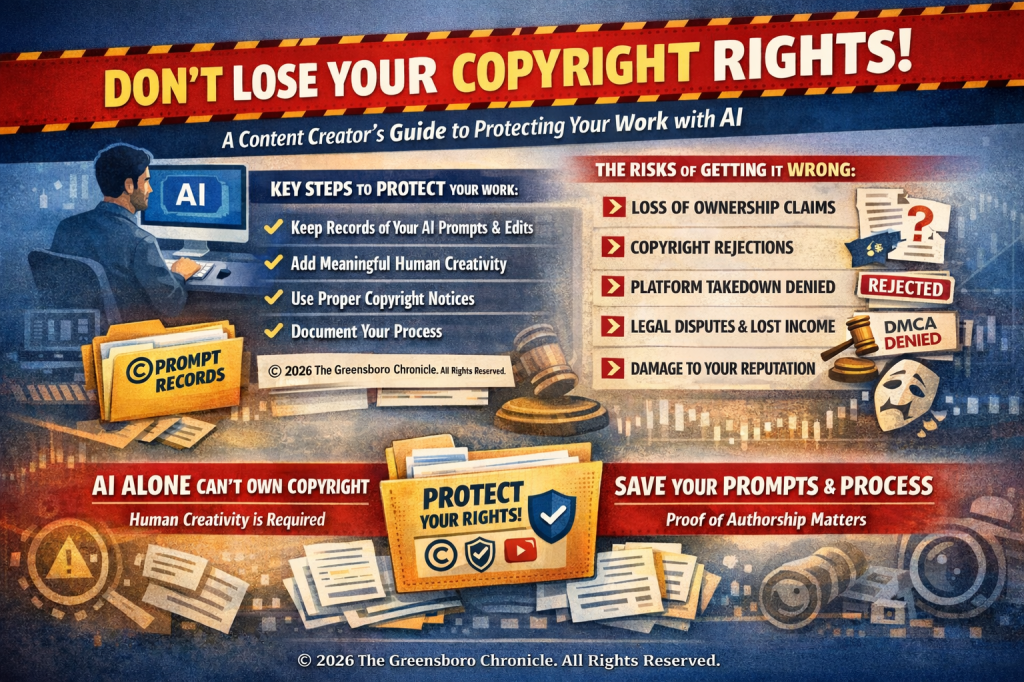
Writing original prompts that reflect creative judgment Editing, revising, or rewriting AI output Selecting, arranging, or combining AI elements creatively Adding original text, design, layout, or commentary Making substantive artistic decisions (style, tone, structure, message)
In simple terms:
AI can be the tool. You must be the author.
What Cannot Be Copyrighted
You generally cannot copyright:
Raw AI output used exactly as generated Images or text created by AI with no human modification Content you merely “requested” but did not shape creatively Fully automated content pipelines with no human authorship
If challenged, claiming ownership of such content can fail—fast.

The Proper Method for Copyrighting AI-Assisted Work
Step 1: Add Clear Human Creativity
Before claiming copyright:
Edit the content Rewrite portions Adjust composition or layout Add original elements Make creative decisions that go beyond simple prompting
Document your process when possible.
Step 2: Use a Copyright Statement—Correctly
Once human creativity is present, you should place a copyright notice on the final work, not the AI output itself.
Example:
© 2026 Your Name or Business Name. All Rights Reserved.
This signals that:
The final version reflects human authorship You claim rights only to your creative contributions
Do not claim “AI-generated” content as fully original human work if it isn’t.
Step 3: Be Honest About AI Use When Registering (If Applicable)
If you formally register your copyright:
Disclose that AI was used Identify which portions are human-created Claim only what the law allows
Failure to disclose AI involvement can invalidate a registration later.

Why This Matters: Consequences of Failing to Do It Properly
1. Your Copyright Claim Can Be Rejected or Voided
If you claim ownership over content that lacks human authorship:
Registration may be denied Existing registrations may be canceled Enforcement actions can fail
Courts do not “fix” improper claims—they dismiss them.
2. You May Lose the Right to Enforce Your Work
If your AI-assisted content is copied:
You may be unable to prove valid ownership Platforms may deny takedown requests Infringers may legally reuse the content
In short: no enforceable copyright = no protection.
3. False or Overbroad Claims Can Backfire Legally
Over-claiming rights in AI content can lead to:
Accusations of misrepresentation Loss of credibility Legal disputes you cannot win
Transparency protects you.
4. Your Brand or Publication Can Be Undermined
For journalists, businesses, and professional creators:
Improper copyright claims weaken authority Trust with audiences and partners erodes Your work becomes easier to exploit
Professional handling of AI content is now a credibility issue.
Best Practices for Creators Using AI
To protect yourself:
Treat AI like a drafting assistant—not an author Always add meaningful human creativity Keep drafts or edit histories when possible Use copyright notices on final works Avoid claiming exclusive rights to raw AI output Be consistent and transparent
The Bottom Line
AI does not eliminate copyright—it raises the bar.
If you fail to:
Add human creativity Properly mark ownership Accurately claim rights
You risk losing legal protection, income, and credibility.
Used correctly, AI can amplify your creativity.
Used carelessly, it can strip you of your rights.
If you publish it, protect it—and do it honestly.
Watch the full video on YouTube:
©️2026 The Greensboro Chronicle. All Rights Reserved.
 Greensboro Chronicle
Leave a comment