Why Keeping AI Prompt Records Matters
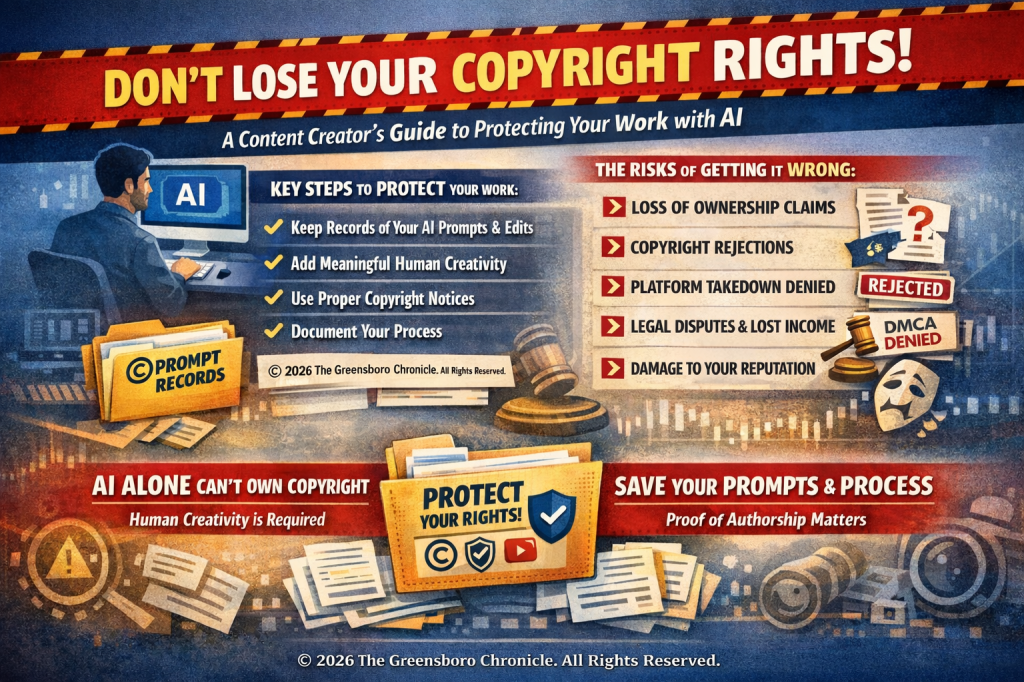
How Documentation and Human Creativity Protect Your Copyright—and What Happens If You Skip Them
As AI tools become common in writing, design, photography, journalism, and marketing, creators are learning a hard truth:
Copyright protection doesn’t just depend on what you publish—it depends on what you can prove.
Two things now matter more than ever:
Keeping records of the AI prompts and process used Ensuring meaningful human creative involvement
Failing to do either can leave your work legally exposed, unenforceable, or even unprotectable.
Let’s break this down in plain language.
Why AI Prompt Records Are Important
When AI is involved, ownership is no longer obvious from the final product alone.
Prompt records help establish:
Human intent Creative decision-making Authorship Timeline of creation
In other words, prompt records help show that you were the creative force—not the machine.
Think of them as receipts for creativity.
What Counts as an AI Prompt Record?
Prompt records can include:
The original prompts you wrote Follow-up prompts refining tone, structure, or style Instructions directing content purpose or message Iterative changes (“rewrite this with a legal tone,” “add investigative framing,” etc.) Notes explaining why changes were made
You don’t need anything fancy. Even:
Saved text files Screenshots Draft histories Time-stamped notes
can establish authorship.

Why Prompts Alone Are Not Enough
Here’s the critical distinction many creators miss:
Prompting is not the same as authorship.
Simple prompts like:
“Write an article about copyright” “Generate an image of a phoenix”
do not qualify as meaningful human creativity by themselves.
To secure copyright protection, you must show:
Creative judgment Original expression Editorial control Substantive modification or selection
AI can assist—but you must shape the work.
What “Meaningful Human Interaction” Actually Means
Meaningful human involvement includes:
Editing AI output substantially Rewriting sections in your own voice Choosing structure, framing, or narrative Combining AI output with original content Making artistic or journalistic decisions Rejecting and revising multiple drafts
Put simply:
You must leave fingerprints on the work.
If your role stops at “generate” and “publish,” copyright protection is shaky at best.
Why Documentation + Human Creativity Go Together
Prompt records alone do not secure copyright.
Human creativity alone may be hard to prove later.
Together, they:
Show your creative process Establish authorship if challenged Strengthen takedown notices Support copyright registration Protect you in disputes or court
This combination is what turns AI-assisted work into legally defensible creative property.

Consequences of Failing to Keep Prompt Records
1. You May Be Unable to Prove Ownership
If someone copies your AI-assisted work and challenges your claim:
You may not be able to show how the work was created Others may claim it was fully AI-generated Platforms may deny enforcement requests
Without records, your word alone may not be enough.
2. Your Copyright Claim Can Collapse Under Scrutiny
If you claim human authorship but cannot demonstrate it:
Registration can be rejected or canceled Courts may rule the work unprotectable Infringers may legally reuse your content
This is especially dangerous for journalists, advocacy groups, and businesses.
3. You May Lose the Ability to Enforce Against Theft
No proof of authorship means:
Weak DMCA takedown claims Delayed or denied removals Lost revenue and exposure
Copyright is only as strong as the evidence behind it.
4. Your Credibility Can Be Damaged
For professional creators:
Over-claiming AI work as fully original can backfire Transparency failures undermine trust Audiences and partners may question integrity
Proper documentation protects not just your rights—but your reputation.
Best Practices for AI-Assisted Creators
To protect yourself:
Save AI prompts and revisions Keep drafts showing edits and changes Add substantial original input Avoid publishing raw AI output Use copyright notices only on final, human-authored versions Be honest and accurate in registrations or disclosures Treat AI like a tool—not a shortcut.
The Bottom Line
AI makes creation faster—but proof makes it protectable.
If you fail to:
Keep prompt records Add meaningful human creativity Document your process
You risk losing:
Ownership Enforcement rights Income Credibility
In the AI era, copyright protection begins long before publication—it begins with how you create and what you preserve.
Create thoughtfully. Document carefully. Protect intentionally.
Watch the full video on YouTube

©️2026 The Greensboro Chronicle. All Rights Reserved.
 Greensboro Chronicle
Leave a comment